文
A

As one of Latin America’s most important consumer and digital finance markets, Brazil continues to attract global fintech platforms.
Its large consumer market, increasingly developed digital payment infrastructure and sustained demand for credit provide room for online lending to expand.
In September, market growth and household financial pressure were both evident: app traffic continued to expand, while household borrowing costs and debt-servicing pressure remained high. Opportunities for customer acquisition in online credit and debt pressure in the household sector are the two main themes in examining Brazil’s cash loan market that month.
1. Five Rate Cuts, Yet Household Borrowing Costs Rise Rather Than Fall
On September 16, the Central Bank of Brazil cut the benchmark Selic rate by 25 basis points to 13.75%. This was the fifth rate cut of the year, bringing the cumulative reduction to 125 basis points.
However, lower policy rates have yet to bring down household borrowing costs. Central Bank of Brazil data shows that the average annualized interest rate on non-earmarked household credit rose to 61.7% in August, up 1.4 percentage points month over month. The rate on revolving credit card loans reached 444.9%.
Meanwhile, outstanding household credit reached BRL 4.7 trillion in August, up 10.5% year over year. The share of non-earmarked household credit more than 90 days overdue rose to 8.0%, the highest level since records began in 2011.
As borrowing costs and delinquency risks rise, demand for personal credit, installment financing and working capital continues to concentrate in mobile lending apps.
2. Downloads Up 208% Since January, Moving Brazil Toward the Top of the Global Rankings
DianDian monitoring shows that downloads of cash loan apps in Brazil rose from 3.4499 million in January to 10.6245 million in September, an increase of approximately 208%.
In global rankings of cash loan app downloads by country, Brazil rose from around seventh place at the start of the year to third in August and September. Download growth accelerated noticeably after June, making Brazil one of the strongest recent markets for traffic growth in online lending apps worldwide, excluding mainland China and India.
The continued rise in downloads indicates that online lending apps are reaching more users in Brazil. Several product formats are capturing this growth, with personal credit, installment financing, working capital and loan referrals providing different paths to expansion.
September’s Top 20 ranking shows that leading apps’ active-user bases and new downloads did not always move together. Platforms are building differentiated advantages around customer segments, payment scenarios and credit assessment methods. Competition is extending from traffic acquisition to product experience and user conversion.
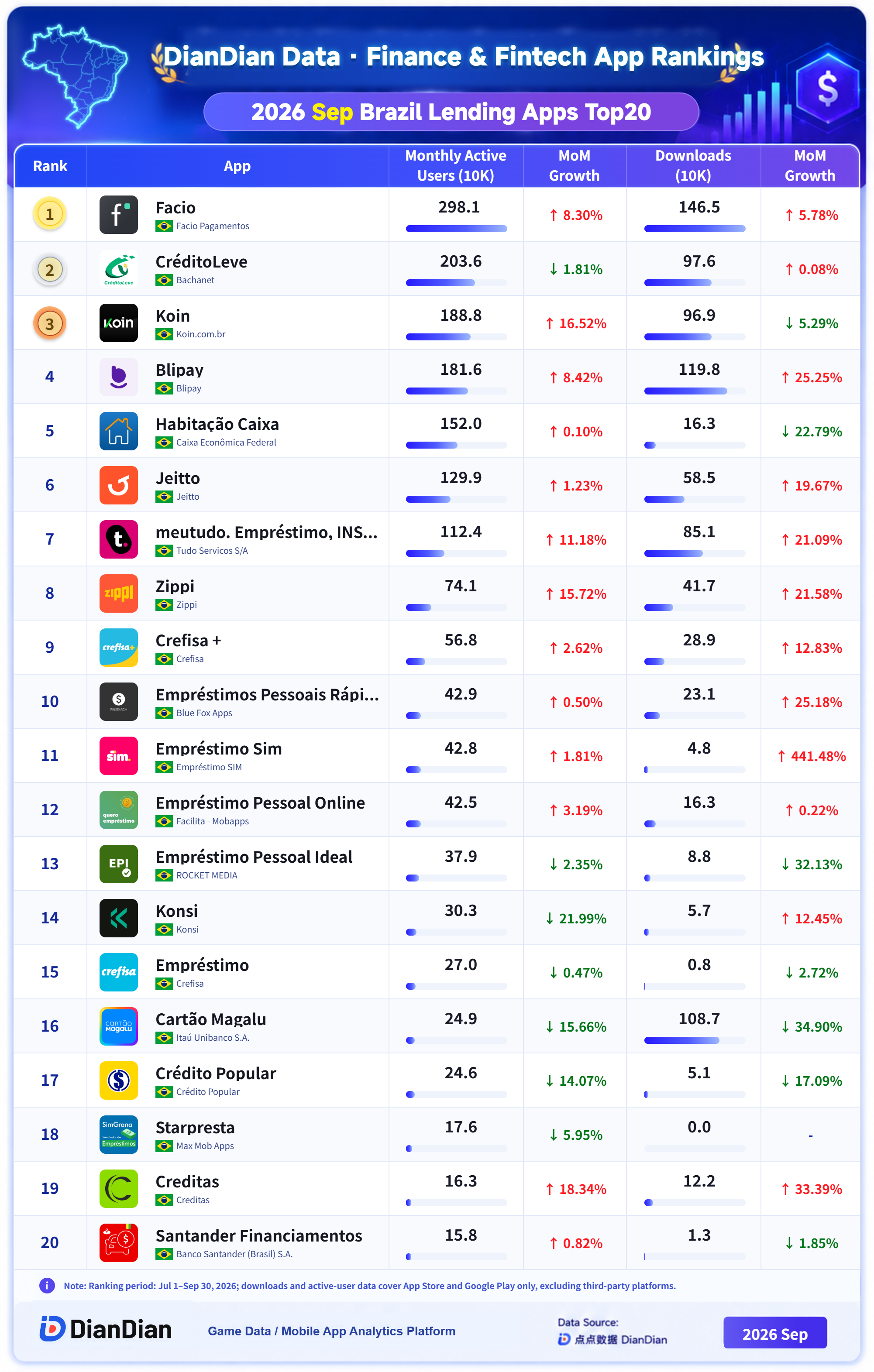
3. Top 20 Ranking: More New Traffic and Higher Overall Activity
In Brazil’s Top 20 online lending apps in September 2026, 13 recorded month-over-month growth in monthly active users and 12 saw downloads increase. Overall market activity rose, but platforms grew in different ways.
The ranking includes platforms that provide credit directly, specialized products for working capital, and loan search and recommendation platforms. Each focuses on different customers, uses of funds and stages of the service process. Multiple business models coexist in a relatively fragmented market.
Note: To provide a broader view, this article uses an inclusive definition of cash loan apps, covering apps that provide financing through personal loans, installment payments, credit cards and auto financing.
Facio: Bank Transaction Data Supports Credit Assessment as the App Takes the Lead
Facio’s MAU reached 2.9807 million in September, up 8.30% month over month. Estimated downloads reached 1.4651 million, up 5.78%. Both metrics grew, placing it at the top of the ranking.
Facio focuses on online personal credit, emphasizing a simplified application process and fast disbursement. With users’ authorization, it incorporates bank account transaction data into credit assessment to understand income inflows and spending and evaluate repayment capacity.
For users with diverse income sources and limited records of fixed wages, bank transaction data can supplement traditional credit information and help platforms understand actual cash flow. More data dimensions do not automatically mean lower risk, however. Results ultimately depend on how accurately the platform assesses income stability and repayment capacity.
Koin: Pix Installments Expand Spending Scenarios, While User Sentiment Weakens
Koin’s MAU reached 1.8884 million in September, up 16.52% month over month. Estimated downloads were 969,100, down 5.29%. The divergence between active-user growth and new downloads suggests stronger engagement among existing users but weaker new traffic.
Koin’s distinguishing feature is its integration of installment services with Pix payments. Consumers can choose installments when shopping at partner merchants or pay directly at merchants supporting Pix installments, embedding short-term consumer financing into the transaction process.
However, user sentiment toward Koin weakened noticeably in September. DianDian monitoring shows that its share of positive reviews fell from 68.84% in August to 44.48%, a decline of 24.36 percentage points and one of the lowest levels in recent months.
According to DianDian monitoring, negative reviews mainly concerned high installment charges, unclear fee disclosures, login or authorization failures, unusable credit limits, automatically canceled orders and withdrawn credit limits. Some users also reported a substantial gap between the original product price and the final amount payable in installments.
These concerns center on fee transparency, credit rules and transaction success rates. Koin’s MAU growth shows that its existing user base remains, but declining downloads and a falling share of positive reviews also highlight how product experience affects acquisition and conversion.
When installment services are embedded directly in payments, users’ understanding of pricing, the actual availability of their credit limits and the smoothness of payment flows all affect willingness to use the service. Clearer fee disclosures, higher transaction success rates and better handling of problematic orders are priorities for the platform.
Zippi: A Focus on Self-Employed Users Drives Year-to-Date Highs in Downloads and MAU
Zippi joined Y Combinator’s accelerator in 2019, completed a Series A of approximately $16 million in 2022 and raised BRL 220 million through a receivables investment fund (FIDC) in February 2026, providing a strong foundation for expansion.
In September, Zippi’s estimated active users reached 741,400, up 15.72% month over month, while downloads reached 416,700, up 21.58%. Both metrics reached their highest levels of the year.
Zippi’s core product, Crédito do Autônomo, serves self-employed people and individual business owners. Its weekly credit limits and repayment schedule match the short inventory, payment and collection cycles and variable incomes of microbusiness owners.
Compared with conventional personal loans repaid monthly, this design places greater emphasis on matching the credit cycle to operating cash flow, extending credit services beyond general consumer borrowing into everyday working capital.
User demographics reflect this target customer base. In September, women accounted for 61.53% of Zippi users, while users aged 31–40 accounted for 52.36%, 25.86 percentage points above the average for finance apps.
Zippi’s growth is reflected both in downloads and in the development of a specific customer base. Designing products around self-employed people and individual business owners gives it a clear positioning beyond the broader personal loan market.
Empréstimos Pessoais Rápidos: Loan Referrals Capture Search Demand
As a loan search and recommendation app, Empréstimos Pessoais Rápidos recorded an estimated 429,200 monthly active users in September, broadly stable overall. Downloads reached 230,800, up 25.18% month over month, placing the app among the industry’s top 10 by MAU.
Unlike direct lenders, the app explicitly states that it is neither a bank nor a financial institution and does not provide loans itself. Instead, it connects borrowers with lenders through loan searches, recommendations and product matching.
DianDian analysis suggests that the presence of such apps among the leaders reflects not only borrowing demand but also active demand for loan information and comparison in Brazil’s online credit market. Referral platforms give borrowers a way to explore different credit products and provide lenders with an acquisition channel beyond their own app-store presence.
In September, the platform’s downloads grew while MAU remained stable, showing that loan search and recommendation services still attract traffic. Whether new traffic converts into qualified loan applications depends on how well recommended products match user needs and whether the platform can operate consistently within local financial regulation and consumer protection requirements.
4. Industry Developments: Licensing, Funding and Debt Management Advance Together
1. Ant International Secures a Brazilian Payment Institution License as Antom Strengthens Local Payment Capabilities
On September 3, Ant International announced that it had obtained a payment institution license from the Central Bank of Brazil. Its Antom platform already supported merchant acceptance of Pix, bank cards and other payment methods. The license will further strengthen its local and cross-border payment services in Brazil.
Source: https://www.pymnts.com/legal/2026/ant-international-secures-payment-institution-license-to-expand-capabilities-in-brazil/
Pix has long been important infrastructure for everyday transfers and merchant collections in Brazil. For payment providers, integrating Pix not only meets local payment needs but also helps connect merchant collections, local payments and cross-border settlement. A local license provides a foundation for operating these services in compliance with local requirements and further strengthens the platform’s ability to serve Brazilian merchants.
Although not directly related to cash loans, this development shows that competition in Brazil’s digital finance market is extending from payment channels into local merchant services and the transaction ecosystem. As payment networks develop, fintech platforms gain more opportunities to reach merchants and connect with transaction scenarios.
2. NG.CASH Raises $15 Million to Expand Credit and Digital Asset Initiatives
On September 23, Brazilian digital finance platform NG.CASH announced a $15 million strategic investment led by Blockchain Capital. It plans to use the funding to expand its credit business and advance initiatives in areas including cryptocurrency, blockchain and stablecoins.
Source: https://www.morningstar.com/news/pr-newswire/20260923sf54387/ngcash-raises-15-million-to-expand-credit-and-financial-access-for-brazils-next-generation
NG.CASH provides digital financial services to young users. The financing shows that its business is extending beyond basic services such as accounts into credit, while exploring digital asset use cases.
Whereas a payment license expands local service capabilities, NG.CASH’s funding more directly supports broader product offerings and business expansion. Together, the two developments show that payment capabilities, capital support and financial product portfolios are also part of competition in Brazil’s digital finance market.
3. Rising Household Debt Pressure Prompts Further Credit Oversight and Debt Relief
Household debt has become an important issue for Brazil’s financial regulators. The Central Bank of Brazil previously said it was considering further regulation of high-cost consumer credit, focusing on borrowing costs, information transparency and the risks of lending to heavily indebted borrowers.
On September 25, the Brazilian government established Desenrola Brasil 3.0 through a provisional measure, providing new negotiation and restructuring options for eligible overdue personal debts and incorporating measures to promote responsible lending.
Source: https://www.metropoles.com/brasil/endividamento-das-familias-chegou-a-499-em-agosto-segundo-bc?utm_source=chatgpt.com
These two policy initiatives address new credit origination and relief for existing debt, respectively. The former focuses on risk assessment and borrowing costs during lending, while the latter helps eligible borrowers restructure overdue debts.
For cash loan platforms, household demand for credit remains, but high-cost loans and household indebtedness are receiving greater scrutiny. Credit assessment, fee transparency and post-disbursement management will directly affect risk performance and determine whether business models can adapt to changes in credit oversight.
5. Summary: Growth Is Real, and So Is the Pressure
In September, downloads of cash loan apps in Brazil reached their highest level of the year, with most Top 20 apps recording month-over-month growth in MAU and downloads. Facio retained a leading position; Zippi focused on self-employed users and working capital; Koin embedded installments in Pix payments; and loan referral platforms attracted traffic through product search and recommendations.
Platforms are entering different segments, including personal credit, installment financing, working capital and loan matching. This reflects increasingly diverse product offerings in Brazil’s online lending market, with competition extending into specific customer segments and use cases.
However, households remain under considerable credit pressure. The average annualized interest rate on non-earmarked household credit rose to 61.7%, and the share more than 90 days overdue reached 8.0%. Following Lula’s reelection, the continuity and implementation of household debt policies also warrant continued attention.
For Brazil’s cash loan platforms, controlling credit risk while expanding their businesses will present a greater operational challenge than in other markets.
Data note: App MAU and download figures are from DianDian. The analysis uses a broad definition of cash loan apps, covering personal loans, installment financing, credit cards and auto financing. Macroeconomic and latest credit data come from the Central Bank of Brazil, Serasa, public reporting and other sources.