文
A
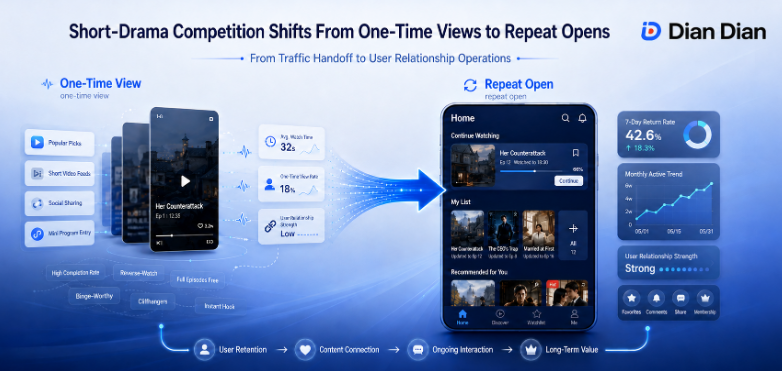
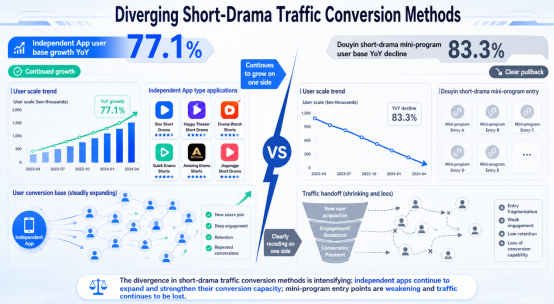
As of May 2026, based on public market data, DianDian Data, and feedback from industry players, the user base of standalone short-drama apps grew 77.1% year over year, while the user base of Douyin short-drama mini programs fell 83.3% year over year.

Within the same short-drama track, the two types of products are now moving along completely opposite user curves.
What makes this data set most noteworthy is the shift in the short-drama consumption path. In the past, short dramas relied more on a “discover and watch” model. Users would encounter a piece of content in the feed, be pulled in by a three-second conflict, a sharp reversal, or an emotional hook, tap in, watch a few episodes, and complete one instant consumption session. Now, however, some users are moving from temporary entry points to standalone apps. They are no longer just passively encountering content; they are actively opening an app, continuing to follow series, and looking for more content.
This means the center of gravity in short-drama competition is changing.
Getting users to finish the current episode is no longer the only question. Getting them to come back next time is where short-drama products are truly beginning to compete.
1. Mini Programs Are Suited to Instant Viewing, but Struggle to Drive the Next Open
The advantages of short-drama mini programs are clear: lightweight entry points, fast conversion, short user journeys, and strong stimulus.
Users do not need to download an extra app, register a complicated account, or actively search. As long as they come across a short-drama clip in the feed and the story is compelling enough, they can tap in and watch immediately. This journey was highly suitable for the early expansion of short dramas.
A lightweight entry means users face almost no additional decision cost. Fast conversion means the path from content exposure to viewing is nearly seamless. A short journey means the format naturally works well with paid traffic and feed recommendations. Strong stimulus allows short dramas to quickly drive viewing through the first three seconds, sharp reversals, and emotional hooks. Therefore, mini programs are not the opposite of short-drama growth. On the contrary, they were once an important gateway for short dramas to break out quickly.
In the early stage of short dramas, the industry’s most urgent problem was how to get users into viewing mode at the lowest possible cost. Mini programs solved that problem well. They turned short dramas from content that users had to actively look for into instant entertainment that could be tapped open casually in the feed.
But the advantages of mini programs also define their limitations.
Users often enter a mini program not because they remember a specific platform, but because they are attracted by a specific piece of content. In other words, the user relationship mainly forms around the “content,” not the “product.” What users may remember is that the episode was satisfying, the reversal was addictive, or the character relationship was exciting. But they may not remember which platform they watched it on, where to open it next time if they want to continue, or how this short-drama entry point differs from others.
This makes mini programs more like a “temporary playback entry point” than a stable consumption venue. They solve the problem of “how to keep users watching at this moment,” but after the viewing session ends, users can easily return to the feed. Whether they continue watching short dramas next time depends more on whether they can come across another sufficiently attractive piece of content. As a result, mini programs can help short dramas complete one viewing session, but they do not naturally convert that session into the next active open.
The value of mini programs leans more toward instant conversion: moving users from content exposure into one viewing session and turning traffic into immediate plays and consumption.
But if short-drama competition is entering the stage of “the next open,” mini programs alone are no longer enough.
2. What Standalone Apps Add Is a Complete Short-Drama Consumption Experience
What standalone apps truly provide is a more complete short-drama consumption scenario.
After entering an app, users can continue following a series, save it, resume watching, search for content, and discover more similar titles through recommendations. Platforms can also accumulate users’ viewing records and preferences through account systems, then conduct longer-term operations through tasks, memberships, benefits, payments, and other mechanisms. These may look like product functions, but together they change one thing: the relationship between users and short-drama content begins to shift from “watching one episode” to “following one series.”
In a mini program, users are more like people who happen to “see a certain episode.” In a standalone app, users are more likely to enter the state of “following a certain drama.”
Although each short-drama episode is brief, its consumption does not have to be one-off. Once users enter a follow-up viewing state, they have reasons to open the app continuously. For example, the series is not finished and they need to continue next time; viewing history is saved so they do not need to search again; recommendations become increasingly aligned with their preferences; similar content is sufficiently concentrated for continued discovery; and task, membership, benefits, and payment systems can extend one viewing session into a longer-term operating relationship.
This is exactly where standalone apps differ from temporary entry points. They are not only responsible for bringing users in; they must also give users a reason to open again. Mini programs let users start watching faster, while standalone apps make it easier for users to keep watching.
According to short-drama app data provided by DianDian Data, leading products have already shown this ability to absorb and retain demand.

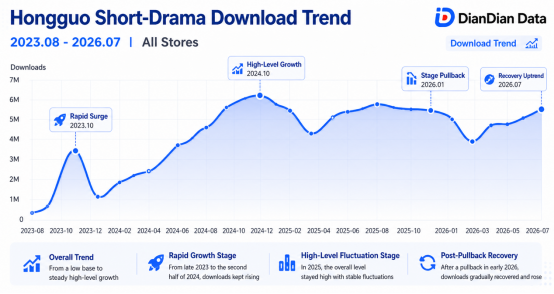
[Hongguo Short Drama] Downloads Across All Stores, August 1, 2023-July 31, 2026
From the download curve, Hongguo Short Drama was still in its initial scaling stage in the second half of 2023, then saw clear volume growth in 2024 and has remained at a high level for a long period since 2025. Although monthly downloads fluctuate with advertising rhythm, content supply, and market campaigns, overall, Hongguo Short Drama did not spike briefly and then quickly fall back. Instead, it has continued acquiring new users over an extended period.
This shows that standalone apps still have the ability to absorb users steadily. In other words, while the user base of short-drama mini programs is declining, users have not stopped consuming short dramas. They are continuing to migrate toward the more complete standalone app scenario.
But downloads only show that users have “come in.” Whether they can stay depends on the active user scale.
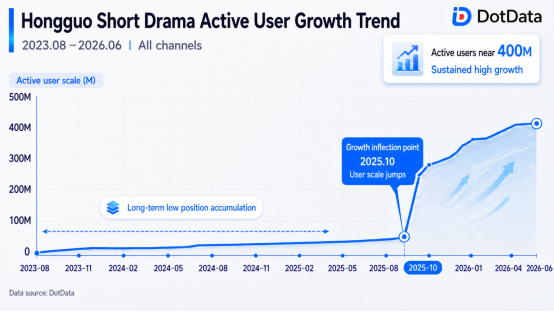
[Hongguo Short Drama] Active Users Across All Stores, August 2023-June 2026
From the active user curve, Hongguo Short Drama’s user scale rose significantly after the second half of 2025 and remained high in the first half of 2026. Especially after entering 2026, its active users across all stores have stabilized near the 400-million level, while its average DAU has also remained at a high level. This data set says more: leading short-drama apps are not only absorbing one-time downloads, but capturing an ongoing short-drama consumption demand.
If downloads indicate that users are still entering standalone apps, active user scale indicates that users who enter are forming more stable usage habits.
Another noteworthy point is that the increase in Hongguo Short Drama’s downloads did not immediately translate into a jump in active users. In the second half of 2024, Hongguo Short Drama had already entered a high download range, but its active user scale did not show a more obvious upward movement until after the second half of 2025. This suggests that for standalone short-drama apps, real growth is not limited to “bringing users in,” but depends on whether a one-time install can be converted into continuous return visits.
When a short-drama app has both new downloads and large-scale active users, its role is no longer just a playback entry point. It begins to become a stable short-drama consumption scenario. This is the product logic behind the change in short-drama entry points: from completing one play to sustaining a relationship.
3. What Standalone Apps Solve Is the Dilution of Short-Drama Demand Inside Super Apps
If mini programs solve the problem of “helping users start watching faster,” standalone apps solve another problem: how to turn short dramas from a content entry point that passively receives traffic into a product scenario that can be specifically designed and operated. This is also why short-drama companies cannot remain permanently attached to super apps or mini programs.
When users open a super app such as Douyin, their main motivation is usually to browse the feed, watch short videos, view livestreams, or consume various forms of content within the platform. Short dramas can certainly gain exposure in this environment, but they are only one of many content formats. In such a content field, user attention is naturally fragmented. A user may be watching a short drama one second and be pulled away the next by short videos, livestreams, e-commerce content, or trending topics. The platform’s feed is powerful and rich, but precisely because it carries so many content formats, it is difficult for short dramas to become the only reason users open the product.
Standalone apps, by contrast, serve a more explicit short-drama demand. When users are willing to download and actively open a short-drama app, their need is often not the vague desire to “browse some content,” but a more direct one: I want to watch short dramas now. This is important for companies. The clearer the demand, the more deeply the product can be built around it. The homepage can be designed around short-drama recommendations; search can revolve around titles, genres, character archetypes, and plot tags; recommendation models can learn short-drama preferences more intensively; following series, resuming playback, and saving content can become core journeys; and payment, membership, benefits, and reward systems can all be designed around the rhythm of short-drama consumption.
Inside a super app, short dramas must compete with many content formats for attention. Inside a standalone app, the entire product can be designed around “getting users to continue watching short dramas.” This is the product value of standalone apps. They are not simply moving the playback page out of the feed; they are concentrating short-drama demand that was previously scattered across the feed into a dedicated product scenario.
For companies, this also means stronger operational initiative. In a super app or mini program, short dramas mostly absorb traffic distributed by the platform. Where users come from, why they come, and whether they return after watching are largely influenced by the platform’s feed and distribution mechanisms. Standalone apps allow companies to put more of these links under their own control. The product interface can be fully designed around short-drama consumption, recommendation logic can focus more on short-drama preferences, user touchpoints can extend from one viewing session to push notifications, tasks, benefits, and memberships, and monetization can expand from single payments to a combination of ads, memberships, and content recommendations.
More importantly, standalone apps have the opportunity to make users remember a short-drama platform, rather than only a specific series. For companies, this does not merely mean adding another distribution channel; it means gaining a product scenario that can be operated over the long term.
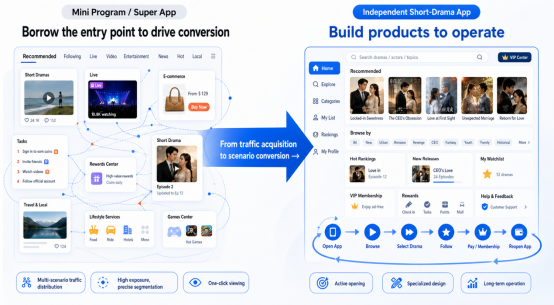
Therefore, the shift of short dramas from mini programs and super apps to standalone apps is not simply a change of carrier. In essence, companies are moving from “borrowing entry points for conversion” to “building products for operation.” The former focuses on one viewing session; the latter focuses on the next open.
4. Harder Than Creating a Hit Is Getting Users to Open Again Next Time
As short dramas move from temporary entry points to standalone apps, the nature of competition will also change.
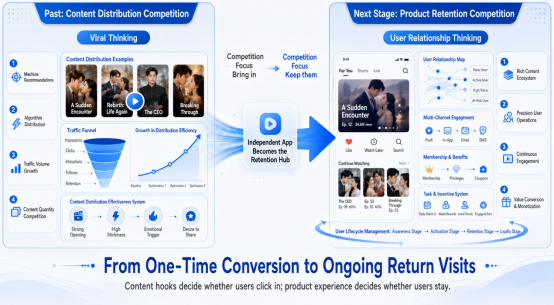
In the past, early-stage short-drama competition largely revolved around content hooks and traffic efficiency. Whoever had the stronger opening was more likely to be tapped; whoever had faster reversals was more likely to keep users watching; whoever achieved higher advertising efficiency could scale a hit faster. As a result, much of the competition focused on whether the first few seconds of content could grab users, whether the story rhythm could continuously create satisfying moments, whether ad creatives could generate conversion, and whether hit short dramas could be quickly replicated.
This logic is still important. After all, short dramas are a content form that relies heavily on emotional stimulus and plot hooks. If the content itself is not compelling enough, later-stage product retention is difficult to establish.
But this mainly solves the problem of “getting users in.” Users tap in, keep watching, and complete one conversion. That is certainly important, but it is not enough. As standalone apps begin to absorb more users, the competition naturally moves further down the funnel: after users finish watching, will they come back tomorrow?
This pushes short-drama competition from content distribution toward product retention.
In the next stage, short-drama apps will compete not only on whether content can continuously create satisfying emotional payoff and whether paid traffic can run efficiently, but also on whether content supply is stable enough, whether recommendations understand users better over time, whether the follow-up viewing path is smooth, whether resuming, saving, and searching reduce user cost, whether the payment experience feels natural, and whether benefits and task systems can drive return visits.
More directly, platforms need to answer one question: after users finish one series, why should they continue watching the next one? This is also the key to short-drama platforms moving from a “hit-driven mindset” to a “user-relationship mindset.” The hit-driven mindset focuses on whether this series can break out. The user-relationship mindset focuses on whether this user can stay. The former values one conversion; the latter values continuous return visits.
In the past, short-drama platforms were more like capturing viewing opportunities one by one in a traffic field. Next, short-drama apps need to turn those viewing opportunities into long-term relationships. Content hooks determine whether users tap in. Product experience determines whether users stay. Paid traffic determines whether users can be reached. Reasons to return determine whether users open again.
The essence of user accumulation is occupying a default choice. When users want to watch short dramas, whoever comes to mind first truly owns the user relationship.
This shift is also related to the overall development stage of the short-drama industry. According to public information from the China Online Audiovisual Development Research Report (2026), as of December 2025, the number of online audiovisual users in China reached 1.099 billion, average daily usage time per online audiovisual user reached 201 minutes, and average daily usage time for micro-short dramas reached 129 minutes. Short dramas have become an important form of online audiovisual consumption.
At the same time, regulation and industry discussion are continuing to push micro-short dramas toward higher-quality development. The National Radio and Television Administration previously released the “Micro-Short Drama+” action plan, promoting the integration of micro-short dramas with cultural tourism, learning, science popularization, brands, rural revitalization, and more scenarios. Industry attention is also shifting from scale expansion to quality improvement and long-term operation.
Against this backdrop, the growth of short-drama apps is not only a channel change, but also a signal that the industry is moving from extensive user acquisition to long-term operation. Playbooks relying only on strong stimulus, heavy advertising, and high conversion will find it increasingly difficult to support the next stage of competition. Platforms need not only hit content, but also a product system capable of absorbing hits, retaining users, and continuously operating viewing behavior.
The growth of short-drama apps is essentially a reflection of this change.
The next phase of competition in the short-drama track is not only about whether content can continuously create satisfying emotional payoff or whether paid traffic can run efficiently, but about who can turn one viewing session into one return visit, and then turn that return visit into stable user accumulation.
Mini programs complete the job of “watching immediately.” Standalone apps are competing for “coming back next time.”
For users, standalone apps provide a more complete short-drama consumption scenario. For companies, standalone apps provide stronger operational initiative.
Therefore, what short-drama apps are truly competing for is the default choice in users’ minds. When users move from “watch when I come across it” to “open when I want to watch,” short-drama product competition moves from traffic conversion into user-relationship operation.