文
A

As the July summer season arrives, major publishers have been making frequent moves, and Tencent is naturally no exception.
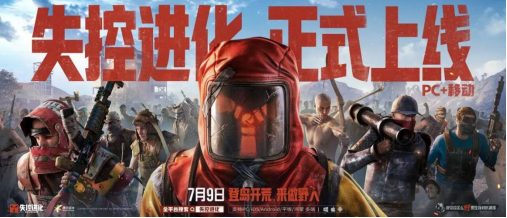
On July 9, Unruly Evolution, a PvP-focused SOC survival confrontation game officially licensed for Rust gameplay, developed by Wuduan Technology with Tencent participating in development and responsible for publishing, officially launched its public beta. The game supports data interoperability and matchmaking across PC, Android, iOS, HarmonyOS, tablets, and other platforms, with players able to choose mobile-only servers or cross-platform PC-mobile servers. It is Tencent's first heavyweight new title in the second half of 2026.

Public information shows that Wuduan Technology and Tencent began contacting and discussing this project as early as around 2020. The title was established and entered development in 2023, and received its game license in October of the same year. It is reported that Tencent was deeply involved throughout the entire development cycle and helped control the product direction. Tencent Senior Vice President Ma Xiaoyi has clearly expressed optimism about Unruly Evolution.

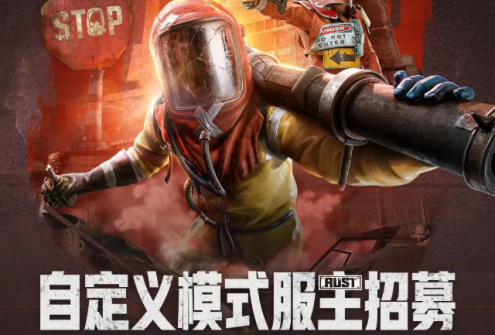
In early April 2025, the game was first revealed to the public and released its PV. Within 24 hours, total pre-registrations across the internet had exceeded 2 million. On May 27 this year, its public beta date was officially announced, and a playful recruitment poster was displayed on the exterior screen of Tencent's newly built global headquarters, Penguin Island. This was also the first screen projection after Penguin Island was completed. In late June, the official team held a large-scale "Savage Festival" and pre-launch press conference in Jinchang, where it announced in high profile that the game's pre-registrations had exceeded 40 million.

All of this clearly demonstrates Unruly Evolution's popularity and attention, and even Tencent's official ambition to use the title to comprehensively activate China's domestic SOC market.
So how has Unruly Evolution actually performed after public beta? Which tier does it occupy among Tencent's new releases this year? What localized changes has its gameplay made compared with Rust? How strong is its long-term operating potential? Below, Diandian Global will break these questions down one by one.
01
960,000 iOS Downloads Versus US$320,000 in Revenue
In the First Four Days of Public Beta, Unruly Evolution Shows a Clear Data Contrast
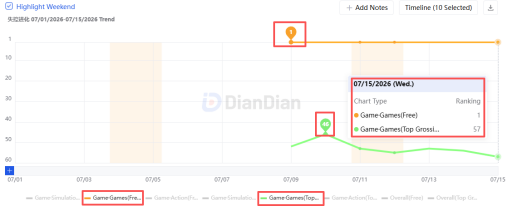
According to Diandian Data, Unruly Evolution has performed very strongly on the iOS free games chart, holding the No. 1 spot continuously for a full week since public beta began. However, its performance on the grossing chart has been somewhat weaker: after reaching No. 46 on the second day of public beta, it has not advanced further and is currently at No. 57.

Trend in Unruly Evolution's iOS Free and Grossing Game Rankings Since Public Beta
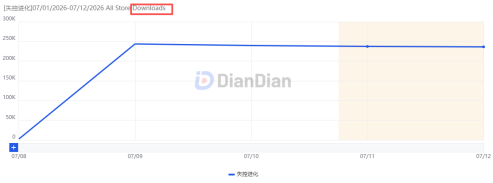
Looking next at specific market data, on the iOS download side, the game recorded about 244,000 downloads on its first day. Since then, downloads have fluctuated slightly without showing a clear trend, and current daily downloads remain around 240,000.

Trend in iOS Downloads for Unruly Evolution Since Public Beta
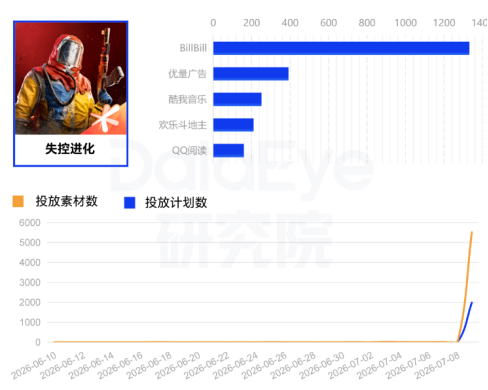
On the ad side, according to DataEye, the game's warm-up phase was relatively low-key. User acquisition intensity only increased on the first day of public beta, with more than 1,000 additional creatives launched. It is also likely that this level will not be maintained at a high point later.

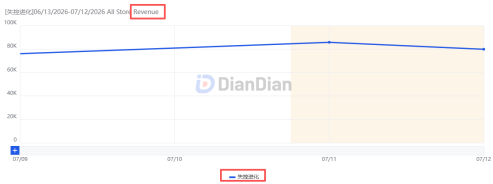
In terms of iOS revenue, first-day gross revenue was estimated at US$76,000, or about RMB 520,000. Since then, the trend has basically matched downloads, with no obvious changes. Current daily revenue is around US$80,000, or about RMB 550,000.

Trend in iOS Revenue for Unruly Evolution Since Public Beta
As of now, four days into public beta, the game has accumulated about 960,000 iOS downloads, with total iOS revenue estimated at US$320,000, or about RMB 2.2 million. Its RPD, or revenue per download, is US$0.34, about RMB 2.28. Combined with the chart performance mentioned above, it can be seen that although Unruly Evolution has delivered impressive free-chart and download data, its revenue performance appears to be below expectations.
From a broader Tencent product perspective, since the beginning of the year Tencent has publicly launched nine key new titles in China. Only four have exceeded 10 million pre-registrations: Assault Fire: Future, Roco Kingdom: World, Honor of Kings: World, and this Unruly Evolution.
In terms of iOS downloads in the first four days, Assault Fire: Future and Unruly Evolution both failed to exceed one million and were basically on par, placing at the tail end among the four 10-million-pre-registration products. However, the former's four-day iOS revenue was more than 11 times that of the latter, a very obvious gap. In fact, Unruly Evolution's four-day iOS revenue only ranks sixth among all nine new titles, barely surpassing All-Star Awakening, Romance of the Three Kingdoms: Strange Tales, and the largely unnoticed Just Dance: Party.
02
Gameplay Threshold, Restrained Monetization, Pre-Registration Conversion Ratio, and Delayed Scale Effects
Together Limit the Initial Data Explosion During Public Beta
Regarding the fact that Unruly Evolution's four-day iOS downloads failed to surpass one million like Roco Kingdom: World and Honor of Kings: World, and the significant mismatch between relatively high download data and revenue,
Diandian Global believes this is first related to the gameplay audience.
SOC itself is not an easy category to pick up quickly. It usually carries the survival experience through an open world, where players must gradually improve their survival state through exploration, resource gathering, crafting, and construction. Compared with level-based products with clear objectives, this type of game gives players greater freedom, while the relationships among its systems are also more complex. Players not only need to learn the controls, but also plan their own development direction, allocate resources, and establish phased goals.
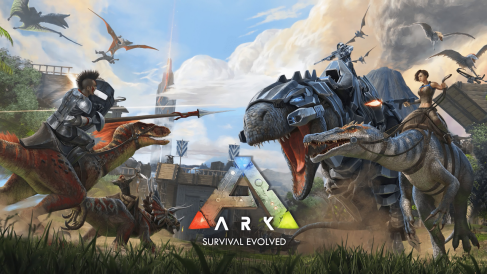
Previously, titles such as LifeAfter and Ark: Survival Evolved had made domestic players familiar with basic loops such as gathering, building, exploration, and fighting monsters. However, players have had little exposure to strong PvP-oriented SOC games that put player competition at the core and revolve around base offense and defense and resource plundering. This branch even requires facing greater strategic and survival pressure.


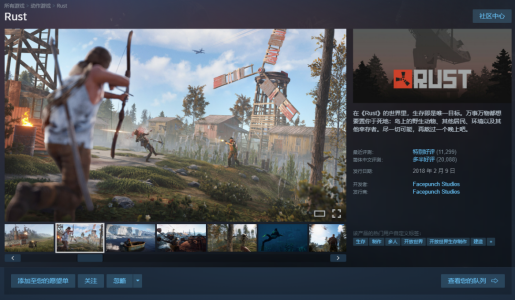
Take Rust as an example. Players enter a deserted island almost empty-handed, starting from chopping trees, mining, and hunting, gradually developing toward building bases, crafting weapons, advancing technology, and then engaging in offense and defense around resource points and player territories. After breaking into another player's base, they can seize resources accumulated over several days; once their own defense fails, their materials and buildings may also quickly return to zero.

This "search, fight, and raid" loop is highly attractive, but the corresponding learning and participation costs are much higher than in ordinary shooters. On one hand, Rust does not use a clear main storyline to constantly tell players what to do next, and its high degree of freedom can easily cause newcomers to lose their sense of direction. On the other hand, the game world does not stop running when players go offline. Death drops, being raided while offline, long-term development, and complex player relationships all create continuous pressure.
Of course, Unruly Evolution has not copied this rule set unchanged into China. Instead, it has carried out multiple rounds of localization around domestic players' stronger preference for clear goals, their wide differences in playtime, and their greater sensitivity to high losses.
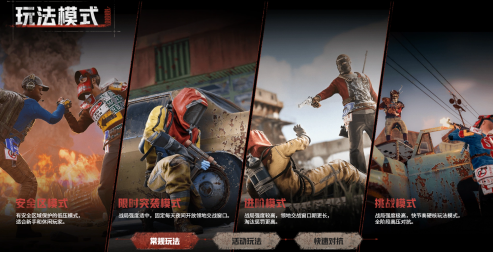
For different user groups, Unruly Evolution has layered difficulty. In regular gameplay alone, it offers four modes: Safe Zone, Standard, Advanced, and Challenge. Safe Zone mode runs on a 10-day cycle, providing protected development areas for newcomers and casual players while placing better resources in contested zones, using rewards to attract players to try PvP actively. Limited-time raids, Advanced, and Challenge modes are shortened to 7 days, 6 days, and 5 days respectively, gradually increasing death drops, base-raid opening times, and confrontation intensity. Among them, Challenge mode opens territory raids throughout the entire stage, bringing it closer to the original Rust experience.


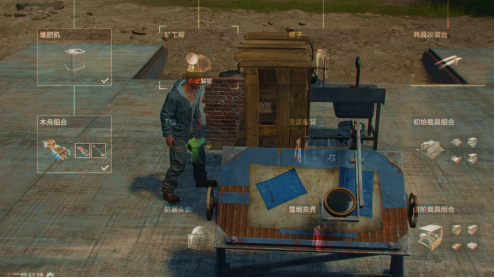
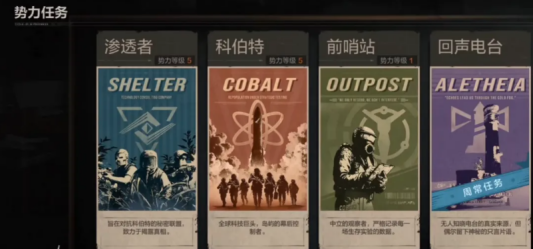
To address the loss of objectives that can easily come with high freedom, Unruly Evolution adds intelligence and progression systems. Ruin exploration, resource collection, faction missions, and other content break long matches into multiple phased goals, while changes in event refreshes, resource output, and PvP rules are also displayed in advance.

Image from GameRes
For team formation, Unruly Evolution adds a gameplay tag system. Players can actively display their play preferences and look for teammates with more similar styles in team recruitment. Planned skill certifications will later further display players' abilities in opening up new areas, building, and combat, reducing the communication and teaming costs among unfamiliar users.

Next, beyond gameplay, the relatively restrained commercialization approach also limits Unruly Evolution's explosive power in the early stage of public beta. The game has publicly promised not to sell combat power or numerical advantages, with paid content mainly concentrated on cosmetic skins. For a strong PvP product, this is a necessary condition for maintaining fairness, but it also has an obvious negative impact on revenue.
It is worth noting that the current statistics cover only estimated iOS revenue and do not include revenue from PC and other platforms, so they cannot represent the game's complete commercial performance.
Third, survival themes naturally attract high attention, but there is often a gap between the number of pre-registrations and the players who actually stay to experience the game.
Finally, Unruly Evolution is a product that relies on large DAU and a functioning player ecosystem. Its scale effects are relatively delayed. The current data point covers only four days of public beta, while even the shortest regular mode requires five days, and Safe Zone mode lasts 10 days. This means many players have not yet fully experienced their first complete cycle from early development, growth, territory offense and defense, to match settlement. Whether difficulty layering, newcomer guidance, and matchmaking mechanisms can gradually bring broader users into the core gameplay has not yet been fully reflected.
03
Public Beta Is Only the Starting Point; the Complete Ecosystem Is Still Being Built
Unruly Evolution Still Has Evergreen Potential
In fact, from the perspective of long-term operations, Diandian Global believes Unruly Evolution has clear potential.
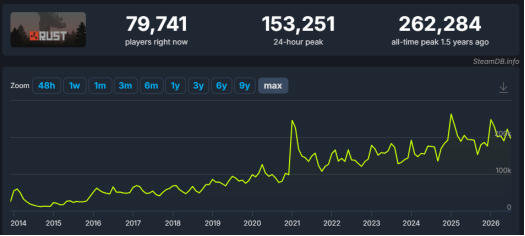
In terms of gameplay framework, Rust has already proven its long lifecycle worldwide. It entered early access in 2013, and in 2024 still had more than 5.5 million unique players contributing about 40 million hours of playtime. Its cumulative sales have exceeded 20 million copies, and concurrent players have remained stable above 150,000 for a long time.

Unruly Evolution inherits this gameplay and, as discussed above, has made localized adjustments. These adjustments need time to truly take effect. They are not intended to turn newcomers into core players immediately, but to first reduce churn after a player's first failure, then gradually guide users into complete multi-day matches.
Cross-platform interoperability also makes long matches more convenient. Players can complete complex operations on PC, then use mobile devices to check base status, handle tasks, or return to defense in time, easing the traditional Rust problem of being tied to a computer for long periods.

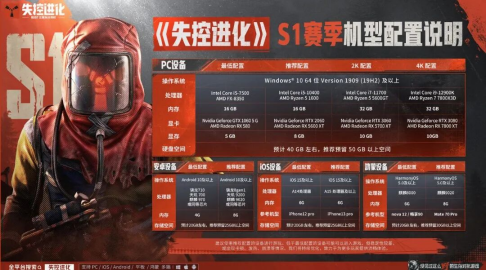
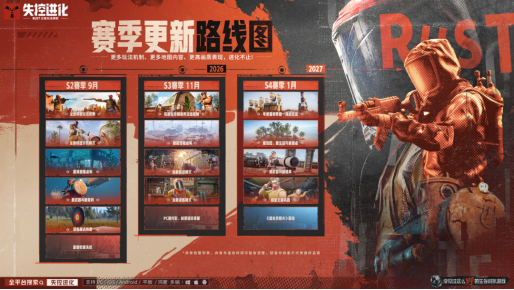
At the same time, Tencent has not reduced its investment in content. The official team has announced update roadmaps for multiple seasons, with future additions including ocean strongholds, launch centers, polar regions, new weapons, and new map ecosystems. It is also advancing the PC 2.0 version with continued upgrades to lighting, materials, rendering, and performance.

Player competition can create variation, but given today's faster content consumption, seasonal updates remain an important way to maintain freshness.
In addition, the game is focusing heavily on UGC. Season S1 has already planned server-owner applications and custom rules, and more complete UGC editing tools will be introduced later, allowing players to create their own maps, modes, and server rules.

When creators can change match conditions, the product no longer has to rely entirely on one-way official content supply, and it also has the opportunity to extend from an SOC game into a survival gameplay platform.
High-freedom sandboxes are also naturally suited to content distribution. A player's alliance, base theft, or multi-player siege can all develop into complete livestream stories. Rust once expanded its influence through streamer servers.
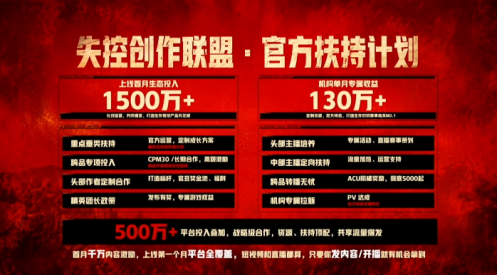
Therefore, on launch day, Unruly Evolution started the "Unruly Alliance," inviting well-known KOLs such as Lan Zhanfei, Tan Qiao, and Dameier to conduct a 12-hour relay early-game challenge livestream. It then actively built creator infrastructure by launching the "Unruly Creator Alliance," investing more than RMB 15 million in the first month. Its purpose is to have creators help ordinary users understand this originally somewhat hardcore gameplay.


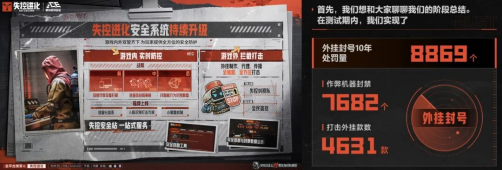
Finally, anti-cheat is the foundation for whether the game can operate over the long term. When SOC players encounter cheats, what they lose is often not a match of a few minutes, but resources and bases accumulated over several days. In response, the game has already integrated Tencent's ACE system and set up device blocking, behavior recognition, manual patrols, and legal follow-up.

Overall, Unruly Evolution has built solid gameplay content for different player groups, and has also supplemented the foundation for longer-cycle operations from multiple aspects including seasonal updates, UGC tools, creator support, and security systems. Therefore, its success or failure should not be judged lightly based only on downloads and revenue in the first few days after launch. As content and the community ecosystem gradually take shape, this game still has considerable room to grow into an evergreen title.