文
A

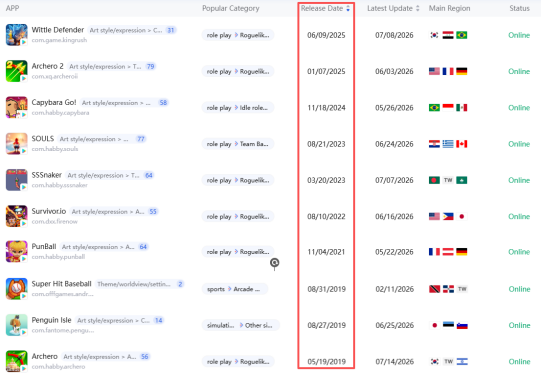
Few would disagree that Habby is one of China’s most active leading hybrid-casual publishers going global, and also one of the players with the highest success rate for new titles. Since launching the breakout hit Archero in 2019, the company has largely maintained a high-frequency testing cadence for new games every year and has formally launched one to two representative titles worldwide each year, with 2020 as the exception.

This product strategy has continued into 2026. In the first half of the year, Habby successively tested several new titles, including Dicero!, Zoo Dice: Arena, and Hero Adventure. Among them, Dicero!, which officially launched globally on April 22, was clearly the first to generate real market buzz.

01
Dicero! Validates a New Direction, Generating US$13 Million in Three Months
Habby Continues to Bet on “Randomness as a Medium,” While Its New Game Targets Slots
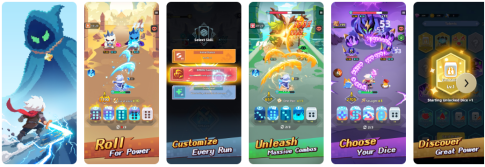
Compared with action-roguelike frameworks such as Archero, Survivor.io, Archero 2, and even the more recent Wittle Defender, all of which emphasize low-barrier controls and instant feedback, Dicero! places the random element of dice at the center. Throw results, dice-type combinations, roguelike three-choice upgrades, and out-of-run progression all jointly affect combat performance. The appeal of the game no longer comes entirely from the controls themselves, but from the continuous strategic contest between random outcomes and build choices.

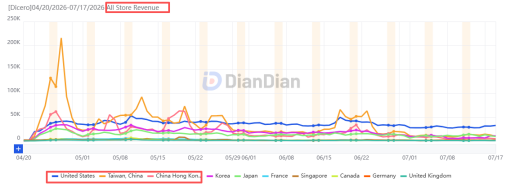
With its relatively novel gameplay framework and explosive user-acquisition push, Dicero! quickly gained momentum in its early launch period. First-month gross revenue reached US$6.16 million, approximately RMB 42 million. However, after entering its second and third months, revenue declined to US$4.30 million, approximately RMB 29.2 million, and US$2.92 million, approximately RMB 20 million, respectively.

Revenue trend of Dicero! since public launch
Total gross revenue is about US$13.10 million, approximately RMB 89 million. The United States, Taiwan, China, and Hong Kong, China ranked as the top three markets, contributing 24.05%, 23.96%, and 13.11%, respectively.
However, it should also be noted that the game’s current paid-user-acquisition scale has only fallen back from its peak rather than fully contracting. Over the past 30 days, the deduplicated number of creatives across both major platforms has remained at around 4,000, indicating that Habby is still continuously validating and maintaining the market scale of this product.

Image source: BigBigAds
Therefore, judging only by its current revenue curve, Dicero! may not yet qualify as a full-fledged breakout hit. Even so, its early chart-climbing ability, revenue performance, and current ability to maintain monthly gross revenue at the million-dollar level are already enough to prove that this product approach has room to work: adding a more distinctive random medium to the mature framework of roguelike build construction plus RPG progression, so that players form new strategic expectations around probability, combinations, and build choices.
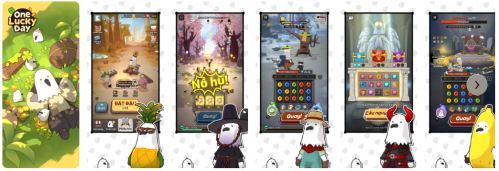
Against this backdrop of product direction shifts, Diandian Global recently noticed that Habby has launched regional tests for a new title called One Lucky Day. Similar to how Dicero! starts from dice, this new game chooses a random medium that is more intuitive and more visually stimulating: slot gameplay. It attempts to integrate slot-machine-style symbol combinations into the broader game framework.

Next, Diandian Global will provide a detailed analysis and breakdown of the game’s testing timeline, development background, and gameplay.
02
From Beta Testing to Regional Testing, One Lucky Day Is Starting to Emerge
Not Developed In-House by Habby, But Continuing a Mature Cooperation Path
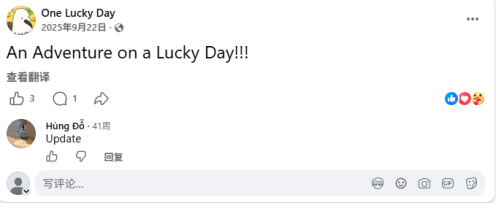
Public information shows that as early as mid-to-late September 2025, One Lucky Day first appeared on official social platforms, where it released trial gameplay videos and began creative advertising. In November of the same year, according to ETNews, the game had already conducted beta tests in selected countries, with user revisit rate and download conversion rate both exceeding expectations. At that time, the official team had already decided to launch it globally in 2026.


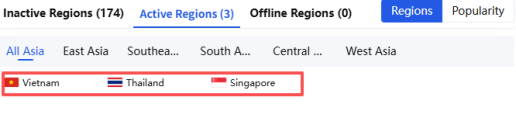
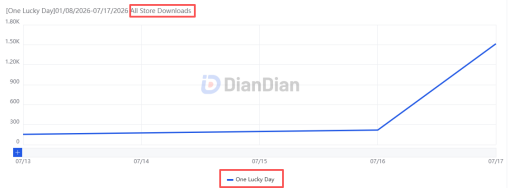
In early July this year, the game was listed on the App Store in selected countries and regions. In mid-July, it began small-scale testing in Vietnam, Thailand, and Singapore. During this period, it received almost no paid-user-acquisition support, but from July 17 onward, related data showed clear growth. Daily downloads have already reached around 2,000, and revenue is also on an upward trend.


Looking vertically at its timeline, the game is still in the early stage of regional testing. The early cadence is more about validating gameplay acceptance and baseline data performance. If downloads, retention, and payment continue to grow, the test markets should expand further, and the product may gradually enter the user-acquisition scaling rhythm that Habby is more familiar with.
Of course, whether the subsequent data can continue to scale and whether the product can enter a wider launch phase ultimately come back to the gameplay itself. But before breaking down the specific gameplay, one important point needs to be clarified: One Lucky Day is not an in-house Habby title. It was developed by the Korean studio Fantome.

Diandian Data shows that the game is currently listed under the Fantome Inc. account. Fantome’s official website has also included it in its game portfolio and marked its Korean title as 운수좋은날.

Reports from Korean media outlet ETNews further confirmed that Fantome, a mobile game development subsidiary under Neptune, has signed a global publishing contract with Habby for 운수좋은날.

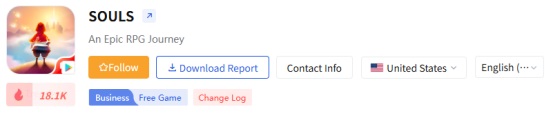
In fact, this is not the first collaboration between Fantome and Habby. The two parties previously worked together on Penguin Isle, launched in August 2019, and SOULS, launched in August 2023, which currently generates around US$200,000 in monthly gross revenue. The former validated Fantome’s grasp of healing-style art, casual users, and long-term management content, while the latter further proved its development capabilities in light-to-midcore RPGs. ETNews also mentioned that what Habby values is Fantome’s already-validated ability to develop for the global market. For Fantome, working with Habby allows it to continue leveraging the latter’s experience in global publishing, user-acquisition scaling, and monetization tuning to push the new title into a larger overseas market.


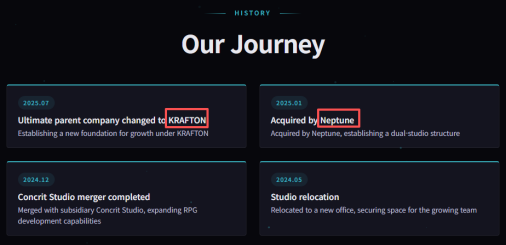
As for Fantome itself, public information shows that it was founded in 2019. In January 2025, Neptune completed the acquisition of a 51.37% stake in Fantome. In July of the same year, as Krafton acquired Neptune-related shares from Kakao Games, Fantome’s ultimate parent company also changed to Krafton. In other words, although Fantome may not be a particularly familiar name to Chinese players, its team background, product track record, and capital relationships all indicate that it is a Korean developer with mature development experience and overseas market validation.

After clarifying the development and publishing relationship, we need to return to the game itself. Compared with background information, what will truly determine whether this title can continue to scale is still how it turns randomness into a sustainable gameplay experience.
03
Not a Gambling Reskin, But a Slot-Style RPG Adventure
Low Barrier, High Feedback, and Progression-Driven
In terms of presentation, One Lucky Day adopts a fantasy adventure theme. Players take on the role of a white ghost named DUDU, setting out from a forest camp and continuously encountering monsters, events, and bosses across different areas. In its art direction, the game uses cartoon-style characters, monsters, scenes, paper-comic-style text, and UI to create a “cute horror plus fairy-tale adventure” atmosphere.

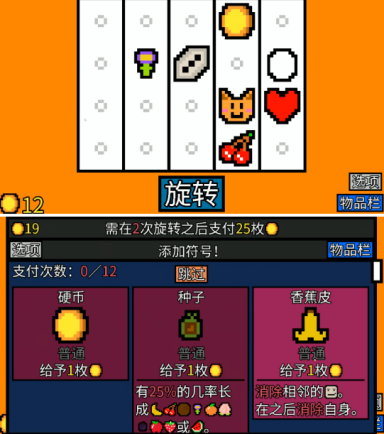
The gameplay framework can be summarized as slot-style combat plus roguelike build construction plus light RPG progression. At first glance, it looks similar to Luck be a Landlord, the pioneering title in the “gambling plus roguelike” category, as both games place random symbols, combination returns, and build growth at the center. But based on actual gameplay experience, One Lucky Day is not simply asking players to use a slot machine to earn coins. Instead, it transforms the slot mechanism into a full RPG combat system.

Luck be a Landlord
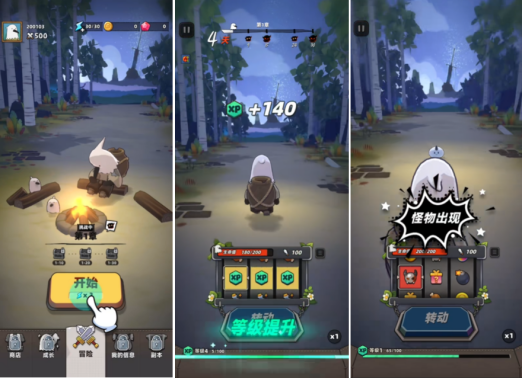
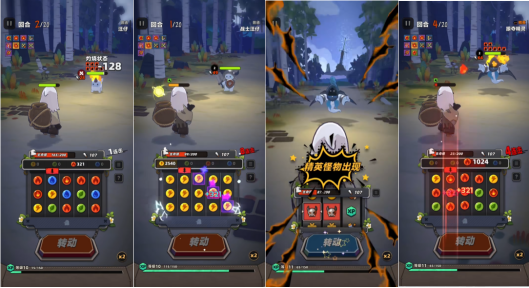
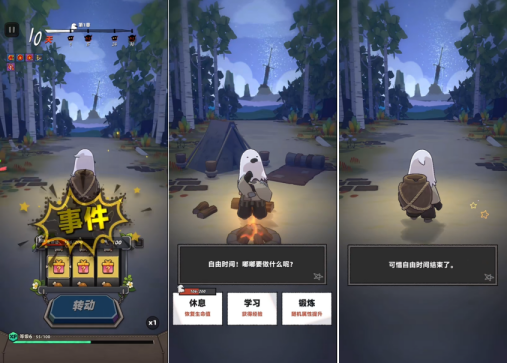
Specifically, the game progresses through chapters. After each adventure begins, players move forward along a Day progress route. At this point, the lower half of the screen shows a one-row, three-column slot board. After tapping “Spin,” corresponding events such as experience, coins, bomb attacks, chicken legs, and monsters appear. If the icons in the three cells are different, the first cell determines the current adventure content. If the other cells show matching symbols, it counts as a win or jackpot. The upper half of the screen presents a traditional RPG-style confrontation, with the player character and pet standing on the left, enemies on the right, and both sides having HP bars.

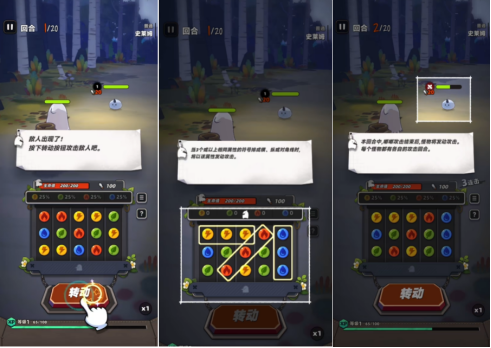
The key point is that when a monster event is encountered, the slot board at the bottom of the screen changes into a three-row, five-column layout. At this time, after tapping the “Spin” button, symbols on the board refresh randomly and form links horizontally, vertically, and diagonally. Usually, three or more identical symbols, or symbols that can trigger a combination, are judged as one group. Damage is then calculated based on the number of combinations, combo status, multipliers, and the character’s current attributes.

In other words, each tap by the player is not an “attack button” in the traditional sense, but the start of a round of random settlement. Symbol landing positions determine base output, the number of connected lines determines the burst ceiling, and multipliers plus additional effects further amplify the result.

Precisely because of this, the game preserves the most direct satisfaction of slot gameplay: players only need to keep tapping “Spin” to see symbols roll, combinations form, numbers jump, and enemies lose HP. On the other hand, it does not remain entirely at the level of pure random feedback. Through roguelike build construction, it allows players to gradually intervene in probabilities and outcomes.
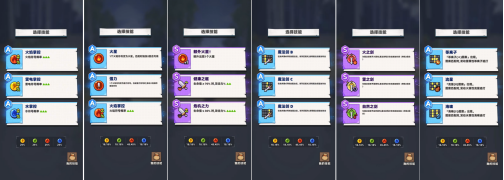
The roguelike component is responsible for turning randomness into strategy. Battles and victories grant experience, and leveling up leads to a three-choice skill interface. Notably, before displaying the skills, the game first rolls out the skill quality, such as B, A, or S, before presenting the corresponding options. This gives the skill-selection process itself a slot-like sense of anticipation.
Skill enhancements can roughly be divided into four categories. The first directly increases stats, such as attack, HP, critical rate, and critical damage, making the character stronger and more durable. The second revolves around elements such as fire, water, lightning, and nature, increasing the appearance probability of corresponding symbols or strengthening elemental damage. The third category changes the settlement rules of the reel itself, such as adding special symbols like Mars, meteors, and tsunamis, or increasing the returns from certain lines, combinations, and match counts. The fourth category consists of weapon-type enhancements such as Magic Sword, Fire Sword, Thunder Sword, and Nature Sword, binding specific positions or elements to additional attacks.

In addition to regular events, the adventure process also includes “free time” choices. Players can choose among options such as resting, studying, and training, corresponding to recovering HP, gaining experience, or improving abilities. This means level progression is not merely a continuous series of monster battles, but also carries a light roguelike map-running rhythm adjustment. Players need to make trade-offs between current HP, pressure from upcoming enemies, and growth returns.

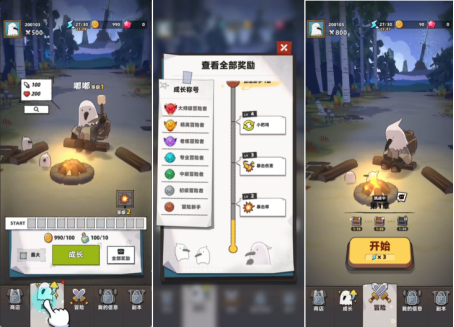
For out-of-run progression, the game continues Habby’s familiar light RPG growth path. The main interface centers on chapter progression, while stamina, coins, diamonds, tasks, battle passes, shops, and other entrances handle resource acquisition and the daily loop. Character growth mainly comes from equipment, pets, souvenirs/amulets, outfits, and camp-level rewards. Equipment, pets, and related systems provide basic attributes such as attack, HP, and critical rate. Outfits combine visual display with attribute supplementation, while prayer, chests, and other features supply additional resources and expand collection goals.

Overall, the design focus of the game is not to transplant slots directly into an RPG, but to break slots down into three usable components. The first is an extremely low operating barrier: players only need to tap Spin to complete one round of combat. The second is strong instant feedback: symbol rolling, lines, wins, critical hits, and damage numbers continuously stimulate players. The third is probabilistic build construction: roguelike skills and out-of-run progression continuously change the likelihood of subsequent outcomes.
04 Conclusion
One Lucky Day can perhaps be viewed as a further extension of Habby’s new-game thinking this year. Compared with the past, when micro-innovation relied more heavily on action roguelikes, Habby has recently been clearly trying to find random carriers with stronger memorability and then place them inside a framework of roguelike build construction plus light RPG progression. Dicero! chose dice, while One Lucky Day brings slot-symbol settlement to the foreground. In essence, both are strengthening the idea that “random results themselves can become the core source of satisfaction.”
Of course, the game is still in the early stage of regional testing. Whether it can expand into more markets, increase user acquisition, and deliver stronger data will depend on retention, payment, and the pace of content consumption. But judging from its gameplay packaging and current preliminary data, One Lucky Day already shows some potential to break out.
For other developers and publishers, this type of product also offers a direction worth referencing: innovation in hybrid-casual products does not necessarily have to come only from controls, themes, or numerical packaging. Embedding an intuitive random mechanism with sufficiently strong feedback into a mature framework can also open up new experiential differentiation.