文
A

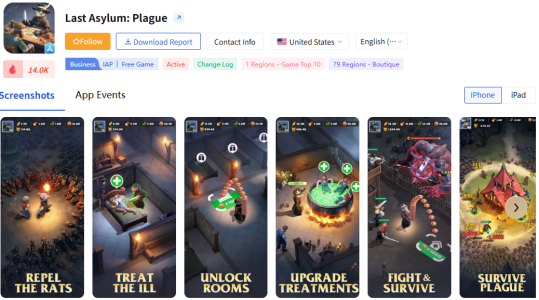
At the beginning of the year, Diandian Global mentioned in the article “Has the First Casual SLG Hit of the Year Already Emerged? 37Games’ New Title Surpasses US$25 Million in First-Month Revenue; Micro-Innovation Still Works Amid Intensifying Competition and Converging Methodologies” that 37 Interactive Entertainment’s Last Asylum: Plague had the potential and strength to become the first breakout hit on the casual SLG track in 2026. Facts have indeed proven this to be the case.

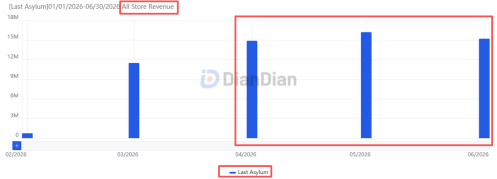
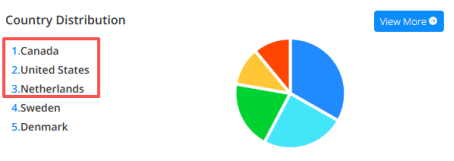
According to Diandian Data, the game officially launched on the App Store in February and on Google Play in March. During this period, revenue grew rapidly: February revenue reached US$750,000, or about RMB 5.1 million, while March revenue reached US$11.5 million, or about RMB 78 million. In April, revenue surpassed US$15 million in one stroke, or roughly RMB 100 million, and monthly revenue has not fallen below that level since. Nearly half a year after launch, the game still ranks in the top 100 of the iOS free games chart in 47 countries and regions, and in the top 100 of the iOS top-grossing games chart in 60 regional markets. Cumulative revenue is estimated at US$63.52 million, or about RMB 431 million, with the United States, South Korea, and Japan ranking as the top three markets at 36.55%, 15.44%, and 10.46%, respectively.

Monthly Revenue Trend of Last Asylum Since Launch
Last Asylum has been able to generate such strong market buzz thanks to a highly appealing new framework formed by its theme and entry gameplay. The choice of a medieval Black Death theme is rare, highly recognizable, and naturally carries a sense of crisis that can create easily understood survival pressure for players. It is well suited to being translated into concrete management actions, such as treating patients, maintaining order, and resisting disasters. On this basis, idle simulation management is packaged as a survival process of receiving, processing, expanding, and automating.
The theme provides memorability, while the idle arcade gameplay provides actionable feedback. Once combined, the two can explain each other, giving the product stronger early-stage appeal and more room to connect with later SLG content.
Inspired by this approach, many companies have begun following the same line of thinking with new products. Recently, Diandian Global discovered that 4399 has launched a similar product called Hell Asylum: Last Warden, hereinafter referred to as Hell Asylum, which uses Western hell judgment as its background theme and has started its first round of user acquisition.


So what kind of product is it? Which stage of testing is it currently in? Has any corresponding market data emerged? Apart from Hell Asylum, what other LA-like products are currently on the market, what stage are they in, and how are they performing? Below, Diandian Global will provide a detailed breakdown and analysis.
01
First Test Goes Live in 10 Regional Markets with Notable Ad Spending
Daily Downloads Rise Rapidly, Suggesting It May Be a Key New Title for 4399
According to Diandian Data, Hell Asylum first appeared on Google Play on July 6, 2026, in 10 regional markets mainly in Europe and North America, including the United States, Canada, the United Kingdom, Sweden, and Australia.

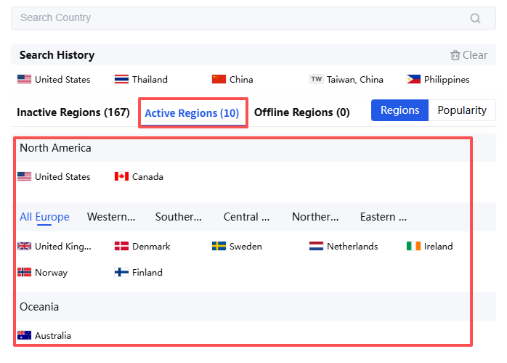

It is worth noting that on the same day the game went live, its ad creative campaign also began. The scale has remained fairly substantial for a first test, with 968 deduplicated ad creatives over the past 30 days. Canada, the United Kingdom, and Norway are the top three markets by ad placement share.


Image from DataEye
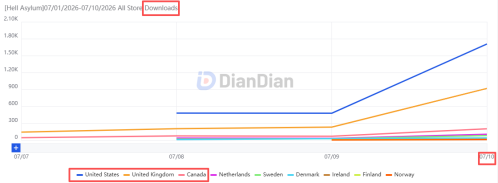
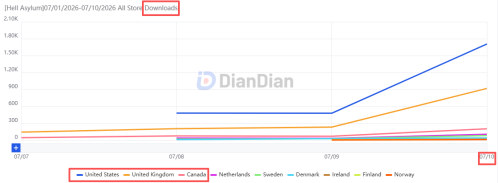
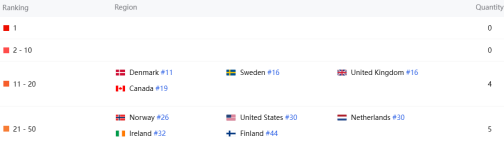
With the support of advertising, the game generated statistically trackable download data as early as July 7. Daily downloads grew during the first three days, though all remained in the three-digit range. Then, on July 10, daily downloads suddenly rose to 3,100. At present, the game has entered the top 50 of the Google Play strategy games free chart in 9 regional markets.
Download Trend of Hell Asylum Since the Start of Testing

Hell Asylum’s Position on the Google Play Strategy Games Free Chart on July 13
On the revenue side, statistically trackable data first appeared on July 9, but the overall figures remain small. Daily revenue in the first two days did not exceed US$500, or about RMB 3,500. At present, the game has only reached No. 42 on Norway’s Google Play strategy games top-grossing chart.
Judging from the first round of testing, 4399 has first shown its level of commitment to the game through advertising investment. Second, the current market data is generally eye-catching and still rising. If the game itself proves sufficiently attractive and polished, its future is worth watching.
02
Rewriting the Management Loop with “Hell Judgment”
How Hell Asylum Turns Souls into an Assembly Line
Next, let us return to the game itself and examine its potential.
The biggest highlight of Hell Asylum is that it places its thematic entry point in the Western underworld, while also mixing in the element of a hell prison.

This choice is not made for novelty alone. It is more like a functional rewrite at the thematic level, replacing the customers, employees, orders, and facilities of traditional management games with souls, demons, judgment, and punishment devices. At the same time, the basic settings of “hell judgment,” “the destination of souls,” and “hell order” are built on religious and cultural symbols that European and American players are relatively familiar with. These symbols have long existed in Western historical narratives, literature, film and television, and games. Therefore, just like the Black Death theme, this subject not only requires relatively little cost to explain its background logic, but also makes the game easier to extend and more attractive in creative marketing materials.

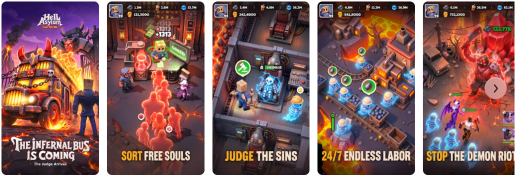
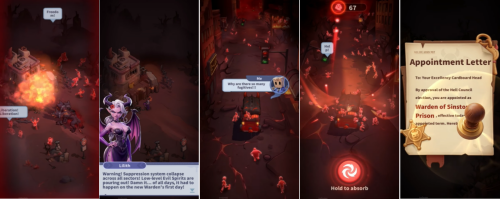
At the beginning of the game, due to an attack by Cerberus and the previous warden’s escape, order in the underworld collapses. Evil spirits imprisoned in the hell prison regain their freedom and run wild, while the facilities originally used for containment, purification, and punishment also fall into shutdown. As the newly appointed warden of hell, the player must take over a broken hell management system, bring chaotic souls back into the process, and then gradually repair the prison, restore production, and expand the scope of control.

In terms of art style, the game uses a somewhat cartoonish dark visual style to balance the potential sense of oppression. The warden played by the player is designed as a paper-bag-headed character with a touch of black humor and absurdity, giving the overall atmosphere a feel similar to the film Ghost Rider.

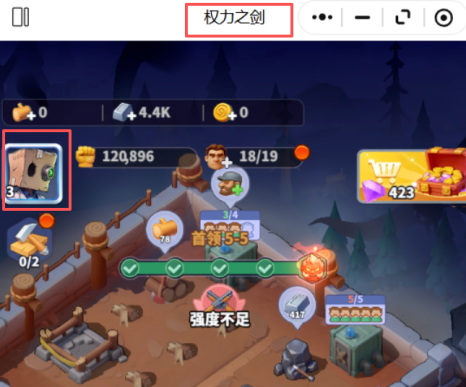
It is worth specifically mentioning that Hell Asylum’s paper-bag-head character design is almost identical to the protagonist design in Sword of Power, a mini game previously published domestically by 4399. In gameplay, the latter borrowed the “idle + SLG” framework of Winter Lord from Jiangyu’s portfolio, while shifting the theme from last year’s snow-and-ice setting to this year’s light post-apocalyptic horror. This shows that 4399 has long been testing various SLG products by imitating proven golden formulas, and has been integrating elements that perform well in tests across different products.

In gameplay terms, Hell Asylum can be summarized as “soul assembly-line management + numerical progression + combat/SLG follow-through.”
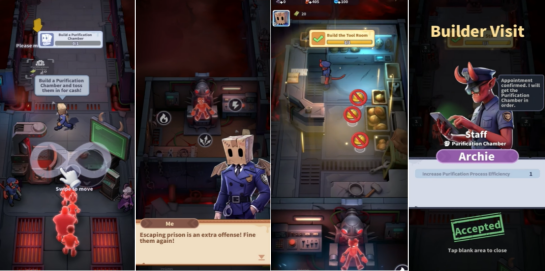
In the early stage, players must first repair basic rooms so that souls can enter the prison system. Then, following mission guidance, they send souls to different facilities to complete steps such as purification, judgment, and punishment. Each step produces resources, which are then used to build new rooms, upgrade equipment, and unlock more functions. On the surface, players are managing hell; underneath, it is a very clear management loop: souls enter, players process them, resources are produced, facilities expand, processing efficiency improves, and then more souls are received.

At the same time, early players also need to personally move, carry, and assign souls. Later, however, demon employees, tool rooms, additional purification rooms, and other content are unlocked, at which point players need to build a more efficient hell processing system.
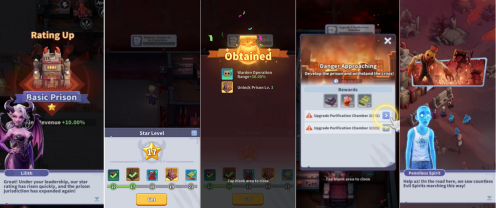
But the game does not stop at light management. As progress advances, the prison’s star level increases, providing an overarching goal for the “soul assembly line” that pushes the expansion of the prison’s jurisdiction and unlocks prison levels. As various crisis events arrive, players face multiple pressures and must build and upgrade production buildings outside the prison, such as volcanic stone mines, ice crystal mines, and magma mines, to obtain more resources. They must also build defenses and continuously use card characters for combat, gradually opening up the game’s numerical depth.


Building upgrades determine soul-processing speed and resource output, the employee system determines automation efficiency, and card characters take on combat and crisis handling. In other words, seemingly simple assembly-line actions in the early stage are continuously accumulated into building levels, job efficiency, character strength, and resource reserves.
Overall, the game relies on the soul assembly line at the front end to provide intuitive feedback, then extends management goals through automation and city building, and later uses card progression and SLG content to support long-term growth. Its core lies in translating a mature management framework into a more recognizable hell judgment process. At the same time, it also performs well in connecting numerical progression with content.
03
The New LA-like Framework Is Still Being Rapidly Tested
Multiple Companies Are Validating Themed Front-End Management
Overall, although Hell Asylum’s cumulative downloads after four days of testing have not yet exceeded 10,000, with the United States and the United Kingdom currently contributing the top two shares, and although its revenue scale still needs further observation after expansion, 4399 most likely has high expectations for the game based on its strong product packaging, solid gameplay experience, and relatively formal first exposure test. It may become one of the company’s key follow-up products.
In addition, as mentioned at the beginning, judging from current testing trends, Hell Asylum does not represent an isolated direction. After Last Asylum validated the commercial potential of this product framework, follow-up attempts around different themes and different front-end scenarios have already begun to appear one after another.
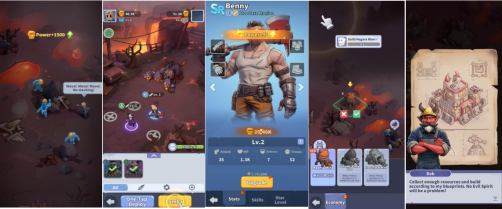
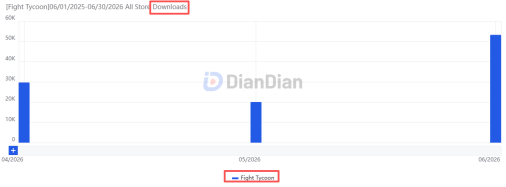
For example, FunPlus is one of the most active participants. It first launched a new boxing-gym management title, Fight Tycoon, which establishes management feedback in the early stage through receiving customers, training boxers, collecting revenue, and expanding the gym. It then uses boxer progression, plot battles, and world-map content to connect with the SLG framework.

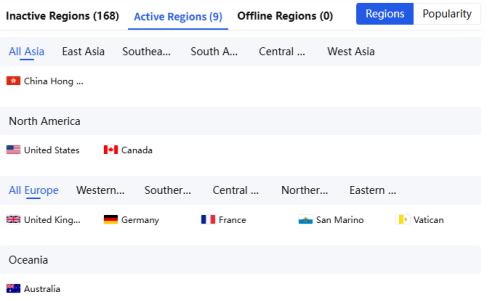
The game began testing in early April this year and expanded its test scale once in June. It is currently still being tested in 9 regional markets, with cumulative downloads of around 130,000. The overall testing cadence is fairly tight, and its prospects are worth following.


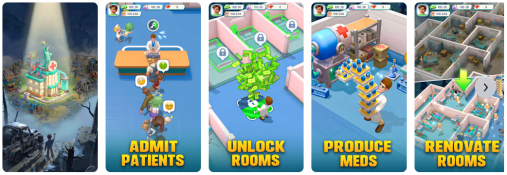
FunPlus then launched Last Hospital, a title themed around a zombie apocalypse and a hospital, formerly known as Last Hope: Hospital. Another build called Last Cure: Survival is also currently being tested online. In the early stage, the game requires players to receive patients, arrange nursing, and expand rooms, before gradually moving into wilderness exploration, fog clearing, resource acquisition, and SLG growth content. However, the game has not yet generated statistically trackable market data.

These products show that companies are not simply trying to copy one breakout hit. Instead, they are continuing to search for front-end scenarios that better support SLG follow-through. Boxing gyms, hospitals, and hell prisons correspond to different emotional entry points, but at the bottom they all point to the same question: how can short-feedback management retain players, and then naturally introduce long-term systems such as resources, characters, maps, and alliances?
As for whether Hell Asylum can ultimately break out, it will still depend on retention, monetization, and scaling performance after the first round of testing. But at least from its current product form, it has already captured the two most important variables in this round of LA-like exploration: sufficiently distinctive thematic symbols, and a front-end management loop that can extend into numerical progression and SLG content.