文
A
As June gives way to the summer season, competition in the global mobile games market is heating up. Compared with May, when the new-game market weakened in both volume and revenue, June saw a further contraction in the number of charting new titles, but revenue began to recover. In particular, overseas markets once again produced clear headliners, with IP-driven games and Korean MMOs becoming the main revenue drivers. Overall, this month featured active categories, buzzworthy topics, and breakout single titles, but it has not yet produced a broad-based upswing across all genres.
First, looking back at two new titles released in the domestic market at the end of May: Heartbeat Trap, the oriental supernatural suspense romance mobile game launched by FriendTimes at the end of the month, continued its strong revenue performance in its second month after launch. In particular, in mid-June, the official debut of the new male lead Wuzhiqi, together with updates to Chapters 14 and 15 of the main storyline, triggered a second peak in in-app purchase revenue. From the trend perspective, by the end of the month its daily revenue had not shown a clear decline. Overall, the game's unpacking-based growth and numerical-loop mechanics, unlike those of other otome titles, may weaken the romance immersion and story emotions that users value; while they cannot create an explosive data surge in the short term, they provide more stable daily retention support and are expected to keep the product's data relatively steady going forward.
Another title, Chaos Zero Nightmare, a cosmic dark-fantasy Roguelite deck-building strategy game published domestically by Tencent, also continued the gameplay advantages already validated by its overseas version after launching in China. After entering June, the first season, Song Echoing in the Galaxy, launched in mid-June, along with the limited main combatant Heidmarie rate-up event, 70 free draws for login, and extra limited gacha items for the one-month public-beta celebration. These activities once again lifted revenue to a new daily peak. The product's strong performance also once again validated Tencent's mature capabilities in overseas anime-game publishing, localized content packaging, and event pacing.
Returning to June's new-game data, this issue again includes four new titles that met our ranking criteria. Overall volume and performance were almost unchanged from the previous month, but the leading titles were slightly weaker. As usual, we will briefly analyze several products released domestically last month in descending order of revenue.
First is Under the Nightfall, a new female-oriented title with a Sicilian mafia theme launched by Tianti Network. With mafia intrigue, family revenge, power struggles, and an everyone-is-evil narrative base, the game is more distinctive in its communication appeal than traditional sweet-romance, companionship, or light-romance routes. In its first month, the title achieved more than 2.55 million downloads in the domestic market and generated more than $3.31 million in estimated revenue, topping June's domestic new-game charts. Its opening performance confirms that there is still room for differentiated themes to break through in the female-oriented market.
The core gameplay of Under the Nightfall revolves around story progression, character development, side-scrolling strategy combat, collection matching, family management, and emotional interaction. The combat experience is relatively light overall. The combination of low-barrier automatic basic attacks and manual finishing skills reduces the learning curve for broad female-oriented users, while the development systems provide a certain degree of playability and retention. Its ability to generate revenue quickly at launch shows that the character and story selling points have already completed their first round of conversion. Following Heartbeat Trap, the two titles have also brought fresh topicality back to the female-oriented genre after a quiet period.
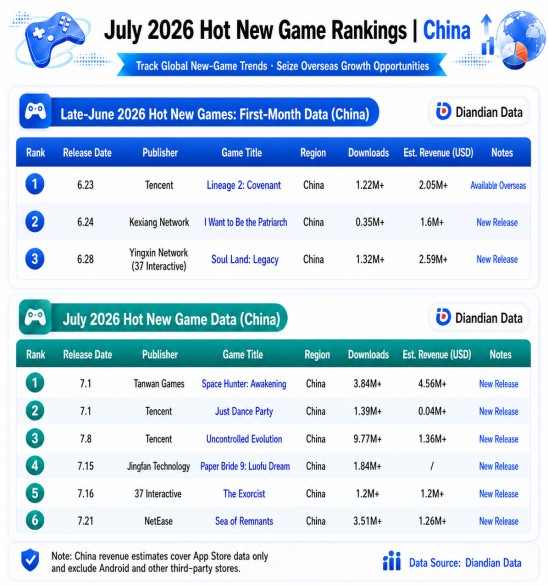
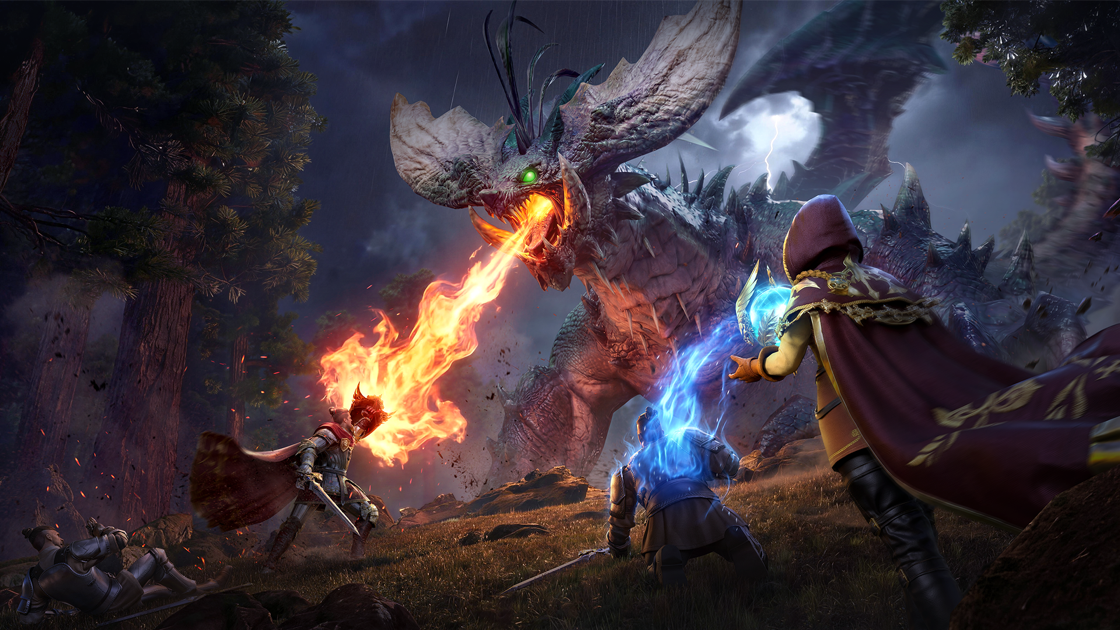
Second is Lineage 2: Covenant, a fantasy MMORPG developed by NCSOFT and published domestically by Tencent. As another mobile adaptation of a classic PC-game IP, the title recreates and upgrades iconic elements from the original, including the continent of Aden, classic classes, boss battles, and clan sieges. At launch, the game quickly drew back veteran players through the nostalgic appeal of its mature IP and achieved both downloads and estimated revenue above one million within just one week.
In gameplay terms, while preserving the classic PC-game experiences of open-world loot farming, dungeon challenges, and large-scale clan PvP, the game further adds offline auto-grinding, free class switching, and automatic growth systems. This to some extent reduces the progression burden of traditional MMOs and better fits current mobile users' demand for lighter experiences. Judging by its opening results, if the game can continue improving the new-player experience while keeping the clan ecosystem and trading economy active, Lineage 2: Covenant may have a chance to secure a relatively stable position in the existing MMO market with the help of its classic IP influence.
Next is Fat Goose Food Street, a casual merge-and-management product published by Xingyi Network and developed by Haoteng Chuangxiang (Crazy Games). As a new Fat Goose IP title after Fat Goose Gym, the game continues the soft, healing art style and round, chubby goose image of its predecessor. Using rebuilding a food street as its core theme, it further expands the original IP assets into the food-management setting popular in this genre. Combined with the user base accumulated by the product on mini-game platforms, this has laid a certain data foundation for the title. According to ranking-trend data from Diandian Data's WeChat mini-program charts, its grossing-chart ranking has remained steadily within the top 50.
In addition, Fairy Tale Master, a healing simulation-management mobile game launched by Aiyou Network under 4399, attracted a certain amount of attention early on with its low-saturation hand-drawn art style, fairy-tale theme, and high degree of decoration freedom. On launch day, it topped the App Store free-games chart in the Chinese mainland market and continued to dominate during the Dragon Boat Festival holiday. However, the game's relatively slow pace and theme also meant that its monetization performance was not particularly strong compared with its popularity on the free chart.
Turning to overseas markets, nine new titles entered our field of view last month. The overall number fell sharply, but performance improved significantly compared with the previous month. This month, Japanese and Korean developers made a strong return, while global IPs such as Pokemon and Game of Thrones demonstrated powerful traffic appeal, becoming important drivers of overseas new-game growth. At the same time, these two regional markets also contributed considerable revenue performance.
Among the new titles released overseas at the end of May, Clash of Critters, a level-based card tower-defense game launched by Farlight Games, Lilith's overseas publishing brand, continued to scale after the statistical window was extended and maintained stable performance across Europe, the United States, Southeast Asia, and other regional markets. According to Diandian Data, by the end of June the title had accumulated more than 5.61 million downloads in its first month outside mainland China, while estimated revenue had exceeded $10.33 million, or about RMB 70.01 million.
The 3D Chinese-style xianxia MMO Qingqiu World: Origin, published by JOYSTAR GAME, continued to achieve relatively strong conversion in markets such as Taiwan, China, Hong Kong, China, and Malaysia thanks to its distinctive romance-social operation strategy. The popularity of the Flower Oath Immortal Journey · Citywide Romance themed event launched in early June drove the product's single-day estimated revenue in Taiwan, China above $540,000, helping it achieve an impressive first-month estimated revenue of more than $7.33 million.
In addition, two other products launched at the end of May broke out this month. The first was Dragon Village 3, the official numbered sequel in Highbrow's Dragon Village series. The return of the classic IP and the resulting fan comeback, combined with launch-period benefits such as a seven-day login reward offering a Legendary Dragon Selection Box, helped the product continue breaking out in South Korea as well as Hong Kong, China, Macao, China, and Taiwan, China.
The second was Duck Survival, a post-apocalyptic Roguelike tower-defense shooter launched by Joy Net Games, 4399's overseas publishing brand. With the contrasting ducks-fighting-zombies theme as its core packaging, the title continues the benefit-driven and fast-scaling strategy the publisher previously used for products such as Legend of Mushroom. Through abundant early gacha resources, an easy-to-learn tower-defense shooting experience, and a clear recruit-build-battle loop, the game quickly attracted user attention in T1 markets led by the United States, France, and Germany. From the revenue trend, its daily revenue is still rising.
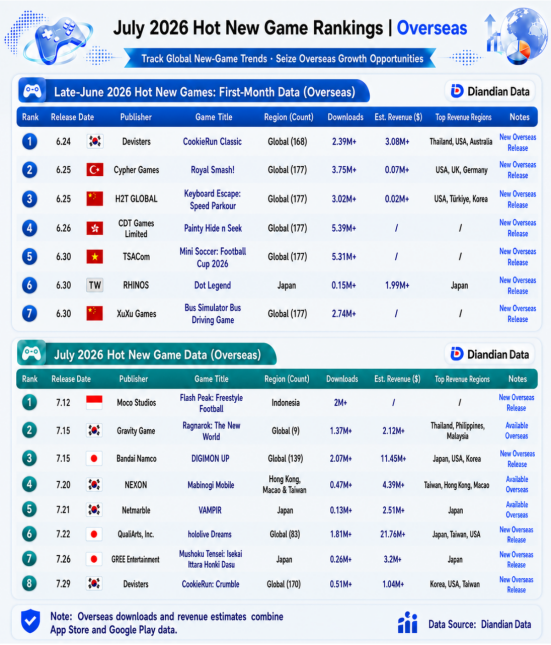
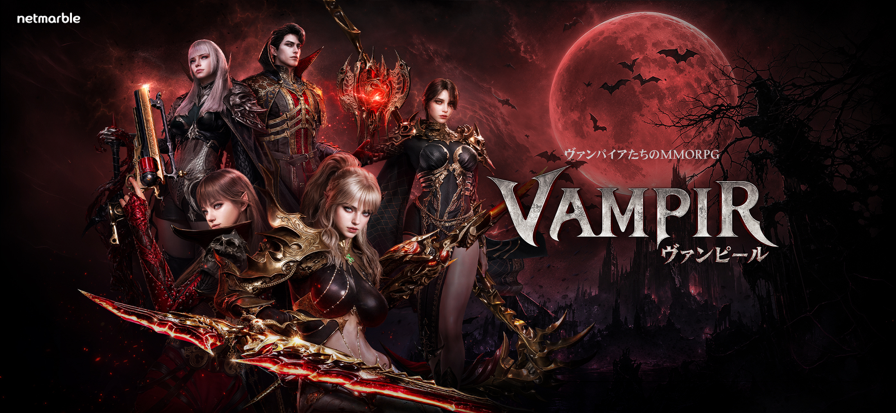
Returning to the new titles that made the June charts, overseas new-game products are still divided by revenue performance. The first tier is led by SOL: enchant, a new MMORPG released by Netmarble in its home market of South Korea. Created with participation from former core Lineage M producers, the game uses Unreal Engine 5 visuals, a divine-right system, a free economy, and core MMO competitive experiences as its selling points. Within only two weeks of launch, it generated more than $20.47 million in estimated revenue in South Korea, or about RMB 138 million, once again validating Netmarble's publishing capabilities in the Korean market and the paid-conversion potential of this product type there.
In gameplay terms, SOL: enchant continues the core framework common to Korean MMOs, including open-world exploration, character development, open-field monster grinding, trading economy, and offline auto-grinding, while differentiating itself through the divine-right system. This system allows all players on a server to compete for divine authority, ultimately becoming the server's absolute god, and to gain abilities at different authorization stages, including battlefield intervention, server-wide buffs, exchange-tax income, and even the ability to influence update pacing and certain game rules. Compared with traditional MMOs, it further strengthens top players' sense of identity and domination, becoming the core reason behind the product's short-term revenue explosion.
The second tier is represented by Pokemon Champions, the official new Pokemon IP mobile battle title launched by The Pokemon Company. Within less than two weeks of its May launch, the game generated more than 4.56 million downloads and over $5.86 million in estimated revenue. The title focuses its content almost entirely on Pokemon battles, using multiple battle modes to precisely serve core players in the Pokemon series who have clear demand for competitive PvP, laying the groundwork for revenue performance.
In addition, the game not only connects data and matchmaking ecosystems with the Switch version, but also supports transferring Pokemon from titles such as Pokemon Scarlet/Violet and Pokemon GO into the game through Pokemon HOME. This lowers migration costs for veteran players and attracts more IP audiences, while more importantly amplifying the long-term value of the series' accumulated collection assets. In that sense, Pokemon Champions matters most as an important mobile foothold for the IP.
Next are two products with revenue above $3 million, grouped into the third tier. The first is Game of Thrones: Dragonfire, launched by Warner Bros. Games and HBO. Built on the world of House of the Dragon, the title uses selling points closely aligned with the source material, such as riding dragons into battle, family alliances, and territorial conquest. It also offers HBO Max account-linking rewards, allowing players to unlock in-game rewards by watching Season 3 of House of the Dragon. This fully leverages the global influence of the Game of Thrones IP and helped the title deliver a solid launch.
The other is Dragon Raja: Cassell's Gate, released for the Japanese market by Archosaur Games. The Chinese mainland version launched at the end of 2024, and the Korean version was released in March as the first overseas stop. The Japanese version inherited a mature gameplay model while launching with a collaboration with the well-known anime The Seven Deadly Sins and a themed event titled Interlude of Fate. Backed by Meliodas, Elizabeth, and other popular SSR characters, the game also got off to a good start in the Japanese market.
The fourth tier consists of other products with million-dollar-level revenue. The first is Soul Land: Awakening World, an open-world MMORPG adapted from the web-novel IP Douluo Dalu and published by G-LI NETWORK, a brand under 37 Interactive Entertainment. As the series' first 3D open-world MMO, its biggest feature is the non-lock-on action system, with dodging, aerial movement, and skill chaining enhancing combat feel and satisfaction. Relying on the IP's influence in Traditional Chinese-language and Southeast Asian markets, the game achieved a strong start thanks to excellent performance in Vietnam, Thailand, and other markets.
The second is RF ONLINE NEXT, a sci-fi MMORPG launched by Netmarble. This release is the international server version of the product, which already had mature operating experience from the earlier Asia server. As the official sequel to the classic PC-game IP RF Online, it continues the original's core framework of long-term confrontation among three factions around resources and Holy Stones, while using Unreal Engine 5 to comprehensively upgrade sci-fi battlefields, mech equipment, and large-scale faction warfare. Its estimated revenue of more than $2.15 million within half a month is within expectations.
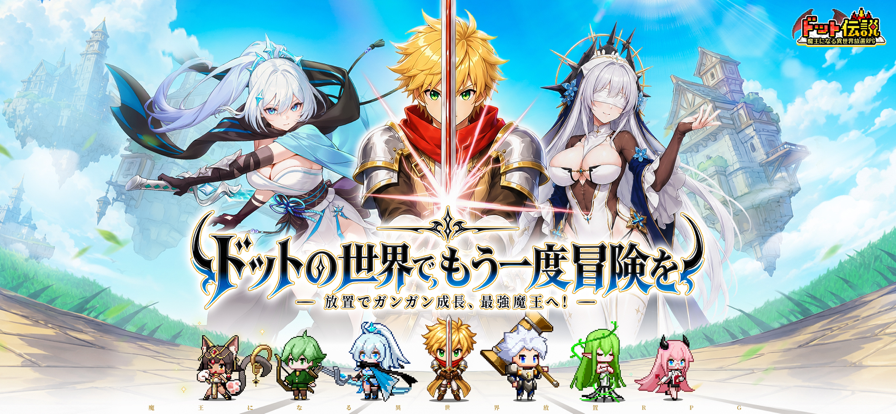
Finally, there is Dot Abyss, a pixel-style idle loot-farming RPG launched by DMM GAMES' new label Kumasan Black and published by EXNOA. As the new label's first product, it set a company record with more than 700,000 pre-registrations, the fastest in DMM GAMES history. Centered on the world of exploring the Great Abyss, the game combines idle growth with Hack & Slash loot-farming, building a relatively clear long-term loop through character collection, automatic combat, equipment drops, and base development. Its overall pace is lightweight, but the feedback is dense and satisfying.
Overall, the global new-game market in June showed a certain recovery compared with May. As the summer season officially begins, competition in the new-game market may intensify further.