文
A
In Q1 this year, Moon Active launched Reality Bay and Family Bay one after another. The two new titles test film-set themes and reuse an island IP, respectively, with cumulative revenue of around US$2.22 million and US$273,000.
According to Gamigion, global player spending on Merge-2 games exceeded US$1 billion for the first time in Q2 2026, up 96% year over year and marking the 21st consecutive quarter of quarter-over-quarter growth. During the same period, total player spending on match-3 games was US$1.8 billion, declining quarter over quarter for the third consecutive quarter. All of this indicates that Merge-2 has become the most prominent growth direction in the casual market.
Judging from the current revenue rankings and new-product supply, Chinese publishers already hold an absolute advantage in the Merge-2 track. Products such as Gossip Harbor and Seaside Escape continue to raise the ceiling for long-term operations, while companies including Yotta, DianDian Interactive, and Lilith keep launching new titles. Competition has moved beyond early gameplay replication and deepened into theme packaging, story production capacity, UA creatives, and numerical tuning. But in the face of a still-expanding golden category, leading overseas publishers have not chosen to hand the market over. Moon Active is one of the companies placing a heavy bet.

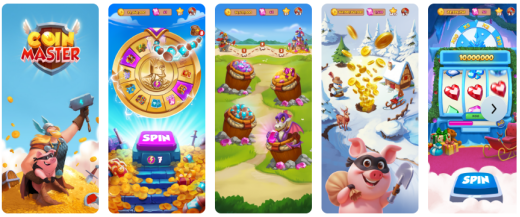
When Moon Active is mentioned, the first product most people probably think of is Coin Master. The game officially launched globally in 2016 (an iOS version was released in 2010, but its gameplay differed from the current version), combining slot-machine spins, village building, friend attacks, resource raiding, and card collection. It has sustained long-term operations almost entirely through an extremely lightweight operation loop.


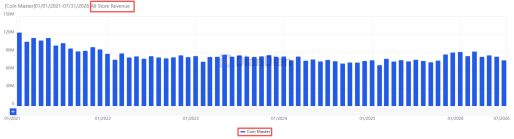
As of now, the title has been operating for more than 10 years and remains one of the world's highest-grossing mobile games. It ranks in the iOS games grossing Top 10 in 87 countries and regions. Last year, its annual revenue was around US$930 million, equivalent to roughly RMB 6.27 billion, with the United States, Germany, and the United Kingdom ranking as the top three markets at 28.69%, 9.12%, and 9.1%. In the first half of this year, its monthly revenue never fell below US$82 million, equivalent to roughly RMB 550 million.

Coin Master monthly revenue trend since 2021
However, after entering 2026, Moon Active has clearly accelerated testing of new Merge-2 products. In Q1, it launched Reality Bay: Merge & Discover (hereinafter Reality Bay) and Family Bay: Merge & Farm (hereinafter Family Bay) in succession. Monthly revenue for both new titles has been growing continuously, but Reality Bay's July revenue was about eight times that of Family Bay.


So what testing stage are these two new games currently in? How is their market data performing? How do their themes and gameplay differ? What is the background and future plan behind Moon Active's heavy bet on Merge-2? DianDian Global will break it down and analyze it below.
01
One Tests a Film-Set Theme, While the Other Reuses a Mature Island IP
Moon Active Bets on Two Routes and Is Testing Scaled Rollout Simultaneously
Judging from current data, both products are still in the testing and validation stage, but their scaling pace and monetization performance already show clear differences.
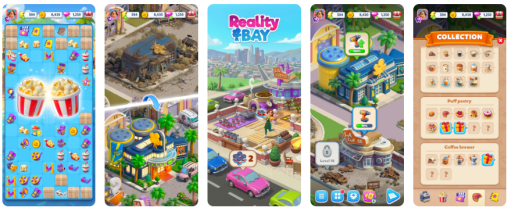
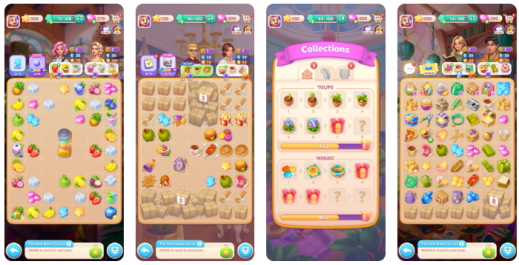
First, let us look at Reality Bay. In terms of theme, it chooses a film studio setting, which is not common among Merge-2 products. Visually, it adopts an overall European and American cartoon style with bright colors, and its character designs lean more toward the fashion and entertainment industry.

Players face a chaotic movie studio and need to merge items such as tools, costumes, props, and lighting equipment to complete orders from directors, actors, and crew members. They then use the coins and resources obtained to repair studios, expand backlots, and advance character stories.

In terms of gameplay loop, it remains the typical generator output - merge upgrade - order consumption - scene renovation - story progression structure. The difference brought by the film theme is that the game can naturally accommodate content points such as celebrity growth, crew gossip, on-set accidents, red-carpet styling, and box-office blockbusters, making it convenient both for story conflict and creative packaging.
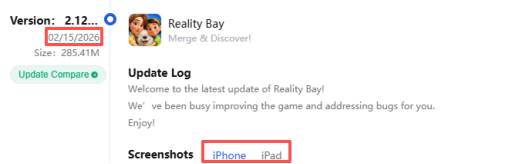
The title first landed on Google Play in India in early February, began external advertising at the same time, and generated trackable market data. It then gradually expanded to markets such as Brazil and the United Kingdom. On February 15, it launched on the App Store in some regional markets. At present, it has launched on both platforms in nearly 170 regional markets and has reached No. 67 and No. 91 on the iOS games free chart in Germany and the United Kingdom, respectively.


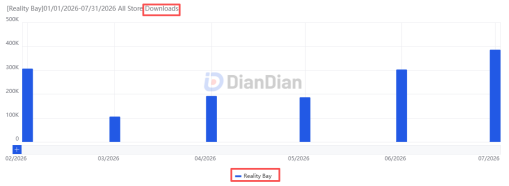
In terms of specific test data, downloads scaled quickly in the first round of testing. Single-day downloads once reached 18,900 on February 8, then fell back in March and began to fluctuate. They rose again in May as testing progressed. Monthly downloads from February to May were 310,000, 110,000, 190,000, and 187,000, respectively. In June, global downloads were around 303,000, and in July they further increased to 386,000, up 27.4% month over month.

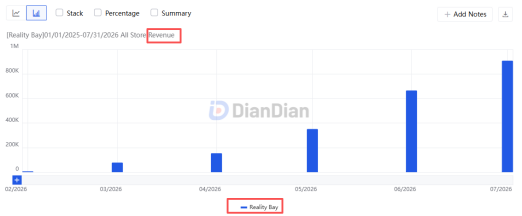
Compared with the phased fluctuations in downloads, Reality Bay's revenue climb has been more continuous. From March to July, monthly revenue rose from US$78,000, equivalent to roughly RMB 560,000, to US$908,000, equivalent to roughly RMB 6.54 million, with July revenue up 36.5% month over month.

So far, its advertising remains relatively restrained. Daily downloads are around 10,000, while daily revenue is stable at around US$30,000, equivalent to roughly RMB 200,000. Cumulative downloads are about 1.497 million, with the United States, India, and the United Kingdom ranking as the top three markets at 21.02%, 14.75%, and 13.58%. Total revenue is around US$2.22 million, equivalent to roughly RMB 15 million, with the United States, the United Kingdom, and Germany contributing the most at 37.68%, 25.51%, and 14.87%.

From a longitudinal perspective, Reality Bay is not a short-term test that surged in the first week and then quickly fell back. Instead, it has gone through several months of steady climbing. Especially after May, both downloads and revenue rose at the same time, indicating that Moon Active has begun to gradually validate its advertising, retention, and monetization potential.
By contrast, although Family Bay began testing earlier, its data scale is much smaller.
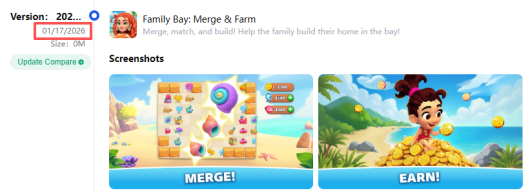
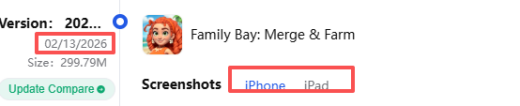
DianDian Data shows that Family Bay first landed on Google Play in some regional markets in mid-to-late January. It generated its first trackable market data in early February, and the game also began external advertising during this period. In mid-February, it launched on the Indian App Store. At present, it has launched on both platforms in nearly 170 regional markets and is in the soft-launch and scaled testing stage.


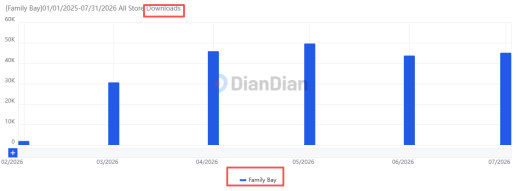
In terms of downloads, February downloads were around 101,000, fell to 71,000 in March, and further dropped to 48,000 in April. They then began climbing again, reaching 71,000 in July, up 31% month over month.

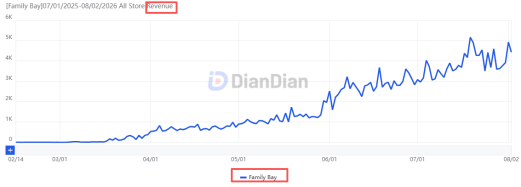
On the revenue side, early monetization started slowly, but the growth trend is clear. From March to July, monthly revenue increased from US$3,541 to US$118,000, equivalent to roughly RMB 850,000, with July revenue up 41.5% month over month.

As of now, like Reality Bay, the title remains in a relatively low advertising stage. Daily downloads are mainly between 1,500 and 2,000, while daily revenue is around US$4,000, equivalent to roughly RMB 29,000. Cumulative downloads are about 398,000, with the United States, the United Kingdom, and Russia ranking as the top three markets at 16.09%, 6.91%, and 4.32%. Total revenue is around US$273,000, equivalent to roughly RMB 1.85 million, with the United States, the United Kingdom, and Germany ranking as the top three contributors at 29.72%, 9.72%, and 6.87%.
In absolute scale, Family Bay is clearly behind Reality Bay, but its significance lies not only in current test-stage data, but also in theme and asset reuse.
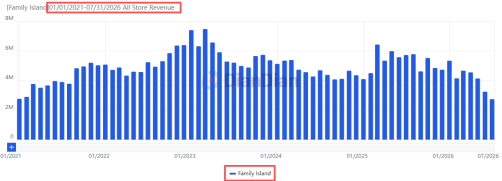
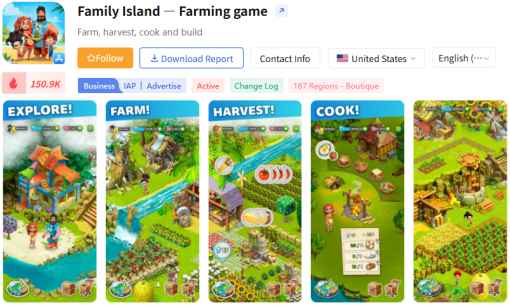
In terms of theme, Family Bay almost openly inherits the core packaging of the farm simulation management game Family Island, which launched in 2019 and generated around US$63.14 million in revenue for all of 2025, equivalent to roughly RMB 430 million.

Family Island monthly revenue trend since 2021
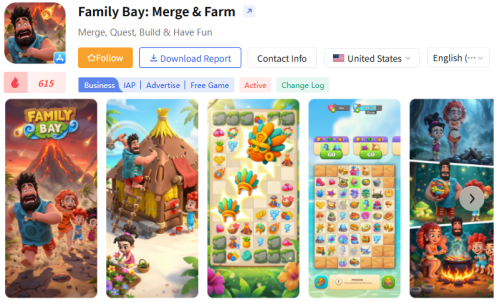
In 2020, Moon Active acquired Melsoft, bringing products such as Family Island and My Cafe under its umbrella. Family Island tells the story of a family rebuilding life on a deserted island, gradually expanding their home through gathering, crafting, building, farming, and exploration. Family Bay also revolves around family, islands, farming, rebuilding, and exploration, but changes the core operation into Merge-2.


In terms of specific gameplay, players need to merge tools, resources, and tropical items on the board, then use those items to clear areas, repair cabins, decorate farms, and open up coasts and jungles. Its outer layer remains the light narrative of a family starting life from scratch on an island, while its inner layer is a more standard Merge-2 order and resource-consumption loop.
Viewed together, the division of labor between the two products is clear. Reality Bay is testing whether the film-set theme can bring new story tension to Merge-2.
Family Bay is more like reconnecting the mature theme assets of Family Island to a lighter and more direct Merge-2 operation entry point. The former currently performs better in data, while the latter better reflects Moon Active's transformation of existing IP and reuse of product experience.
02
From Travel Town to Merge Hotel Empire
The Former Still Generates Over US$16 Million in Monthly Revenue, Showing Deep Accumulation in the Merge-2 Track
Although the two Bay-series products only entered the market in Q1 this year, Moon Active is not a newcomer to the Merge-2 track. On the contrary, the company has accumulated several years of experience in this direction through product operations and external acquisitions.
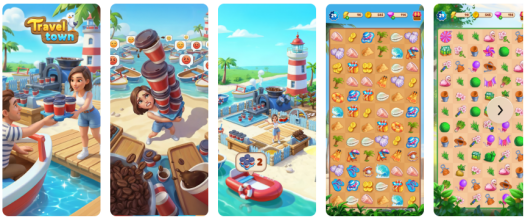
The most important product among them is Travel Town. The title officially launched in 2021. In terms of gameplay, players earn coins after completing orders, then use them to repair the town, open areas, and advance character stories. It already has the complete structure of today's narrative-driven Merge-2 products.


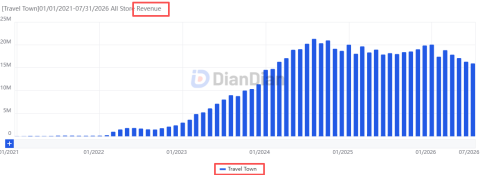
In 2022, Moon Active brought Travel Town, its development team, and related business under its ownership. Since then, it has continued to increase content updates, event operations, and market spending for the product, gradually growing it into a leading product in the Merge-2 track. As of now, the title has been operating for five years, and its revenue remains very strong, with US$16 million, equivalent to roughly RMB 110 million, in revenue last month.

Travel Town monthly revenue trend since launch
The significance of Travel Town is not only that it is a new hit. It gave Moon Active a globally validated Merge-2 numerical model, including energy production and consumption, generator cooldowns, order difficulty, board space, event cadence, and monetization design. For Merge-2, a category highly dependent on numerical balance, these backend capabilities are more important than simply copying a merge board.
In addition, Moon Active also has another noteworthy product, Merge Hotel Empire - Design Game.

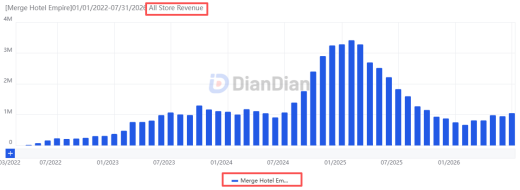
Developed by GreenPixel, the title launched in March 2022 and saw data grow steadily until reaching a monthly revenue peak of US$3.42 million, equivalent to roughly RMB 23.1 million, in February 2025. After that, its monthly revenue began to decline slowly and currently fluctuates around US$1 million.

Merge Hotel Empire monthly revenue trend since launch
Merge Hotel Empire's gameplay structure is Merge-2 + hotel renovation + text-driven story. Players obtain repair resources through merging, gradually renovate the hotel, and advance character relationships, secret investigations, and emotional storylines in the process. It represents one of the most classic Merge-2 paths: using merging to provide short feedback and renovation plus story to provide long-term goals.


However, it should be noted that unlike Travel Town, public information can currently only confirm that Merge Hotel Empire was developed by GreenPixel and published by Moon Active. It is not yet clear whether the two companies have an acquisition or investment relationship. But judging from product ownership and operating performance, it can still be regarded as an important sample for Moon Active in the Merge-2 track.
In summary, before Reality Bay and Family Bay, Moon Active had already encountered and operated two mainstream Merge-2 models through Travel Town and Merge Hotel Empire: the former leans toward town repair + order merging + character story, while the latter leans toward hotel renovation + character relationships + long-term decoration.
Together with the family island management experience provided by Family Island, Moon Active's launch of the two Bay-series new games is not trial and error from scratch, but a process of splitting, recombining, and retesting already validated product capabilities within new thematic packaging.
From this perspective, the key to Moon Active's future development in Merge-2 is not merely whether it can create another merge board, but whether it can steadily transfer the numerical tuning, event cadence, and monetization capabilities accumulated from hit Merge-2 products into more themes.
If this path works, the Bay series will not merely be two soft-launch new titles, but may become the vanguard for Moon Active's continued expansion of its Merge-2 product portfolio.
03
Acquiring Mature Products, Deconstructing and Reusing Mature Capabilities
Accelerating the Move Away from Single-Product Dependence and Seeking More Growth Pillars
Returning to the company level, what Moon Active has done in recent years is not simply pivot to Merge-2, but continuously expand its casual game portfolio while Coin Master provides a stable base.
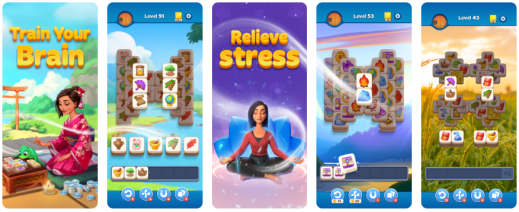
In addition to the Melsoft and Travel Town-related businesses mentioned above, the company acquired Beach Bum in 2021 to supplement board game and social competitive capabilities; acquired Zen Match and its team in 2022 to enter the tile-match direction; and invested in Spyke Games, the developer of Tile Busters, in 2024 to further expand its puzzle-casual layout.


These transactions involve different gameplay types, but the underlying logic is relatively consistent: Moon Active tends to directly acquire mature projects that already have validated products, teams, and users, then uses its own UA, monetization, and long-term operating capabilities to continue scaling them. Compared with entering an unfamiliar category completely from scratch, this approach can significantly shorten the trial-and-error cycle and also helps the company gradually move away from reliance on Coin Master as a single product.
Finally, it is worth noting that although Merge-2 is not the only direction Moon Active is betting on, it is certainly the one most worth increasing investment in.
On one hand, the track is still growing and has already proven capable of supporting long-term monetization. On the other hand, the product structure of Merge-2 is also well suited to Moon Active's ability reuse. It has a sufficiently light operation entry point as well as enough long-term depth, forming a complete loop through orders, energy, boards, area repair, story progression, and live-ops events. For Moon Active, which is skilled at user acquisition, numerical tuning, and long-term operations, this is a naturally suitable track for continued deep exploration.
Therefore, the significance of Reality Bay and Family Bay does not lie in whether they can immediately replicate Travel Town's results in the short term, but in the fact that they demonstrate Moon Active's next-stage product engineering approach: breaking validated casual capabilities into modules and recombining them within different themes.