文
A

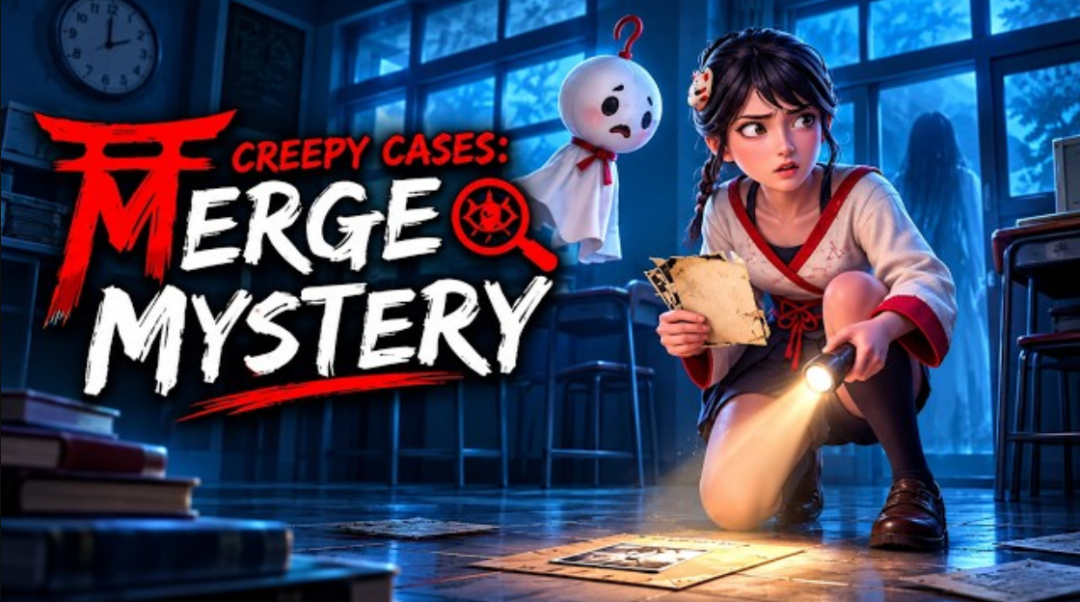
Creepy Cases, a new game linked to Betta Games, has just begun overseas testing. Can its combination of Japanese ghost stories, merging to ward off spirits and scene investigation provide a breakthrough for the group’s merge-2 portfolio?
Horror themes have continued to gain popularity over the past year. They are no longer confined to traditional Chinese horror, expanding into light horror, mystery and broader suspense. Product formats have also extended beyond MMOs and card games into multiplayer PvE, tower defense, idle games and extraction games. This broader thematic range makes it easier to find forms of expression suited to overseas markets.
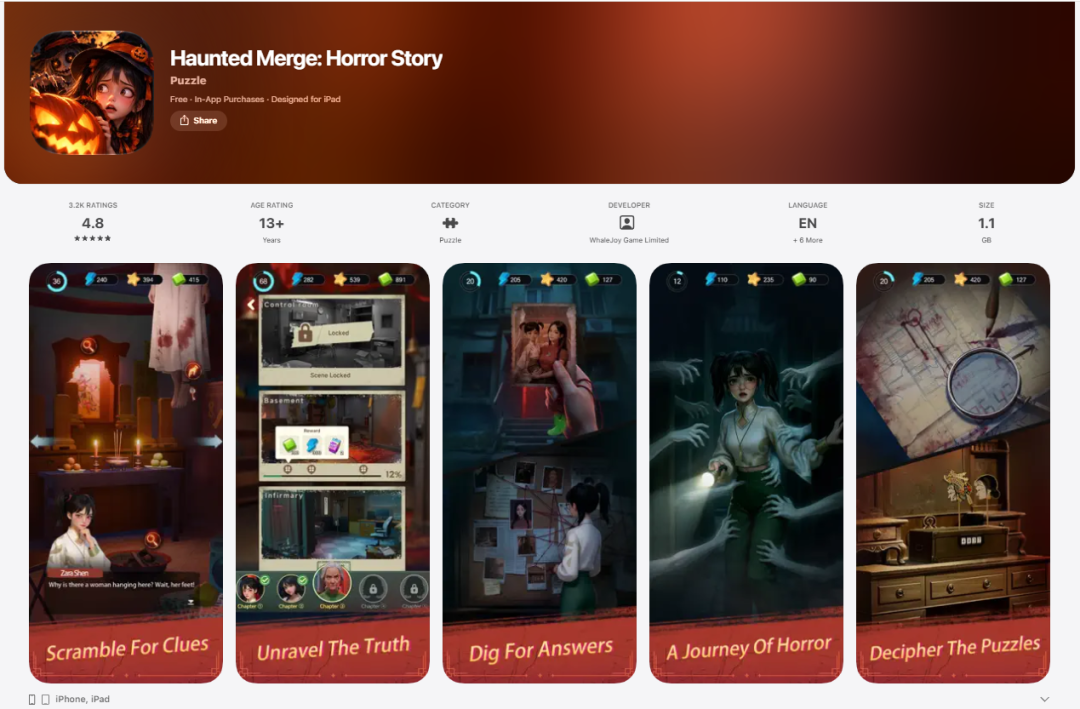
Merge-2, one of the hottest categories of the past two years, has naturally explored this direction as well. An early entrant was Haunted Merge: Horror Story (谁来救救我), released by Lanse Aoyi (蓝色奥义). The game places Chinese folk horror inside a merge-2 and puzzle-solving framework. Its heroine moves into Xingfu Apartments, where strange incidents keep occurring, in search of her missing parents and the truth about her own origins. Players merge talismans, food and tools to obtain resources and advance the investigation.
The title began small-scale Android testing in five Southeast Asian markets in July 2025 and first generated measurable market data in late October that year. Expanded testing began this January, and monthly revenue peaked at $1.69 million in March, or approximately RMB 11.3 million. Revenue declined afterward but generally stabilized between $1.2 million and $1.4 million per month, or approximately RMB 7.9 million–9.5 million. As of November 6, total revenue was approximately $14 million, or RMB 94 million. The United States, Taiwan, China, and Japan accounted for 19.18%, 15.98% and 13.42%, respectively. Cumulative downloads stood at approximately 6.12 million, led by the United States, Germany and South Korea with shares of 13.94%, 5.93% and 5.32%.
Haunted Merge’s modest success has encouraged other developers to follow, including Merge Escape: Horror Story and Merge Mystery: Puzzle & Story in the second half of the year. The former entered testing in September 2025 and was developed by PapaBox (Chengdu Pinyou Technology, 成都品游科技). Its heroine signs an agreement to livestream supernatural encounters while searching for her missing younger brother, and merged items can be used directly at the scene to solve specific puzzles. The latter began testing in June this year. Its story moves to the Victorian-style Blackwood Manor, where a female journalist investigates an old case using clues left by her parents. Its Android publishing account is wane group team, which industry observers speculate may be linked to Wuhan Halewode (武汉哈乐沃德).
DianDian Overseas recently discovered another light-horror merge-2 release, Creepy Cases: Merge & Mystery. It takes the more specific direction of Japanese horror and offers a relatively smooth experience, suggesting strong acquisition potential once advertising begins. Its link to Betta Games also makes its performance after scaling worth watching.
What is the game’s setting, and how does its gameplay unfold? How can the publisher behind it be identified? How has Betta Games developed, and what has it tried in merge-2? DianDian Overseas examines these questions below.
01
Available in the US and the Philippines, with Small-Scale Testing Yet to Gain Traction
How Do Japanese Ghost Stories Fit into Merge-2 Puzzles?
DianDian data shows that Creepy Cases first appeared on Google Play in the United States and the Philippines in late October 2026. It has already received two updates. Testing remains at a very early stage, so no measurable market data is available yet.
Rather than judging commercial performance prematurely, the more useful question at this stage is how the game brings together Japanese ghost stories, scene investigation and order-based merge-2 gameplay.
The story begins with Chiyo Kanda investigating her older sister’s disappearance. Following a trail of clues, she arrives at Nakamura Travel Agency. The previously brightly lit street suddenly becomes deserted and chilling, and the door opens without anyone touching it. Determined to find her sister, she enters the building, crosses the corridor and heads toward the agency on the third floor.
The opening first establishes the goal of finding a family member, then creates questions through a sudden environmental change. This gives players a reason to keep investigating before they encounter the merging mechanics. An employment offer left by her sister further connects her to the agency.
The art uses semi-realistic characters and environments. Narrow corridors, an old elevator, blue-green lighting and red light behind doors create the oppressive mood of a Japanese urban ghost story. Sequences such as a cleaner suddenly blocking the elevator or a face appearing behind a door add scares to the otherwise measured investigation.
The game does not maintain the same level of tension throughout. Teru, a teru teru bozu weather doll accompanying the heroine, can move and talk, responding with facial expressions and text emoticons. The heroine’s quips and everyday board items such as rice balls and sushi also soften the pressure of the cold, unsettling environments.
The gameplay flow combines scene investigation, story-specific merging and ongoing order-based merging. Players find interaction points and information at the scene. Some supernatural incidents require merging a specific item to resolve them directly, while most investigative actions advance after players complete orders to earn coins.
The first merging sequence takes place directly at the scene of danger. While the heroine is in the elevator, an abnormal cleaner suddenly blocks the doors. Players must merge an exorcism omamori charm on a small board and submit it to dispel the figure. They then merge a magatama bracelet to protect the heroine. Item production therefore directly changes the character’s circumstances.
After entering the travel agency, play alternates between investigation and order-based merge-2. Players swipe horizontally through scenes, locate switches, inspect notices and search cabinets, using objects and dialogue to determine their next actions. For example, finding an angry Ebisu statue and an empty offering table leads them to a scroll in a cabinet explaining the offering rules, which creates a food-preparation task.
The regular board follows the framework of producing items from generators, merging them and fulfilling orders for coins. Coins are then used for offerings, investigation and dialogue progression. After two rounds of offerings, the statue smiles and a key appears in its mouth. Changes to the offering table reveal another clue about a hidden drawer. The game thus connects observing the scene, identifying a need, completing orders and taking action, rewarding the player’s investment with visible changes and new clues.
On the board, the connection between where merges are made and how space is unlocked remains particularly interesting. Generator upgrades gradually add further resource trade-offs.
Overall, Creepy Cases’ main strengths are its distinctive theme and relatively natural connection between mechanics. After the travel agency, the game introduces other locations, including a station, leaving room for later chapters to vary puzzle items and settings. The limitation is that it has not entered large-scale testing: level pacing, the speed of content consumption and the breadth of audience acceptance remain unvalidated. Whether advertising creatives can communicate both the Japanese horror atmosphere and the merge-2 actions will directly affect acquisition efficiency.
02
From Utility Apps for Global Markets to a Casual-Game Portfolio
BETTA-Affiliated Teams Test the Merge-2 Market Through Different Themes
As noted at the outset, new light-horror merge-2 games are not rare. The team behind Creepy Cases, however, deserves a closer look and is one reason the title is worth watching.
Creepy Cases is currently listed under the publishing account AUTUMN STUDIOS LIMITED. Its publicly listed contact information matches that of Betta Games’ main account, BETTA GAMES, and Playorcas, the main account of Jingjia Technology (鲸甲科技), in which BETTA holds a stake. Together with other cross-referenced information, this strongly indicates that the game belongs to the BETTA-affiliated group.
Looking back, Betta Games initially had little connection to games.
In 2011, Hu Zhinong, who had worked at Yahoo China and served as CTO of Baofeng (Storm Media Player), founded Fotoable, Betta Games’ predecessor, with two other technically trained partners in a residential building in Beijing’s Changping district. The company initially focused on photography and image-editing tools. Products including FotoRus, InstaMag, PIP Camera and InstaBeauty remained near the top of photography app rankings for long periods through global distribution and continuous iteration.
By around 2015, Fotoable’s products covered video, weather, keyboards, journaling, news and English learning, with substantial global user numbers and monthly active users. The overseas publishing, acquisition and localization capabilities accumulated in utilities laid a foundation for its later shift into games.
In 2017, Fotoable began moving into mobile games under the Betta Games name. Word Crossy launched that August and spent an extended period near the top of the US iOS grossing chart in 2018. At its peak, combined monthly revenue across both stores reached approximately $3 million, or RMB 20.1 million. It remains in operation, with monthly IAP revenue around $100,000. BETTA subsequently released Word Crush, Word Villas and Word Hike, making word and crossword games its first validated gaming direction.

Word Crossy
BETTA then expanded toward casual categories with richer content and progression structures and higher revenue ceilings.
Around 2019, the company released titles across several directions, including match-3 and merging game Townest: Alfred’s Adventure, merge-3 game Mergical, idle card game Dragon Maze and casual roguelike Alpha Soldier. Most performed moderately, but they accumulated experience for later development and publishing.
Solitaire Home Design, launched in November 2020, brought BETTA wider industry attention. It combines solitaire, home decoration and story interaction. Players complete card levels to obtain renovation resources, gradually transform rooms and advance the characters’ stories.
DianDian data shows approximately $56.685 million in cumulative revenue from 2021 to date, or RMB 380 million. Monthly revenue peaked at $4.21 million in March 2022, or RMB 28.19 million, then began a sustained decline. Current monthly revenue is approximately $17,000, or RMB 114,000.
Meanwhile, BETTA also incubated sports studio StarLark. Its flagship title is Golf Rival, launched in April 2018.
In October 2021, Zynga announced its acquisition of StarLark and the Golf Rival business from BETTA, with disclosed cash and stock consideration of approximately $525 million, or RMB 3.526 billion. Years later, the game still has meaningful scale, with current monthly revenue around $3 million, or approximately RMB 20 million.
Beyond StarLark, Jingjia Technology is another team worth watching within the BETTA ecosystem.
Jingjia registered an independent entity around the end of 2021. Public reports indicate that BETTA holds approximately 35% of its shares. Early products included pool game Infinity 8 Ball, launched in March 2021, with approximately $55.89 million in cumulative revenue, or RMB 374 million, and current monthly revenue around $350,000, or RMB 2.35 million; and Extreme Tennis, a tennis game launched in October 2022 with relatively modest results.
The product that opened a new growth opportunity for Jingjia was Panthia: Magic & Merge Game. It uses merge-3 gameplay and combines merging with fantasy-world building. Players direct sprites to clear obstacles on themed island maps, merge building materials and ultimately construct advanced buildings known as Wonders. Each chapter corresponds to a storybook-like continent, with merge maps and home building linked through star resources.
DianDian data shows that the game first generated measurable figures in October 2023. To date, Panthia has accumulated approximately 4.985 million downloads and $64.285 million in revenue, or RMB 431 million. Monthly revenue peaked at approximately $3.154 million in September 2025, or RMB 21.13 million. In October this year, it still generated approximately $1.282 million, or RMB 8.59 million.
Its success shows that BETTA-affiliated teams have not confined themselves to their earlier strengths and can recombine established merging, chapter progression and construction systems.
BETTA itself has also continued testing. From around 2021 to 2023, the company tried Restaurant Rush: Cook Tycoon, Tank Raid, Jackpotland-Vegas Casino Slots and Fairyscapes Adventure, spanning management simulation, shooting, casino and adventure-puzzle games. Love Choice: Interactive Game, released in 2024, explored live-action interactive video, showing continued interest in new content formats. In 2025, it also released Merge Tile: Match & Merge and made a strategic investment in an AI creative-tools company.
The products currently listed under its publishing accounts show that BETTA-affiliated teams are again broadening casual-game testing. Alongside Creepy Cases, AUTUMN STUDIOS LIMITED lists Nuts Master, Cooking Blast: Match & Sort, Jigsaw Jiggle, Solitaire Home Makeover and Jackpot Odyssey Slots, covering sorting, cooking, jigsaws, solitaire and casino gameplay.
Merge-2 is also an important direction.
Playorcas’ Fairground Days: Merge Game launched on Google Play in June 2026 and on the App Store in September, before being removed from the latter in early October. It is currently testing in six regional markets. The game takes a familiar heartwarming approach: heroine Emma completes orders, restores the amusement park left by her parents and uncovers the past during its rebuilding.
AUTUMN’s Love & Bakery was an earlier experiment. Google Play listing records date to February 2024, while DianDian records from late October that year show it had been removed. It combines merging food and tools with renovating a house, investigating an accident and adopting pets, using suspense to support an everyday-life story.
03 Summary
BETTA’s development shows a transition from utility apps to a range of casual games. Through its own teams, affiliated teams and different product lines, it has built experience in word games, solitaire, sports and merging.
Merge-2 remains an area where this portfolio has yet to break through, with no standout representative title so far. Creepy Cases seeks a differentiated entry point beyond familiar food, renovation and relationship stories, using Japanese ghost stories and investigative puzzles in an effort to become one of the BETTA group’s first merge-2 successes.
A distinctive theme does not guarantee broad user reach. Horror can attract an initial curious audience but may also limit acceptance among female casual players and broader audiences. To scale, the game needs to balance scares, mystery and lightweight interaction while continually providing new investigative goals through chapter updates.
If the merge board turns into prolonged repetitive orders while story puzzles arrive too slowly, players may lose their motivation to explore. If the horror becomes too intense, it may also limit advertising reach and placement. Conversely, linking each round of orders to a new investigation objective, scene change or key item could create a sustained motivation that distinguishes the game from conventional merge-2 products.
Creepy Cases is still in early validation, with insufficient market data to judge acquisition costs, retention or monetization. The next question is whether its memorable Japanese-horror visuals can generate consistent ad clicks, and whether the concrete cause-and-effect connections between merging and puzzle solving can keep those users engaged.