
文
A

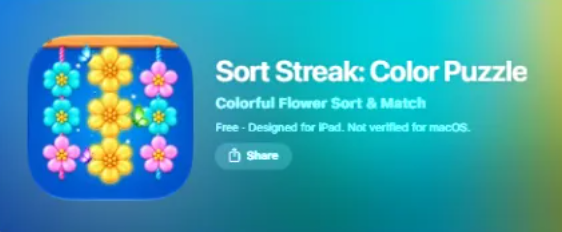
In the first 23 days of its initial scaling test on Google Play, Sort Streak accumulated approximately 300,000 downloads, with daily downloads rising from fewer than 6,000 to about 35,000. Its sorting gameplay, built around flowers, ropes and pots, has attracted similar products and renewed attention to Learnings’ innovation in lightweight puzzles.
Among Beijing-based publishers expanding overseas, Learnings (乐信圣文), whose international gaming brand is Oakever Games, has long maintained a low profile. This year’s succession of breakout new releases, however, has placed it firmly in the industry spotlight, making it increasingly difficult to remain unnoticed.
For much of the second half of this year, its two new titles Meowdoku! and Amaze GO!, together with long-running Vita Mahjong, have consistently ranked in the US iOS free-game Top 15. Cat logic puzzles, arrow puzzles and mahjong solitaire—three different puzzle formats—have contributed new users within the same portfolio. In October alone, their combined global downloads exceeded 40 million.
Learnings’ success across multiple parts of casual puzzles largely comes from finding room to improve the experience within established rules. It adjusts themes, interactions and level design, turns those points of appeal into advertising creatives, and gradually scales through testing across markets and channels.
DianDian recently found that its new color-sorting game, Sort Streak: Color Puzzle, had begun scaling. The game replaces the liquid in water-sorting puzzles with flowers and ropes, adding whole-strand dragging, flowerpot collection, hidden flowers and locked flowers. In less than a month, daily downloads have increased 400%, while several similar designs have already appeared in the market.
What do the current testing data and advertising activity show? How do the gameplay and its innovations work in detail? And how is Learnings’ portfolio structured today? DianDian Overseas examines these questions below.
01
Accessible Gameplay and Expanded Advertising Drive a Sharp Download Rise in November
Sort Streak Enters the Sorting Category with Flower-Strand Gameplay
Sort Streak arrived on Google Play in the middle and latter part of September 2026 and on the App Store in late October. It now covers more than 170 countries and regions worldwide, although no measurable iOS market data is available at this stage.
DianDian data and public information show that the first concentrated promotion began on October 13. Measurable Android data first appeared on October 17, with fewer than 6,000 downloads per day. Brazil and India were the main download sources at that point. Around October 22, multilingual ad copy and reused creatives began appearing as the game gradually entered more markets. Daily downloads grew slowly during this period but continued to fluctuate between 7,000 and 14,000.
A more sustained growth trend began in November, with current daily downloads around 35,000.
This growth also improved its chart performance: the game now ranks in the Google Play free-game Top 50 in seven regional markets.
After 23 days of its first scaling test, the game has accumulated approximately 300,000 Google Play downloads. Brazil, India and the United States lead with shares of 41.9%, 23.81% and 13.18%, respectively.
Supporting this testing round is a flower-strand sorting mechanic that is easy to understand visually.
Sort Streak preserves the relationships among color, capacity and empty space found in water-sorting games, replacing containers with ropes hanging from above. Players pick up a single flower or a consecutive group of same-colored flowers at the end of a rope and drag them to an empty rope, or to one with a matching end color and enough remaining capacity. Once the required number is assembled, the whole strand is collected into a pot and counted toward the objectives at the top of the screen.
Instead of tapping two test tubes in sequence and waiting for liquid to pour, dragging a flower strand gives players direct control over the movement. Connecting flowers, arranging them and collecting them into pots provide more continuous feedback. After some objectives are completed, new strands are introduced within the level, creating multiple rounds of sorting. This also changes space planning. To reach flowers deeper inside a strand, players must first relocate the other colors at its end and keep empty ropes available as temporary storage. After a pot is collected, they must reorder their plan around the newly introduced strands. Space briefly freed up may not remain available until the end of the level.
Later mechanics continue to focus on sequencing. Question-mark flowers introduced in level 6 reveal their colors only when moved to the end of a rope. Locked strands in level 11 require players to complete the objective for a marked color first, and question-mark pots appear later. Players must manage known arrangements while reserving space for unknown colors or prioritizing unlock conditions. Some levels add bonus rewards for completing a specified flower color within a move limit, bringing efficiency into the puzzle-solving process.
Win streaks add another reason to hesitate before restarting. When no moves remain, the game warns that restarting will break the streak. Hints, undo and extra ropes address uncertainty about the next move, an incorrect sequence and insufficient space, respectively. The results screen also offers the option to watch an ad for more coins or booster rewards, placing rewarded advertising after level completion.
Because the gameplay is so visual, Sort Streak’s acquisition creatives do not need complex stories. Most show flowers being dragged, colors being sorted and pots being collected. Some first demonstrate a wrong move, encouraging viewers to find the correct sequence. Others replace flowers with colored balls, yarn balls or gems, using different materials to strengthen the visual feedback of organizing objects.
Sort Streak did not invent the structure of vertical chains, moving items at their ends and rearranging them into groups. Link Associations, released in May this year, used a similar design built around semantic relationships: players identify words belonging to the same category and classify them by moving chains.
Strong gameplay design and innovation naturally encourage other products to experiment. Bloom Sort: Flower Match 3D from Pogame Limited and BloomCord from Picorea retain the combination of flowers, hanging ropes and pots. Hypervation’s Diamond Sort: Gem Sorting changes the objects being moved to gems.
BloomCord
Diamond Sort: Gem Sorting
Sort Streak’s current strengths are its relatively complete combination of familiar sorting rules, direct dragging and continuous collection, along with an early-mover advantage. Competition will increasingly center on level design, control feel, visual clarity and ad load. With the same strand of flowers, the more important question after scaling is whether players still feel like sorting one more level.
02
Scaling In-App Advertising While Exploring In-App Purchases
A Two-Pronged Strategy and Frequent New-Game Testing Make Learnings Hard to Beat
Placing Sort Streak within Learnings’ product changes this year shows that seeking further improvements within mature rules has already been validated in several directions. Meowdoku! and Amaze GO! are two earlier examples that achieved scale.
Amaze GO!, launched in February, adds image deconstruction to arrow puzzles. Arrows form animals, people or geometric shapes, so clearing the board in sequence also gradually dissolves an image. The game has accumulated approximately 135 million downloads. Monthly downloads peaked at 29 million in May and declined afterward, but still reached approximately 11.57 million in October.
Meowdoku! entered the market in May this year, combining sudoku-style row and column constraints, colored-region rules and adjacency restrictions. Players locate cats on a grid. The theme makes an abstract logic puzzle feel more approachable and gives advertising creatives an easily recognizable identity. Cumulative downloads are approximately 135 million, with around 11.57 million in October, and the game is still scaling.
Learnings’ commitment to casual puzzles and its product approach did not emerge suddenly this year.
Founded in 2016, Learnings is led by founder and CEO Liu Yiwei, who previously worked at Google. Early releases Sudoku and Paint by Number, both launched in 2018, were followed by Zen Color and Jigsawscapes in 2021 and Zen Word in 2023. Together, they gradually covered classic puzzle formats including sudoku, coloring, jigsaws and word games. Sudoku alone has recorded approximately 126 million downloads across both stores since 2021, with about 2.55 million in October this year.
These formats do not rely on complex stories or constantly expanding numerical progression. User needs are relatively clear, but the details of the basic experience matter: visual clarity, smooth controls, a continuing supply of playable levels and whether ads interrupt concentration.
From late 2023 through 2024, Learnings expanded its matching-game portfolio through Vita Mahjong and Tile Explorer. Vita Mahjong uses mahjong-solitaire pair matching, with larger tiles, clearer designs and a gentler pace that lower the barrier to entry. It has accumulated approximately 355 million downloads, including around 11.1 million in October.
Tile Explorer uses triple matching and layered clearing. Players select identical objects from multiple layers and form matches within limited holding space. It has accumulated approximately 227 million downloads, with 4.01 million still recorded in October.
The company has also continued testing more specialized lightweight puzzles. Jigsawcard Solitaire Puzzle, launched in November 2025, combines card movement with jigsaw feedback and has accumulated approximately 29.8 million downloads. Colorever, launched in 2026, asks players to sort gems by color and gradually restore pixel images. It has approximately 5.86 million cumulative downloads, including about 2.1 million in October.
These products preserve goals users already understand while changing the interactions and visual feedback. Sorting becomes arranging flowers, sudoku becomes placing cats, and arrow clearing becomes dismantling an image. Learnings has thus established an iterative process spanning rule selection, experience refinement and creative testing.
While continuing to operate a puzzle portfolio centered on in-app advertising, Learnings is also exploring merge-2 games that depend more on in-app purchases and ongoing content. Mystery Town: Merge Games is one title that has already achieved scale. Its protagonist arrives in a town to investigate an uncle’s disappearance. Players merge items to fulfill orders, obtain resources, restore buildings, unlock areas and advance the story.
The game began testing in July 2024. Monthly revenue first exceeded $1 million in August 2025 and has continued rising since. Current estimated monthly revenue is $12.41 million, or approximately RMB 83 million, with cumulative revenue of around $104 million, or RMB 700 million. The United States, Japan and South Korea are the leading contributors at 34.71%, 11.84% and 9.69%, respectively.
Mystery Town’s publishing account, Cedar Games Studio, has recently been testing another merge-2 game, Star Returns: Merge & Story. The story follows Hollywood star Aurora as she reopens her mother’s bakery and investigates her daughter’s disappearance. Players advance the plot by merging meals, fulfilling orders and running the shop.
DianDian data shows that Star Returns launched on the App Store in Hong Kong, China, Canada and the United Kingdom on October 21. Measurable market data appeared on October 25. In November, it arrived on Google Play in Brazil and Canada. Cumulative downloads are currently around 3,000 and revenue is below $1,000, placing it at a very early stage of validation.
Overall, Learnings’ portfolio is gradually taking shape along two parallel paths. Lightweight puzzles keep finding new ways to express established rules, while merge-2 games accumulate revenue through longer content and spending cycles. The former provide experience in creative testing and acquisition; the latter require continued development of capabilities in narrative, events and economic-system operations.
03 Summary
Returning to Sort Streak, its current growth shows that color sorting can still attract fresh market attention through changes to interaction and level structure. Similar flower-and-rope products have already appeared, however, so more time is needed to determine whether it can continue scaling.
Learnings also continues testing new games frequently. Beyond the products already discussed, this year’s releases include Bubblepics, Light Up, Molesweeper!, Connect Tracks and Twindoku, followed by Amaze Clear 3D in late October. Across color, logic, jigsaw and route-planning puzzles, the company keeps seeking new entry points and putting them to the test in the market.

This broad range of options makes Learnings unlikely to be held back by any single short-term setback.