文
A
In August 2026, the Indonesian market operated amid a mix of factors. A magnitude-7.7 earthquake struck Flores Island in mid-month, while demonstrations and social incidents occurred in Jakarta and other areas at month-end, adding some uncertainty to the monthly market environment.
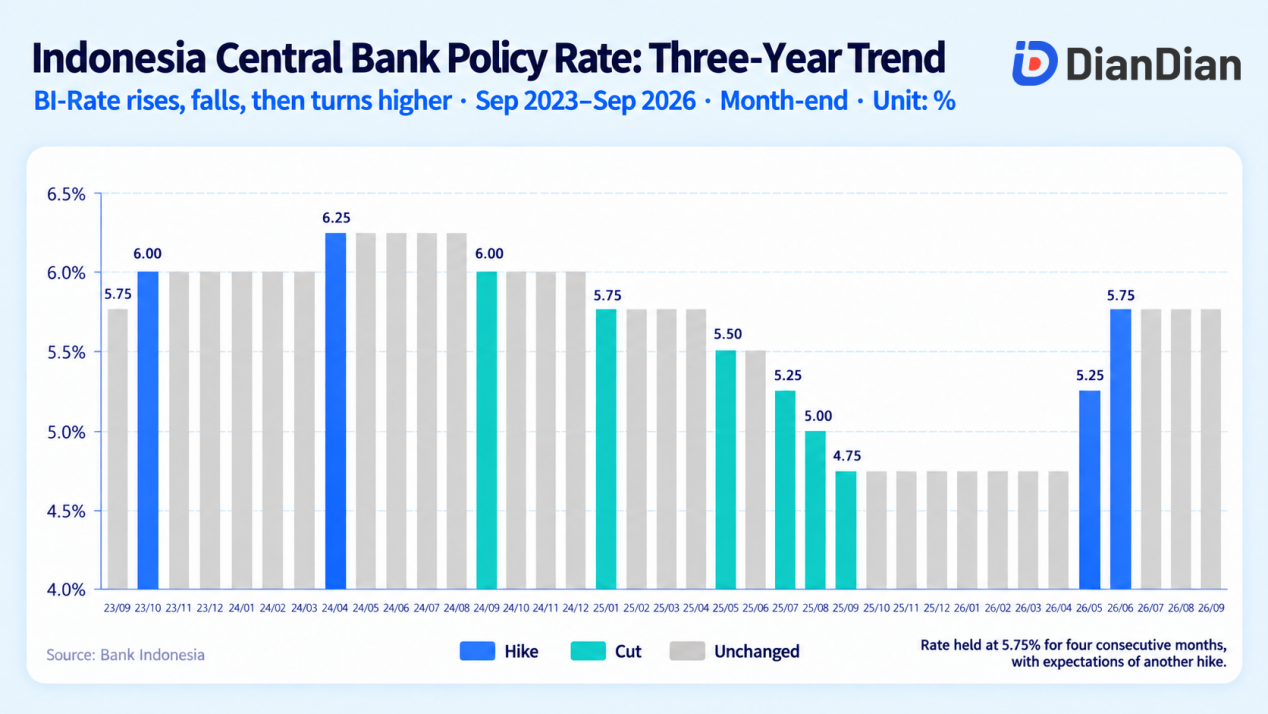
On the policy front, Bank Indonesia kept the BI-Rate at 5.75% in August, continuing to focus on exchange-rate stability and external risks while supporting economic growth through macroprudential policy. The market consensus for September remains that the rate will stay at 5.75%, with short-term expectations leaning toward stability. By October, some institutions forecast a rise to 6.00%, and expectations of a rate hike are beginning to emerge.
https://tradingeconomics.com/indonesia/interest-rate
On the consumption side, there is still a gap between recovering confidence and spending growth. The consumer confidence index reached 118.5 and remained in optimistic territory. The long Independence Day weekend and Indonesia Shopping Festival also warmed some consumption scenarios. However, Bank Indonesia estimates that actual retail sales in August grew only 0.5% year on year and declined 0.1% month on month, indicating limited real consumption growth.
Against this backdrop, the latest disclosed industry loan-outstanding balance and August app data provide two perspectives for observing Indonesia’s online lending market: whether market scale is still expanding, and how limited user traffic is being reallocated among platforms.
1. Market Scale: Loan Balances Continue to Grow, but Industry Expansion Is Moderating
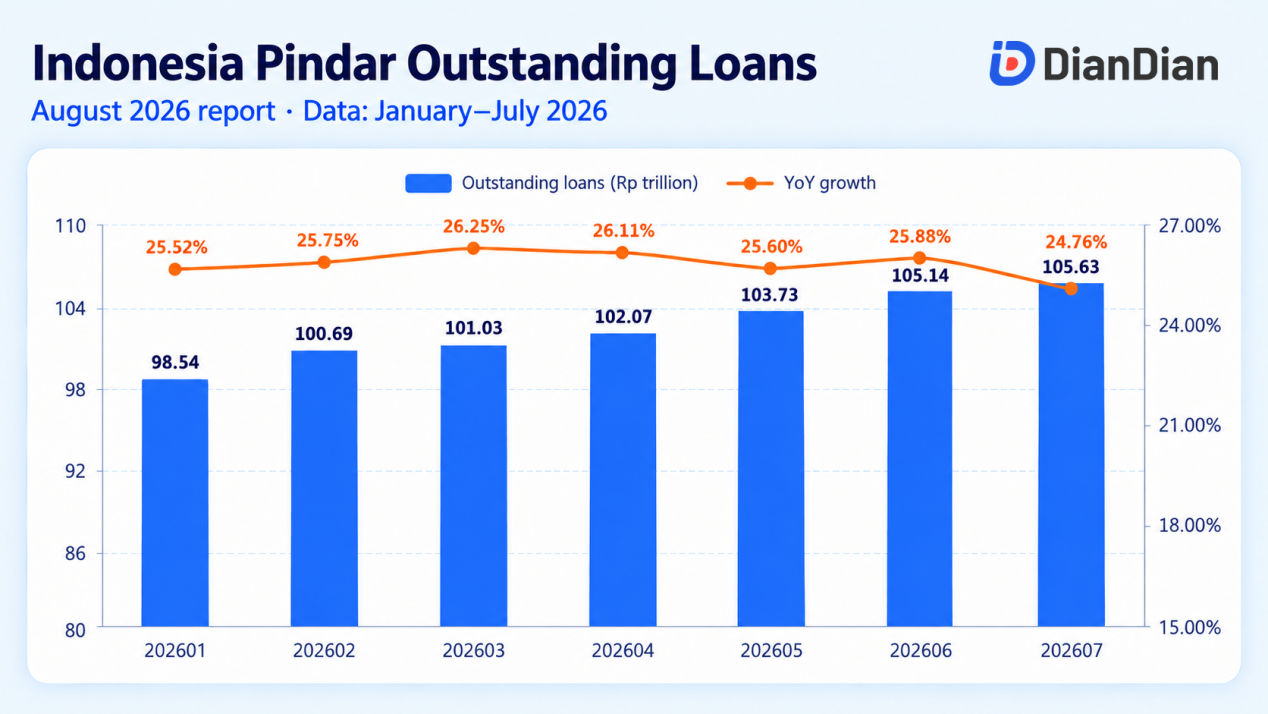
Recent data released by OJK shows that, as of July 2026, the outstanding balance of Indonesia’s Pindar (online lending) industry reached IDR 105.63 trillion, up 24.76% year on year.
The trend since the beginning of this year shows the outstanding balance rising month by month from IDR 98.54 trillion in January. By July, it had increased by approximately IDR 7.09 trillion in total.
Based on this trend and the August market environment, Diandian Data estimates that Indonesia’s Pindar loan balance will reach IDR 106 trillion to IDR 107 trillion in August, corresponding to year-on-year growth of approximately 21.0% to 22.1%, slower than in July.
This means that Indonesia’s online lending market is still expanding, but the pace of expansion has become more moderate.
What deserves closer attention next is whether user demand behind the scale growth is expanding in tandem, and which platforms ultimately receive the incremental demand.
2、User Demand: Lending Searches Are Generally Stable, While Interest in Fast Loans Has Relatively Increased
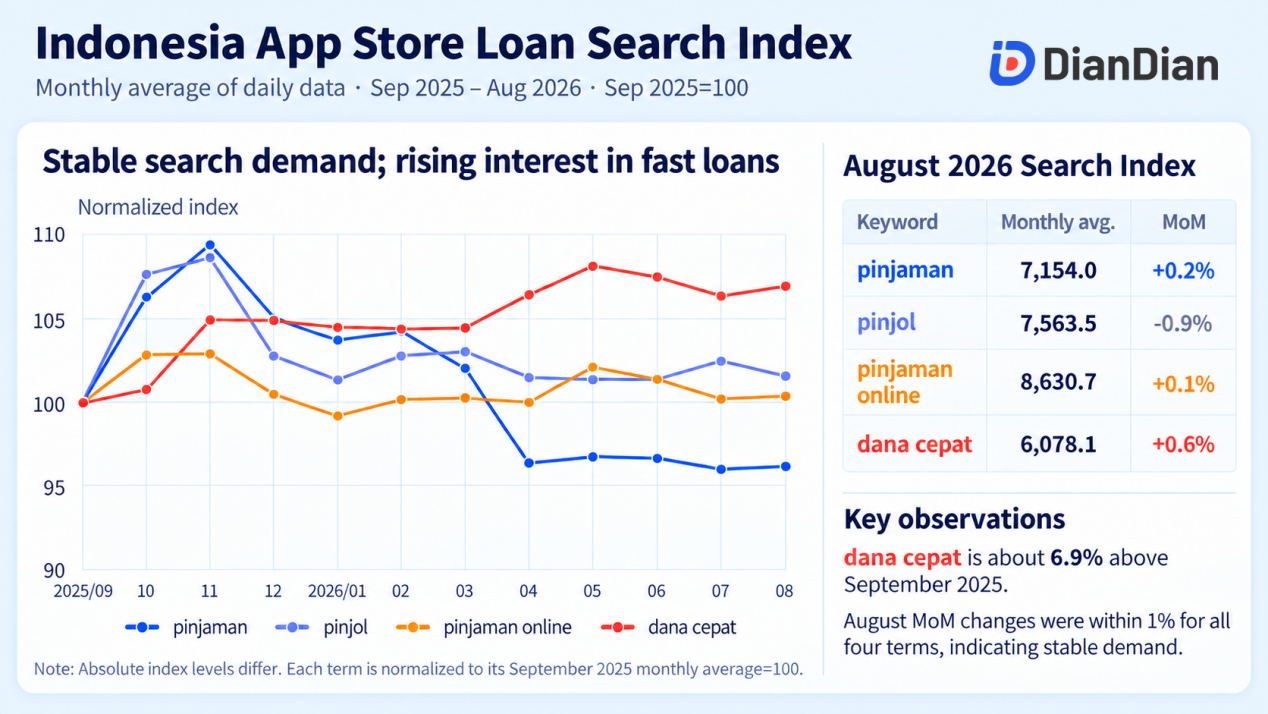
To observe changes in user demand more directly, this analysis selects lending keywords in Indonesia’s App Store—pinjaman, pinjol, pinjaman online, and dana cepat—calculates their monthly averages based on daily search indices, and normalizes each keyword to 100 at the beginning of its observation period.
The normalized results show that in August 2026, the search indices for the four lending keywords were 96.1, 101.6, 100.4, and 106.9, changing 0.2%, -0.9%, 0.1%, and 0.6% from July, respectively. Monthly changes were all small, indicating that overall search demand related to online lending remained stable without a clear expansion.
Over the past year, the dana cepat index rose 6.9% from September 2025, the largest increase among the four keywords. Pinjol rose 1.6%, pinjaman online was essentially flat, and pinjaman declined 3.9%.
This indicates that overall user interest in online lending has not expanded materially, but interest in fast-turnaround and instant-borrowing needs is relatively higher.
Accordingly, an important feature of the August market was that industry scale continued to grow while user demand did not expand notably in tandem. Under these conditions, competition among platforms is increasingly about competing for limited user traffic rather than achieving synchronized growth through overall market expansion.
Changes in the August Top 20 further show this reallocation of traffic.
3. Platform Competition: Active Users Dip Slightly as Limited Traffic Begins to Be Reallocated
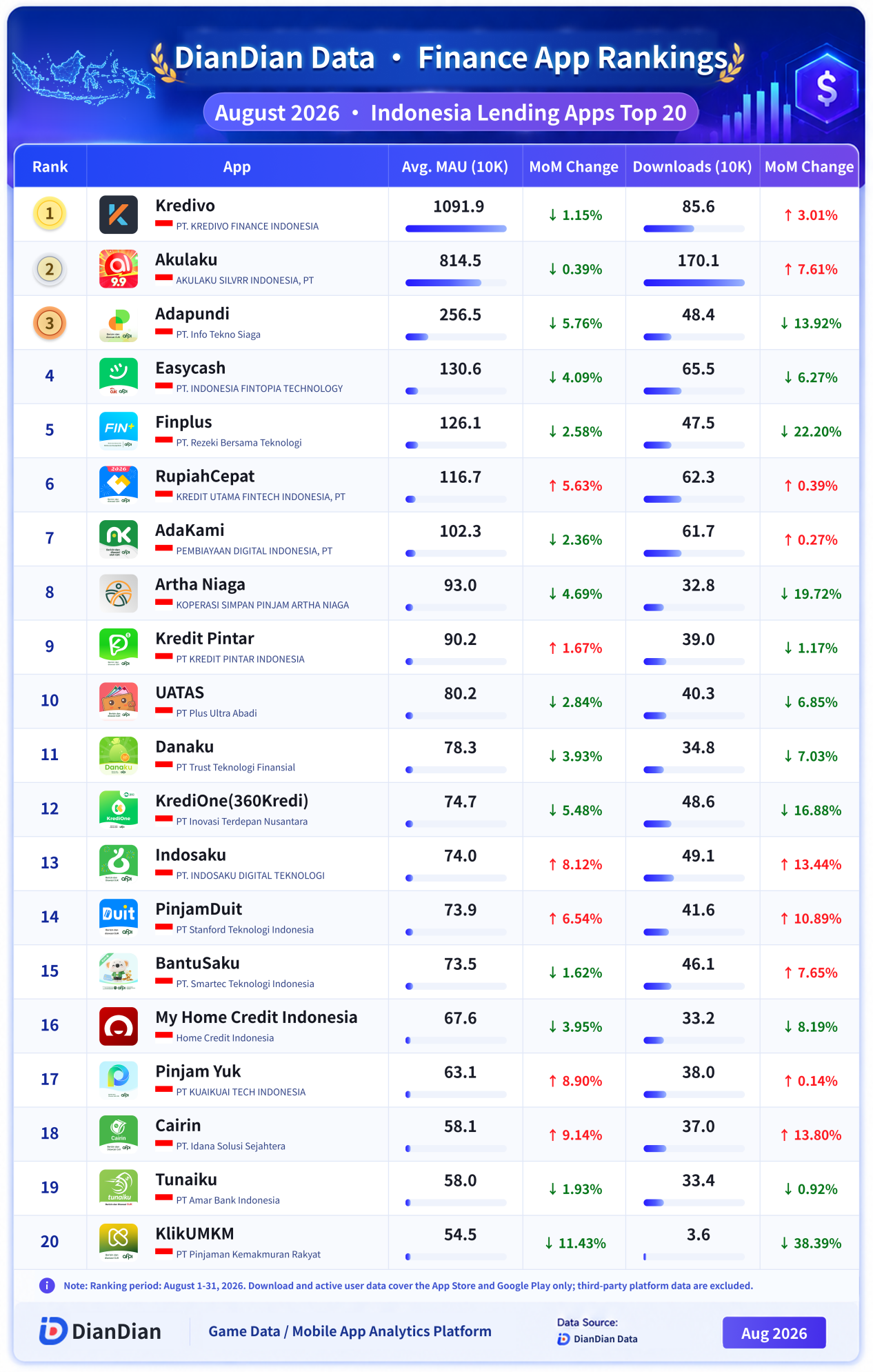
In August, the combined active users of Indonesia’s Top 20 cash-loan apps totaled approximately 35.26 million, without deduplication, down 0.2% month on month. Combined downloads reached approximately 10.1866 million, down about 2.18% month on month.
Overall, user demand remained stable, but both active users and downloads among the Top 20 declined. With new traffic not expanding materially, user performance began to diverge across platforms, and limited traffic increasingly reflected reallocation among platforms.
Leading Platforms: The Consumer-Finance Ecosystem Continues to Strengthen
The top two apps, Kredivo and Akulaku, are both known for their BNPL businesses. Their August MAUs reached 10.919 million and 8.145 million, respectively, together accounting for more than half of Top 20 active users. Since both also offer cash-loan products, they are included in the same ranking for this analysis.
In August, both platforms continued to operate around their consumer-finance ecosystems.
Kredivo moved KrediMall, bill payment, and promotional entrances forward, and partnered with Mister Aladin to launch PayLater travel offers. Akulaku introduced the Alika AI assistant, further integrating shopping recommendations, PayLater services, and bill management.
Downloads of the two apps grew 3.0% and 7.6%, respectively, during the month, partially easing the overall decline in Top 20 downloads.
The performance of leading platforms shows that when overall new traffic is under pressure, deeper integration of consumption scenarios, payments, and credit products remains an important way for them to maintain user activity.
Upper-Mid-Tier Platforms: New Downloads and Active Users Mostly Under Pressure, While RupiahCepat Explores a Niche Audience
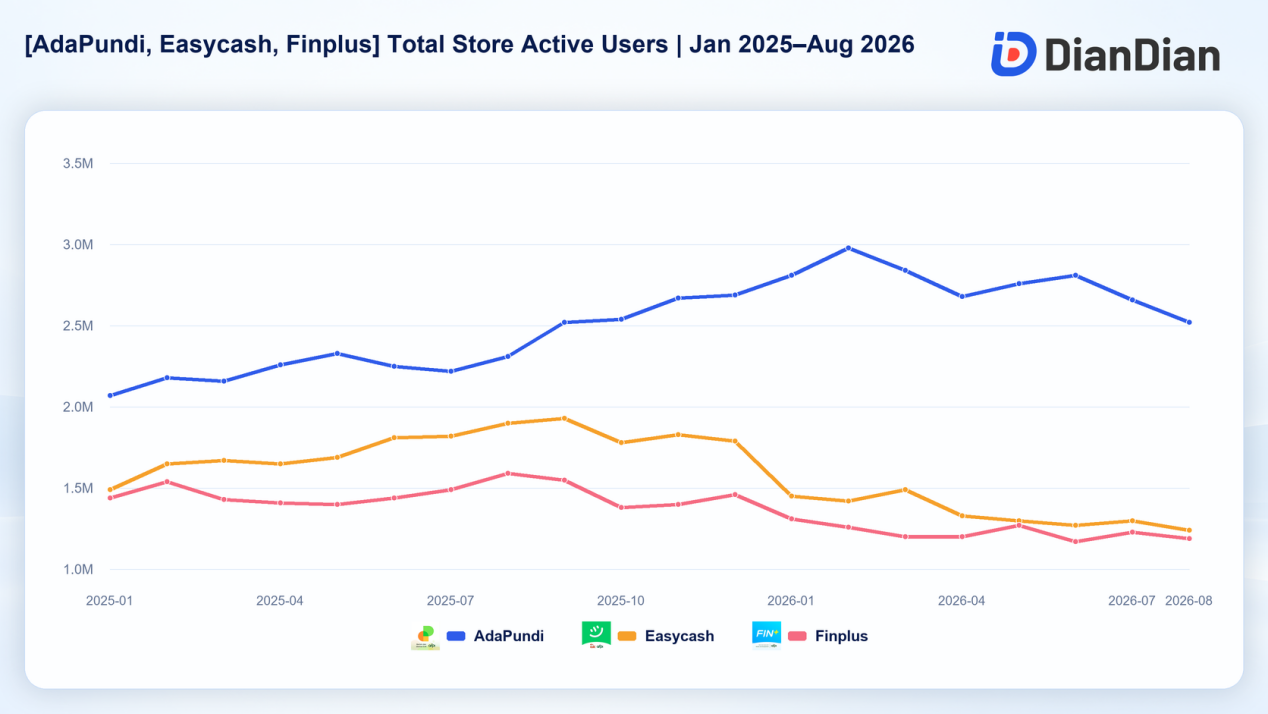
Adapundi, owned by Yinspark Technology, ranked third with 2.56 million active users. However, its August MAU declined 5.8% month on month and downloads fell 13.9%, with both active and acquisition metrics declining simultaneously.
Easycash and Finplus ranked fourth and fifth, with MAUs of 1.306 million and 1.261 million, respectively. Both saw active users decline in August. Finplus downloads fell 22.2% month on month, showing a more pronounced contraction on the acquisition side.
Compared with leading platforms, the changes among upper-mid-tier platforms more directly show that when new market traffic is limited, differences first appear in customer-acquisition ability and the ability to retain existing users.
RupiahCepat, owned by Mobi Magic, ranked sixth, with approximately 1.167 million monthly active users in August, up 5.6% month on month, while downloads rose 0.4%.
Its download change was limited, but MAU still grew, suggesting a greater contribution from existing-user activity or repeat borrowing.
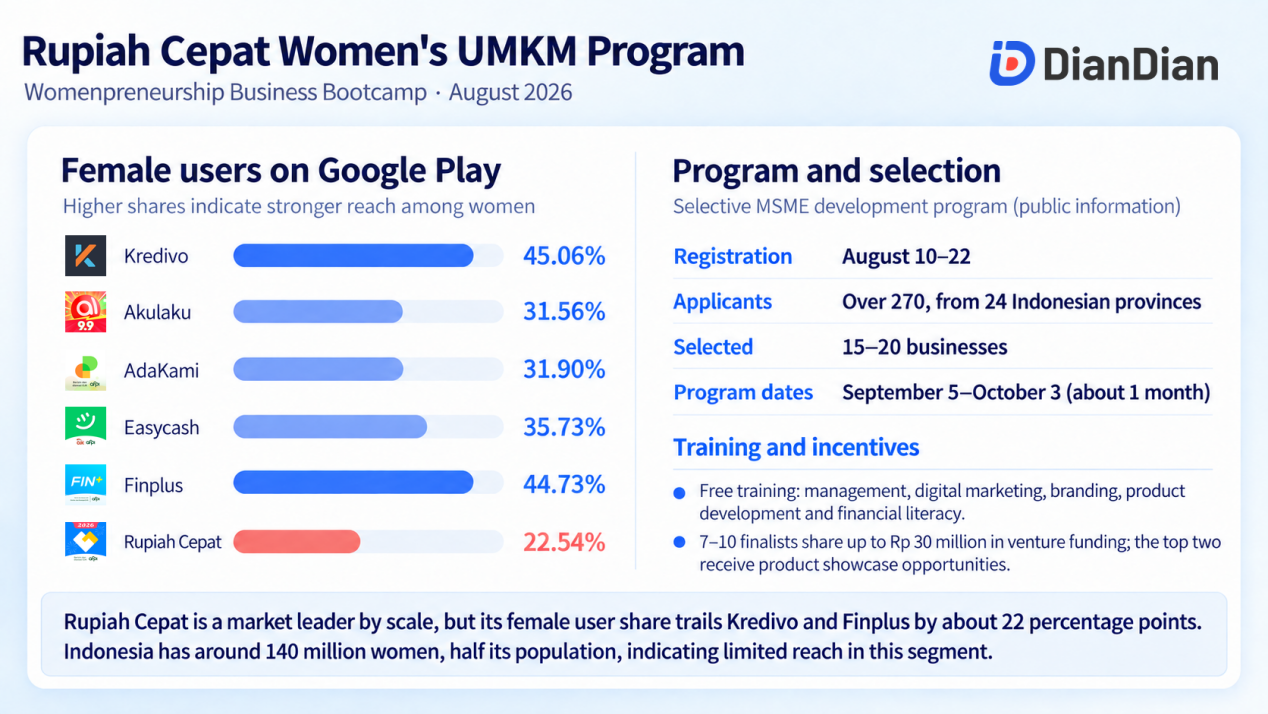
According to Diandian Data monitoring, women account for only 22.54% of its Google Play user base, a relatively low share among major platforms and approximately 22 percentage points below Kredivo and Finplus.
To reach this audience, RupiahCepat launched recruitment in August for the Womenpreneurship Business Bootcamp, attracting more than 270 applicants from 24 provinces.
This shows that through entrepreneurship training and business support, the platform is strengthening its connection with women micro- and small-business operators. For RupiahCepat, which has a relatively low proportion of female users, such offline activities are also a way to reach niche audiences and build brand awareness.
Mid-Tier Platforms: Rankings Are Close, but New Traffic Has Already Diverged
Changes among mid-tier platforms better reveal the structural features of traffic competition.
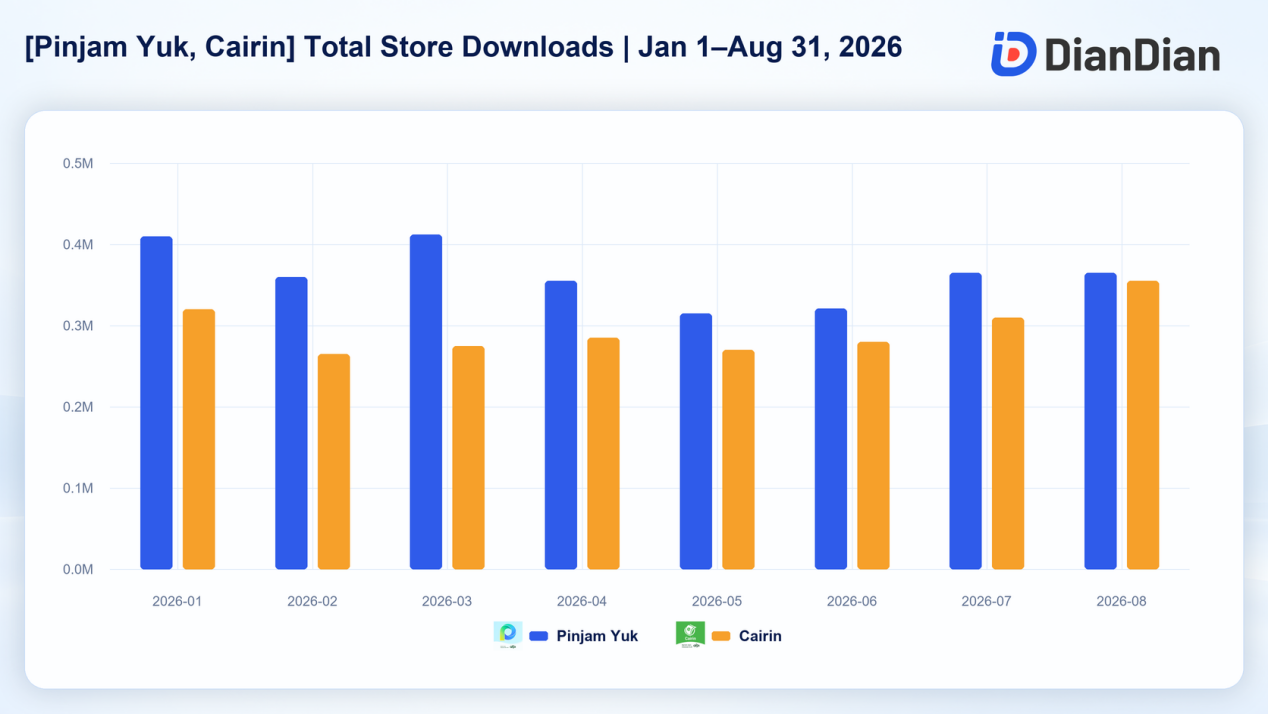
Take Pinjam Yuk and Cairin as examples. They ranked 17th and 18th, respectively, with August active users of approximately 631,000 and 581,000. Pinjam Yuk was temporarily ahead.
However, Cairin grew faster in terms of new traffic.
Cairin recorded 369,600 downloads in August, up 13.8% month on month. Pinjam Yuk had slightly more downloads in absolute terms, at 379,600, but growth was only 0.1%.
In other words, the two apps currently have similar active-user scales, but a clear difference has already emerged in new traffic.
For mid-tier platforms, the speed of acquiring new users may reflect changes in the competitive landscape earlier than current active-user scale does.
If this difference persists, it may subsequently be transmitted to MAU and ranking positions.
Bottom of the Ranking: Promotion Changes Still Translate Quickly into Active Performance
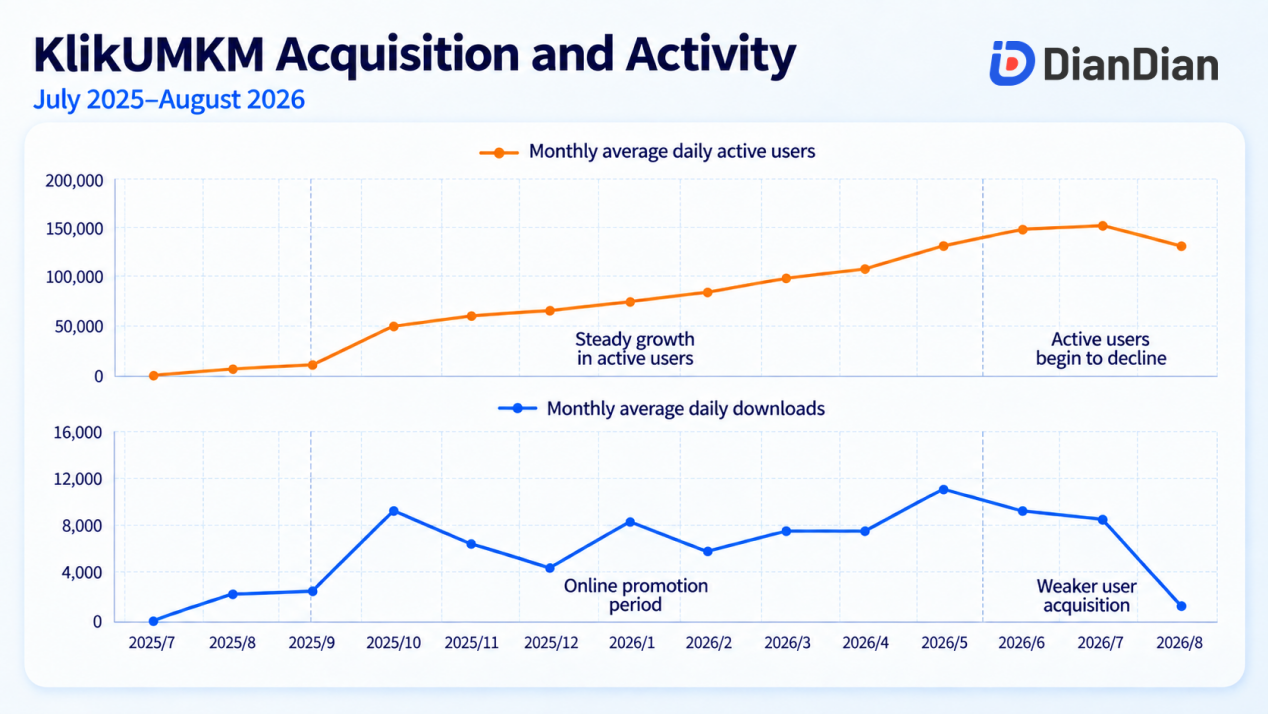
In August, KlikUMKM had 544,500 active users and ranked 20th, down 11.43% month on month but up 1,573.56% from the same period last year. Downloads fell 38.39% month on month, although its ranking improved significantly from 107th in the same period last year.
Historical download trends show that KlikUMKM’s average daily downloads rose notably from September 2025, at one point reaching approximately 10,000, while active users grew in tandem. After July 2026, average daily downloads fell clearly to 1,000–2,000 per month, and active users declined accordingly.
Therefore, KlikUMKM’s August change was closer to a pullback after lower promotional intensity. It also shows that under the current competitive environment, changes in traffic investment can still quickly pass through to platform activity.
Across the Top 20, 13 apps saw active users decline month on month in August, while only seven grew. Market demand did not expand materially, but traffic performance has already diverged across platforms.
Beyond the competition for traffic, platforms must also consider whether incoming users can truly become business assets.
04 Business Conversion: Platform Competition Extends from Traffic Acquisition to the Funding Chain
This conversion process—from credit approval and disbursement to repayment—depends at every stage on stable support for fund collection and payment flows. For Indonesia’s Pindar industry, these flows mainly rely on bank accounts, escrow accounts, virtual accounts, and payment gateways. Platforms need stable and compliant system connections with banks and payment service providers.
As online credit businesses expand, risk identification and handling in the payment process are also receiving continued regulatory attention. Bank Indonesia has required BI-FAST participants to improve fraud detection, abnormal-transaction monitoring, and emergency response mechanisms. OJK disclosed that by the end of August, the Indonesia Anti-Scam Centre had received 668,441 financial-fraud reports and verified more than 1.276 million accounts. (Note: This figure reflects Indonesia’s overall digital-finance environment and does not directly correspond to the Pindar industry.)
This means that platform competition occurs not only in user acquisition but also across the funding chain, including disbursement, repayment, reconciliation, and abnormal-transaction handling. For operating institutions, payment settlement is not merely about adding funding channels; it must also ensure stable operation of core links while meeting fund-security and regulatory requirements.
In a market where traffic competition is intensifying and overall user demand is stable, whether the funding chain can reliably support incremental business will also affect how efficiently platforms convert users into actual business.
5. Delisted Apps: Silent Long-Tail Players Gradually Exit, but Platform-Lifecycle Risks Remain
If the rankings above show how active platforms compete for limited traffic, app delistings and listings offer another perspective on the condition of existing platforms in the market.
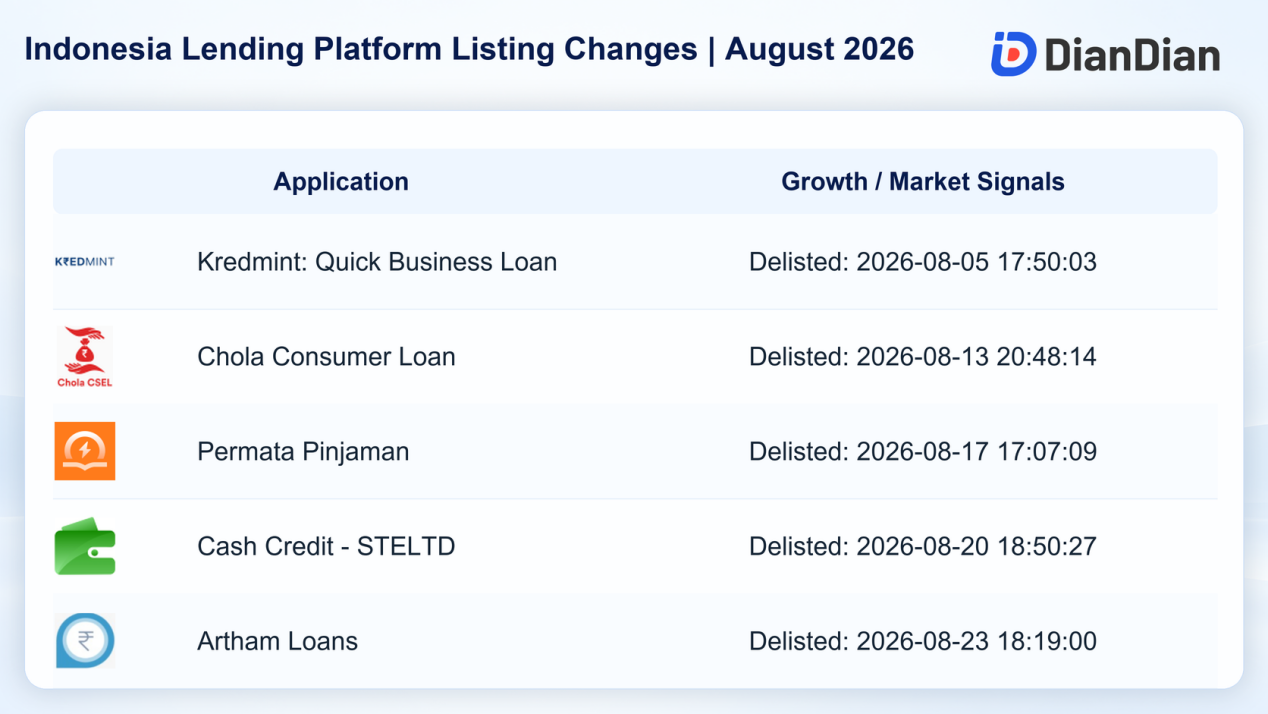
Diandian Data has long monitored the listing and delisting activity of lending platforms in Indonesia. In August 2026, typical delisted credit apps included Kredmint, Chola Consumer Loan, Permata Pinjaman, Cash Credit, and Artham Loans. The delistings were concentrated between August 5 and 23.
All five apps provided actual credit services, covering small-business loans, cash loans, personal loans, and consumer loans. Artham Loans and Chola Consumer Loan had last been updated two or three years ago, and their long lack of version maintenance was a notable common feature.
Compared with active platforms in the rankings that continue to acquire users, update products, and compete for traffic, these delisted apps are closer to long-tail or silent platforms without sustained operations, and therefore have limited direct impact on the current competitive landscape.
What deserves more attention is platform-lifecycle risk.
It is common for one institution to operate multiple app packages, and some poorly maintained apps may still carry a certain stock of users. If they cannot continuously adapt to regulatory requirements and app-store rules, or have shortcomings in privacy policies, data security, or third-party SDK management, their lifecycles may shorten further.
Therefore, app delistings do not mean that market demand is declining. What deserves closer attention is that as leading and mid-tier platforms continue competing for limited traffic, long-tail apps without sustained operating capabilities may gradually withdraw from mainstream competition.
6. Conclusion: The Market Is Still Expanding, but Platform Competition Is Shifting toward Traffic Reallocation
The core story of Indonesia’s cash-loan market in August is not market scale itself, but that market growth and platform growth have begun to diverge.
On the one hand, the outstanding Pindar balance is expected to continue growing, and industry scale remains in an expansionary phase. On the other hand, lending-keyword search indices remained generally stable, indicating that user demand did not expand materially in tandem.
With limited incremental demand, competition among platforms is increasingly expressed as a contest for limited traffic. Top 20 active users fell 0.2% month on month and downloads declined 2.18%; 13 apps saw active users fall while only seven grew, showing that industry growth has not been distributed evenly across platforms.
Therefore, the market question is no longer only how much further it can grow, but who ultimately receives the limited traffic and whether platforms can convert that traffic into sustainable business.
From this perspective, loan balances reflect market scale, search indices reflect user demand, ranking changes reflect traffic allocation, while payment settlement, data governance, and sustained operating capabilities determine whether platforms can truly absorb new business.
For institutions operating in the market, Indonesia’s cash-loan market remains in an expansionary phase, but the competitive logic is gradually shifting from “shared incremental growth driven by market expansion” to “platform reallocation under limited traffic.”