
Union
Store

A
Tencent 2026 H1: Domestic Games and Advertising Power 70% of Q2 Incremental Revenue, While AI Starts Facing the Numbers
Diandian_official
08/21/2026
1490

Tencent's 2026 H1 results showed steady growth, but more important than the increases in revenue and profit is where exactly that growth came from.


In 2026 H1, Tencent's revenue reached RMB 401.243 billion, up 10% year on year; gross profit reached RMB 229.698 billion, up 12%; and non-IFRS operating profit reached RMB 151.263 billion, up 9%. Based on the disclosed figures, first-half gross margin was approximately 57.2%, nearly 0.9 percentage points higher than in the same period last year. Overall, Tencent's financial performance in the first half continued the steady growth expected by the market.


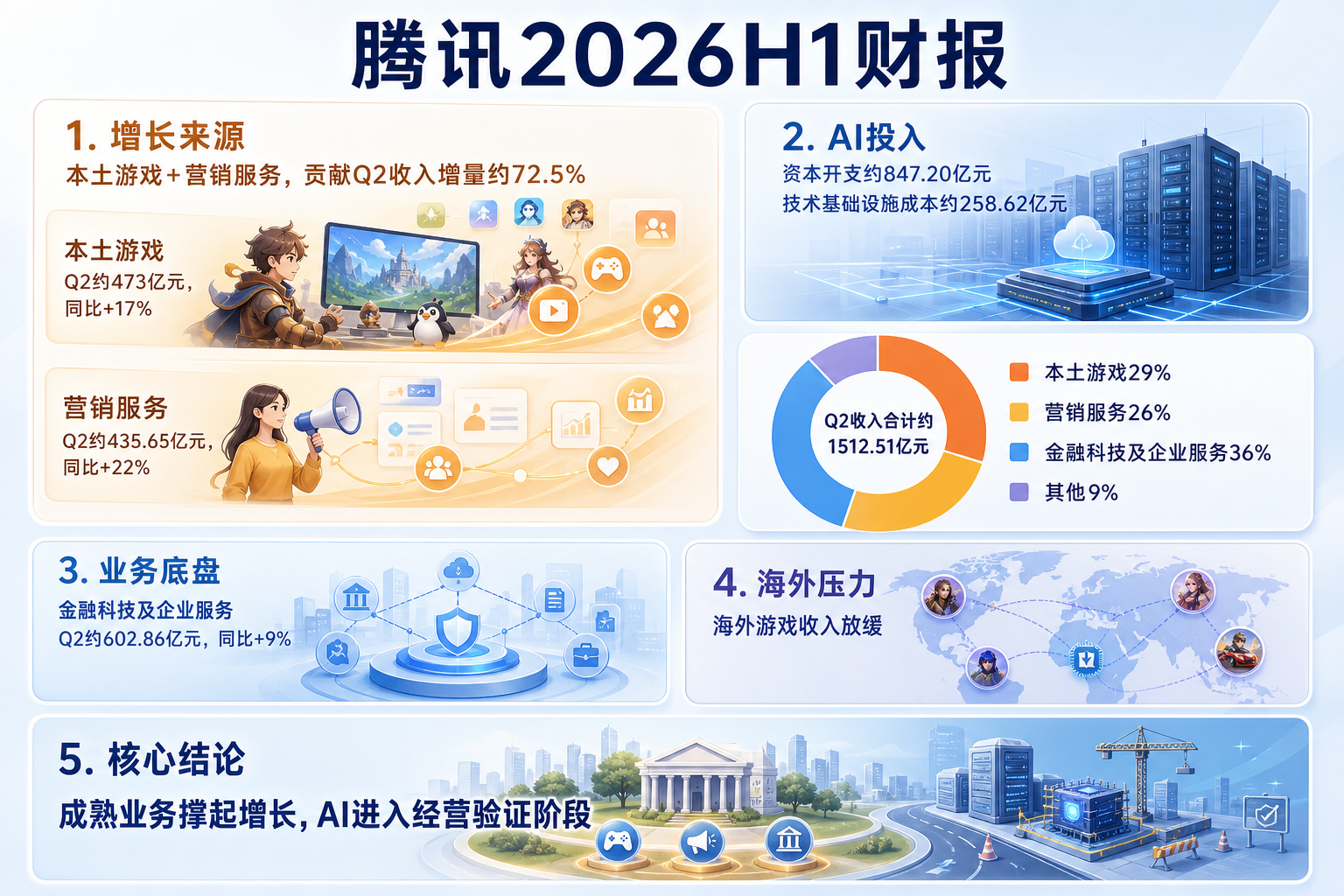
A semiannual report presents Tencent's overall operating results. Looking at the second quarter alone makes it easier to see which businesses were providing incremental growth as the first half ended. Tencent's revenue was approximately RMB 184.5 billion in the second quarter of 2025 and rose to about RMB 204.8 billion in the second quarter of 2026, an increase of roughly RMB 20.3 billion. Domestic-market game revenue increased by RMB 6.9 billion, while marketing-services revenue increased by RMB 7.803 billion. Based on a rough calculation using the disclosed figures, the two businesses contributed a combined RMB 14.703 billion, or 72.5% of Tencent's Q2 incremental revenue.


These figures outline Tencent's current growth structure. WorkBuddy, an office AI agent; Yuanbao, a consumer-facing AI assistant; and Hunyuan, Tencent's AI foundation model, have opened product space for Tencent's next stage, while games and marketing services remain the main sources of current growth. AI's role is also changing: it is entering the revenue chains of advertising and cloud services while beginning to affect profit margins, capital expenditure, and cash flow.


The most notable change in Tencent's 2026 H1 results is therefore that different businesses are beginning to show a clearer division of labor: domestic games and marketing services drive growth; overseas games have entered a phase of slower growth and product divergence; fintech and business services provide a stable base; and AI is moving from product planning toward operational validation.


I. Domestic Games Contribute One-Third of Incremental Revenue as Overseas Markets Shift Gears

In the second quarter, domestic-market game revenue was RMB 47.3 billion, up 17% year on year and 4% quarter on quarter. It increased by RMB 6.9 billion from the same period last year, accounting for approximately 34% of Tencent's total Q2 incremental revenue.


Key quarterly comparisons of Tencent's domestic game revenue growth


Growth came from the coordination of a group of products. From 2023 to 2025, Tencent's annual domestic game revenue rose from RMB 126.7 billion to RMB 139.7 billion and RMB 164.2 billion, while the year-on-year growth rate increased from 2% to 10% and 18%. By 2026 Q2, evergreen titles such as Honor of Kings and Game for Peace continued to provide the foundation, while Delta Force, the VALORANT series, and Rock Kingdom: World took over the incremental growth. The financial report also noted that the average daily active accounts of Delta Force and VALORANT reached new highs in Q2.


This combination further strengthened the multilayered structure of Tencent Games: evergreen products maintain the base, growth products provide incremental revenue, and multi-platform operations extend the reach and revenue cycle of IP.


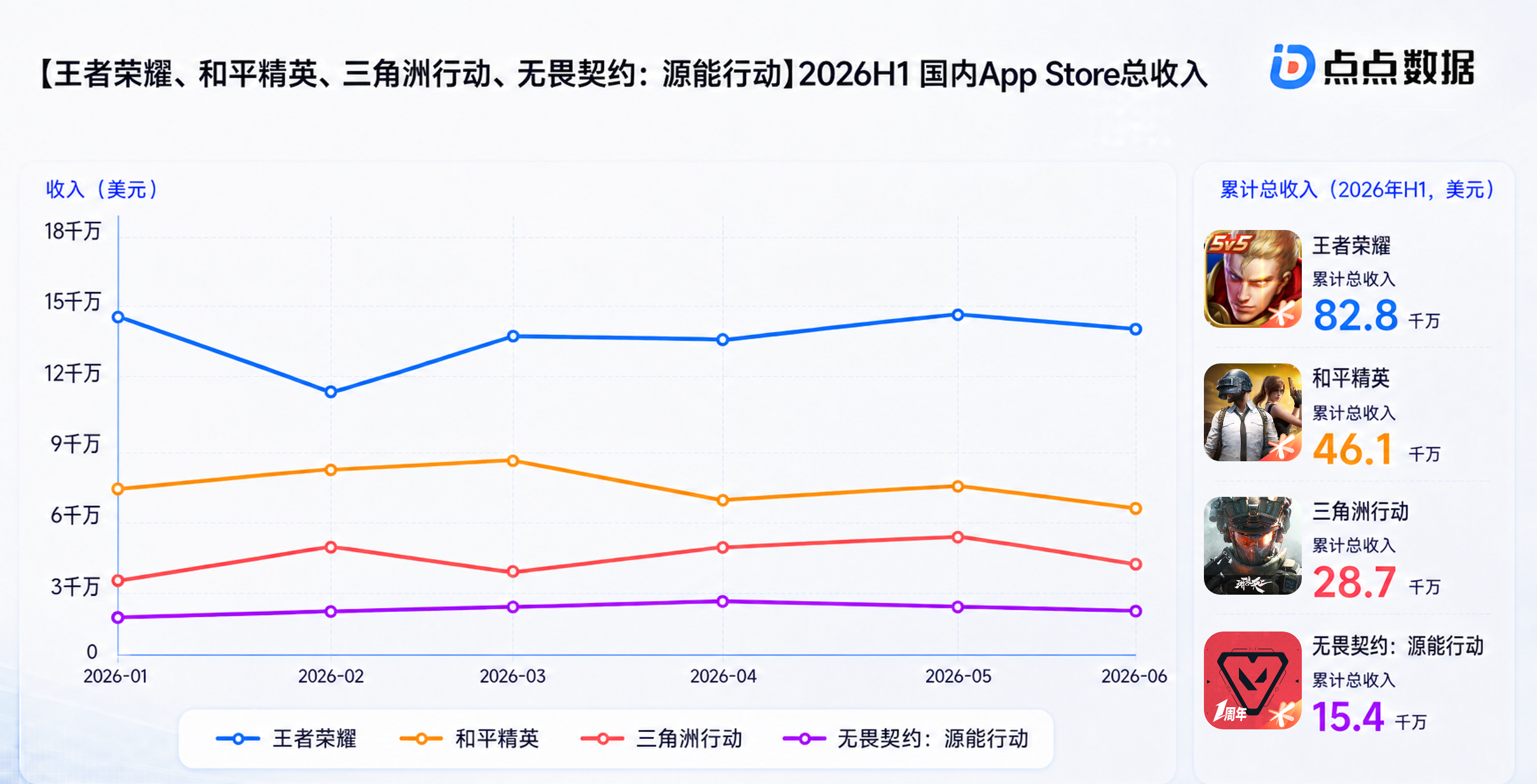
This is consistent with observations from Diandian Data. First, the evergreen games: in 2026 H1, estimated average monthly App Store revenue in China for Honor of Kings, Game for Peace, Delta Force, and VALORANT: Energy Operation was approximately US$137.94 million, US$76.81 million, US$47.90 million, and US$25.61 million, respectively. The four products are at different life-cycle stages and, from a mobile perspective, also show the product tiers among Tencent's leading games.


[Honor of Kings, Game for Peace, Delta Force, VALORANT: Energy Operation] Total China App Store Revenue in 2026 H1


Among new products, Rock Kingdom: World is the one most worth highlighting. According to Diandian data, the product opened pre-downloads on March 22. Its App Store daily active users in China then climbed rapidly, reaching a period peak of approximately 936,100 on April 5. After interest cooled, average daily active users from April to June were about 595,100, 407,500, and 335,600, respectively, while daily active users were still around 265,400 on June 30. This trajectory demonstrates both the launch power of a classic IP and the fact that the game was not merely a short-lived user-acquisition product, but has the potential to become an evergreen title.


[Rock Kingdom: World] Daily Active Users on the China App Store, March 22–June 30, 2026


Compared with the joint growth of multiple products in the domestic market, Tencent's overseas games showed much clearer product divergence in the first half.


In the second quarter, Tencent's overseas game revenue was RMB 18.6 billion, slightly below RMB 18.8 billion in the same period last year. At reported exchange rates, revenue fell 0.8% year on year; at constant exchange rates, it grew 4%. Exchange rates had a certain impact on reported revenue, while the underlying growth rate of overseas games had also slowed noticeably. In the second quarter of 2025, Tencent's overseas game revenue grew 35% at reported exchange rates and 33% at constant exchange rates. One year later, constant-currency growth had fallen to 4%, meaning Tencent's overseas games had moved out of the previous year's high-growth range.


The product performance disclosed in the financial report also reflected this change. In the second quarter of 2025, games from Supercell, PUBG MOBILE, and Wuthering Waves jointly drove growth in overseas game revenue. By the second quarter of 2026, Wuthering Waves and VALORANT continued contributing growth, while revenue from some Supercell games declined. Considering that products such as Clash Royale had temporarily strengthened in 2025 and raised the comparison base, the pullback in 2026 Q2 was closer to normalization after a breakout, which also explains why overseas game growth shifted gears so clearly.

The three overseas mobile games covered by Diandian data further illustrate the different rhythms among products.


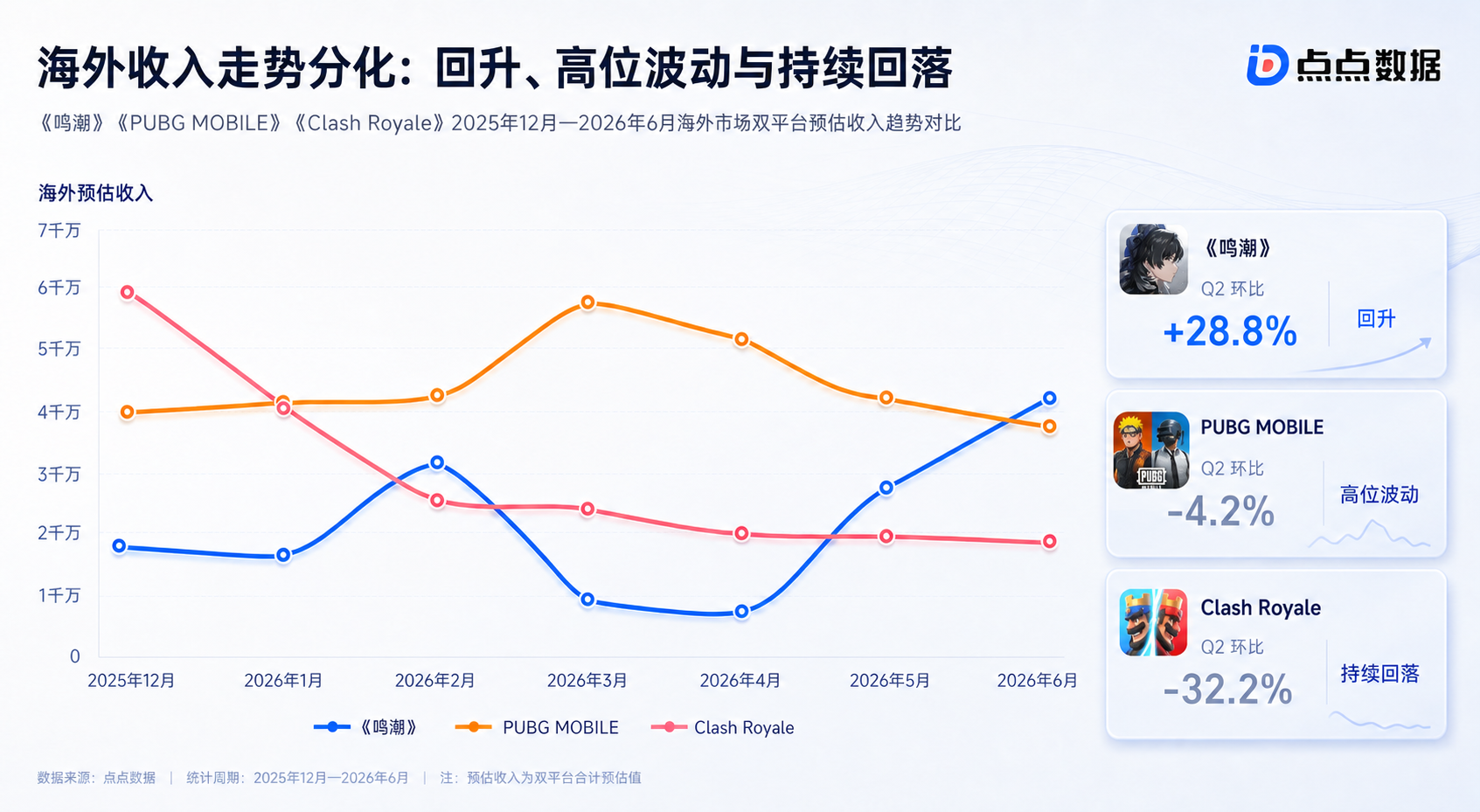
Estimated overseas revenue on both platforms for Wuthering Waves, PUBG MOBILE, and Clash Royale, December 2025–June 2026


Looking at quarterly performance, estimated overseas revenue for Wuthering Waves in 2026 Q2 grew 28.8% quarter on quarter, while PUBG MOBILE fell 4.2% and Clash Royale fell 32.2%. The three products therefore showed recovery, fluctuation at a high level, and continued decline, respectively.


Domestic and overseas games thus showed two different rhythms: the domestic market expanded revenue through a combination of evergreen products and new releases, while overseas games entered a phase of slower growth and product divergence. The future strength of Tencent Games' growth will depend simultaneously on whether domestic new releases can sustain their performance and whether the overseas product portfolio can generate new synergies.


II. AI Enters Operational Validation, With WorkBuddy First Delivering a User-Side Answer


Games explain where Tencent's current growth comes from; AI determines where Tencent is directing incremental profit and cash.


Tencent's AI business has now entered three different stages: advertising and cloud services are beginning to show revenue impact; models and infrastructure are entering the cost base; and native applications such as WorkBuddy are beginning to test their commercialization potential. The recent push into agents by DeepSeek and ByteDance also makes Tencent's product pace more worth watching. In the early model race, Tencent did not have the strongest market voice; but as global AI competition fully enters the agent era in 2026, Tencent has successfully opened the domestic market through WorkBuddy, with user growth, long-term retention, and willingness to pay all effectively validated.


In the second quarter, Tencent reported non-IFRS operating profit of RMB 75.636 billion, up 9% year on year, with an operating margin of 37%. Excluding the financial impact of new AI products such as Hunyuan, Yuanbao, CodeBuddy, WorkBuddy, and Xiaowei, operating profit would have been RMB 86.1 billion, up 19%, with an operating margin of 42%. The two measures differed by approximately RMB 10.5 billion, representing the net impact of revenue, costs, and expenses from the entire new-AI-product portfolio. These figures give the outside world a more direct view of how AI products affect Tencent's profit conversion: the core businesses are still growing, while R&D, promotion, and usage costs for new products have already begun to occur in parallel.


Comparison of Tencent's two Q2 non-IFRS operating-profit measures


Expenses and infrastructure further outline the intensity of investment. Q2 sales and marketing expenses grew 26% year on year, with the increase mainly coming from promotion of games and AI-native products. General and administrative expenses grew 22%, including Hunyuan model upgrades and WeChat AI R&D. In 2026 H1, technology-infrastructure operating costs reached RMB 25.862 billion, up approximately 81% year on year.


Changes in capital expenditure and cash flow are even more direct. Capital expenditure reached RMB 84.720 billion in 2026 H1, already exceeding the RMB 79.198 billion recorded for all of 2025. Free cash flow was negative RMB 13.8 billion in 2026 Q2; excluding prepayments for computing-power purchases, free cash flow was RMB 37.6 billion.


The actual figure reflects the cash expenditure Tencent genuinely incurred during the period, while the adjusted figure shows that the core businesses still generate cash. Taken together, they present the time lag of AI investment: computing power and infrastructure first create cash outflows, while the corresponding revenue returns require a longer period of validation.


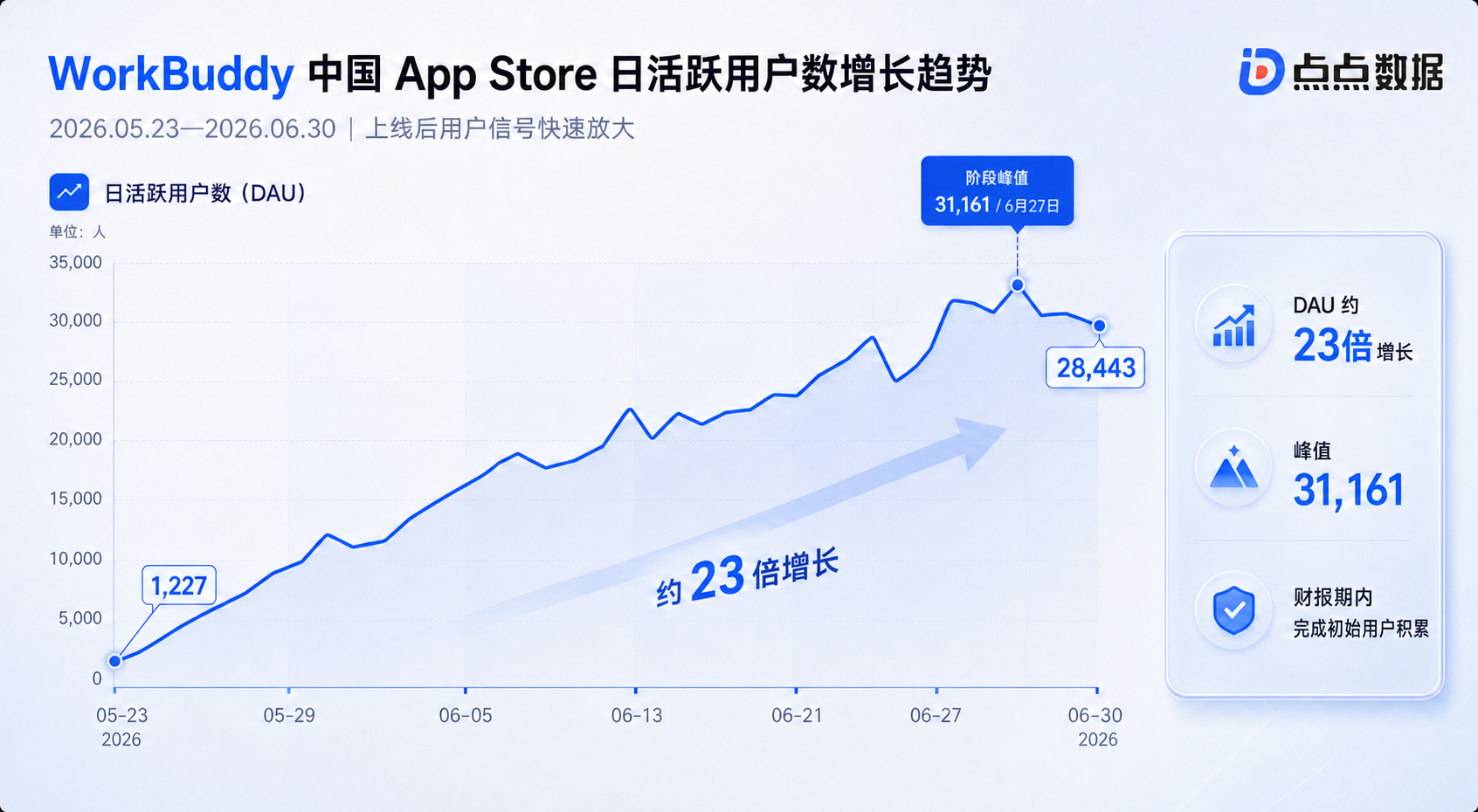
Tencent's flagship AI product for C-end users, WorkBuddy, also launched on mobile on May 21. Diandian data shows that from May 23 to June 30, WorkBuddy's daily active users on the China App Store rose from 1,227 to 28,443, expanding to approximately 23 times the initial level, and reached a period peak of 31,161 on June 27. Considering that most WorkBuddy users are concentrated on PC and that the mobile version is essentially a 'remote control' that cannot function independently of the PC version, the rapid growth in daily active users also reflects the product's accumulation of users in the Chinese market.


[WorkBuddy] Daily Active Users on the China App Store, May 23–June 30, 2026


Retention also sent positive signals. Day-1, Day-7, and Day-30 retention for newly installed WorkBuddy users was 32.08%, 12.34%, and 6.04%, respectively, compared with category averages of 19.54%, 7.70%, and 3.92% for tool apps over the same period.


[WorkBuddy] Retention of New Installs in China, May–June 2026


Tool apps are a broad reference category, but WorkBuddy's lead at multiple retention checkpoints still indicates that its first users showed a stronger willingness to keep using it.


Tencent said in its financial report that users showed strong willingness to pay through subscriptions and purchases of tokens. The key data points for WorkBuddy going forward will be paying users, payer rate, ARPU, token consumption, renewals, and customer-acquisition cost. Activity and retention show that users are willing to use the product; payment and unit economics will answer whether WorkBuddy can form an independent commercialization loop.


III. Advertising Adds RMB 7.8 Billion as WeChat Monetization Is Driven by Multiple Variables


WorkBuddy is still waiting for payment data, but the commercial returns from AI in Tencent's mature businesses are already easier to observe, with marketing services being the clearest example. In terms of incremental revenue, it is another main growth line alongside games.


Marketing-services revenue was RMB 43.565 billion in 2026 Q2, up 22% year on year and RMB 7.803 billion from the same period last year, accounting for approximately 38% of Tencent's total incremental revenue in the quarter.

This round of growth was first built on usage within the WeChat ecosystem. As of the end of June, combined monthly active users of Weixin and WeChat reached 1.439 billion, up 2% year on year; total user time spent on Channels grew by more than 20%. Growth in the WeChat user base has slowed, but time spent on Channels continues to expand. More content viewing creates more advertising exposure and monetization opportunities for Tencent.


The second factor is transaction scenarios. Channels, Mini Programs, Weixin Search, and Weixin Stores place content, advertising, and transactions in the same ecosystem. After seeing content, users can enter a Mini Program or store to complete a conversion, while advertisers can track campaign results more easily. For the platform, this path extends a single traffic exposure into subsequent transaction opportunities.


Based on a summary of Diandian data and conversations with industry practitioners, Channels' commercial appeal mainly comes from relatively stable traffic and a shorter monetization path between content, private-domain operations, and transactions. Tencent once used Weishi to compete in the standalone short-video app market. After Weishi failed to establish a lasting advantage, Channels, launched in 2020, shifted the strategic focus back to the WeChat ecosystem. Today, Channels' user time is up more than 20% and marketing-services revenue is up 22%, showing that the shift from standalone-app competition to ecosystem-native growth has begun to deliver commercial results.


Beyond traffic and transaction scenarios, AI is further improving ad-recommendation and campaign-delivery efficiency. Tencent said that AI advertising-recommendation models, the AIM+ upgrade, and integrated marketing capabilities within the WeChat ecosystem jointly drove business growth. AIM+ can already provide Weixin Stores and short-drama advertisers with end-to-end campaign capabilities covering targeting, bidding, creative assets, and landing pages.

After WeChat's user-base growth entered a low-speed phase, Tencent can still seek incremental growth through time spent, advertising inventory, transaction links, and recommendation and delivery efficiency. Tencent's 22% Q2 growth must also be understood as the combined result of changes in these factors.


The quality of growth still depends on gross margin. Q2 marketing-services gross margin was 57%, below 58% in the same period last year. Tencent said that revenue growth from AI marketing capabilities basically offset the AI infrastructure costs required for advertising and content recommendation. This means AI marketing capabilities are beginning to show revenue effects, while additional computing and recommendation costs are also entering the accounts. In the next stage, the key for marketing services will be converting revenue growth into further gross-margin improvement.


IV. Fintech Protects the Base, While Cloud Services Provide Another Growth Line


Fintech and business services do not have the high growth rates of games and advertising, but they form one of Tencent's most stable business foundations.


The segment generated revenue of RMB 60.286 billion in 2026 Q2, up 9% year on year, and gross profit of RMB 31.422 billion, with gross margin holding at 52%. From an annual perspective, gross margin rose from 40% in 2023 to 47% in 2024 and 51% in 2025. Efficiency improvements accumulated over the past several years have become a more stable profit base.


Fintech growth mainly came from commercial payments, wealth management, and consumer-loan services, reflecting transaction activity and financial demand. Business services were mainly driven by cloud-revenue growth, backed by AI-related service demand, overseas expansion, and a more favorable pricing environment.


This segment has two types of value for Tencent. Payments and financial services provide a relatively stable revenue base, while cloud services bring AI demand into B2B revenue through computing services, model calls, and enterprise solutions. Because Tencent does not separately disclose cloud revenue, the share of AI cloud, or customer renewal rates, the scale and profit quality of this growth line will require more operating data.


For overseas SaaS and enterprise-services teams, this represents another path to AI commercialization: embedding model capabilities into existing enterprise workflows and earning revenue through computing, delivery, and solutions. Enterprise customers ultimately care about whether systems can run reliably, reduce costs, and create quantifiable business value. Tencent Cloud is benefiting simultaneously from AI demand, overseas expansion, and improved pricing, which also reminds developers to put product capability, delivery capability, and commercial pricing on the same P&L.


Conclusion


Tencent's 2026 H1 report is still one in which mature businesses drive growth. Domestic games and marketing services contributed roughly 70% of Q2 incremental revenue, fintech and business services protected the base, while overseas games exposed product-cycle and exchange-rate pressure. AI has entered revenue, profit, and cash flow, but before it can become an independent growth engine, it still has to pass two tests: revenue scale and return on investment.

Tencent's latest financial report offers a clear illustration of how platform companies grow: they build multiple revenue sources from evergreen products, content traffic, transaction scenarios, and enterprise customers, then use these mature capabilities to support trial and error with new products. As for the AI story, although it is still being narrated and mapped out, it will eventually come down to the most basic operating questions: Why do users stay? What are they willing to pay for? And how much R&D, acquisition, and inference cost is required for every yuan of revenue?