文
A

In July 2026, the Philippine cash-loan market finally saw the regulatory expectations that had been hanging over it take effect.
On July 7, the Philippine Securities and Exchange Commission (SEC) officially issued MC 20 (2026), deciding to lift, effective August 1, the moratorium on registering new Online Lending Platforms (OLPs) that had been in place for nearly five years since November 2021. It also clarified that newly established OLPs must disclose and register touchpoints including the platform name, brand, website, app, and domain with the SEC, while strengthening requirements for capital, business plans, operations, and consumer protection.
The new rules also set limits on the number of platforms: a single lending company (LC) or financing company (FC) may operate no more than five OLPs, with the permitted number directly linked to paid-in capital.
A Regulatory Shift: The Market Response to Moving From Blocking to Channeling
It is worth recalling that during these years of suspending new registrations, the SEC's cleanup did not stop. It continued removing unregistered and non-compliant platforms, revoked the registrations of more than 2,000 lending and financing companies, and worked with Google to remove unregistered OLP apps.
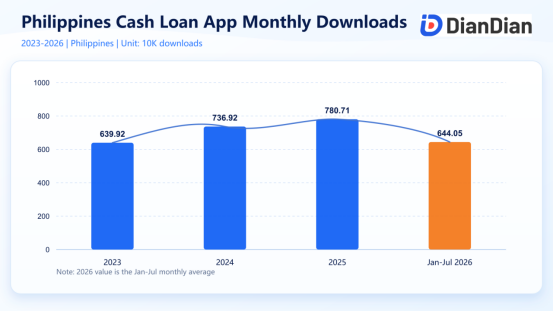
According to Diandian data monitoring, average monthly downloads of Philippine cash-loan apps rose rather than fell from 2023 to 2025, increasing from 6.3992 million to 7.8071 million. Given genuine credit demand, simply suspending and banning platforms was like pushing water down into the ground: demand did not disappear, but shifted toward more concealed gray and black-market channels that were harder to regulate.

During the first seven months of 2026, average monthly downloads of cash-loan apps fell to 6.4405 million, a clear decline from 2025. Diandian's analysis suggests that improving supporting institutions, rather than simply imposing a moratorium, is the key to bringing demand back into a compliant channel. The implementation of MC 20 is advancing along a combined approach of 'opening access while setting regulatory lines.'
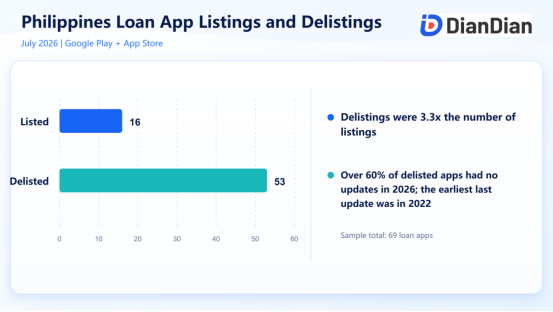
Changes on the supply side are even more apparent. Diandian monitoring shows that in July 2026, across Google Play and the App Store in the Philippines, the number of cash-loan apps removed was 3.3 times the number of newly listed apps. More than 60% of the removed apps had received no updates in 2026, and the oldest had been inactive since 2022.

This shows that the new rules constrain more than just 'who can enter.' Existing shell brands, zombie apps, and risky apps that have gone without updates for long periods are accelerating their exit from the market. The old strategy of spreading customer acquisition and scaling through a large number of apps is shrinking both economically and from a compliance perspective.
From suspension to reopening, and from bans to market cleanup, Diandian believes MC 20's replacement of 'closing the door and banning' with 'opening the door and setting thresholds' is a more sustainable regulatory path than blocking isolated points.
Competitive Landscape: Mr. Cash Downloads Down 33.32% Month on Month, Credit Cash Surges 156.45%, and Moregold Is Removed
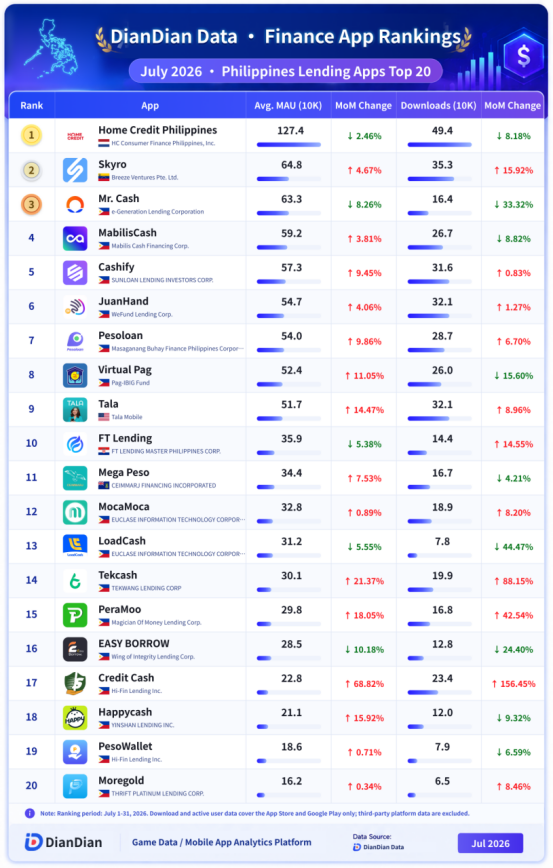
The overall Philippine cash-loan app TOP20 across both platforms moved upward in July 2026. The top 20 apps, without deduplication, had approximately 8.8641 million total active users and about 4.3555 million total downloads, up 4.13% and 3.12% from June, respectively.
Among the top three, Home Credit Philippines remained in first place with 1.2744 million active users and 493,600 downloads, although the two metrics fell 2.46% and 8.18%, respectively.
Skyro ranked second with 648,500 active users and 353,200 downloads, representing month-on-month growth of 4.67% and 15.92%, respectively. Mr. Cash ranked third with 633,500 active users and 164,300 downloads. Its active users fell 8.26% month on month, while downloads fell 33.32%, a pronounced pullback.
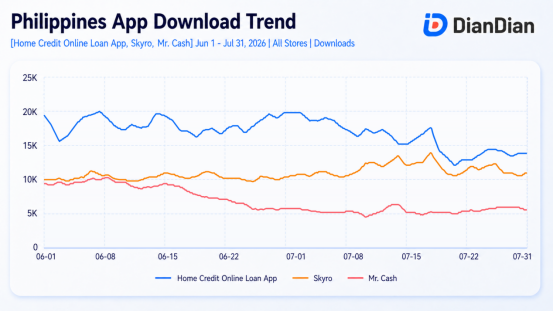
Looking across January to July, the three top apps showed clear differences in trajectory. Diandian monitoring shows that Home Credit's monthly downloads remained stable between 494,000 and 622,000, indicating a solid base. It continued updating its version in July and expanding lending and payment scenarios within its main app, demonstrating how a leading platform can maintain stable traffic through brand strength, its existing user base, and comprehensive financial capabilities.
Skyro was the only one of the three to maintain a sustained upward trend, with monthly downloads rising from 285,000 in January to 353,000 in July, an increase of about 24% over six months. Public information indicates that in July it expanded QR-based buy-now-pay-later scenarios, partnered with Netbank to optimize repayment and payment processing, and surpassed 2 million installment-loan transactions. Its growth came more from the continued expansion of product scenarios and infrastructure.

Mr. Cash, backed by the Chinese-invested Xiamen-based company Mouqu, briefly surged at the beginning of the year, but downloads have fallen steadily since peaking in March. By July, they had dropped to roughly 40% of the peak. Its specific activity was mainly maintenance on Google Play, including bug fixes, performance optimization, and login-function adjustments; new user acquisition did not improve in parallel.
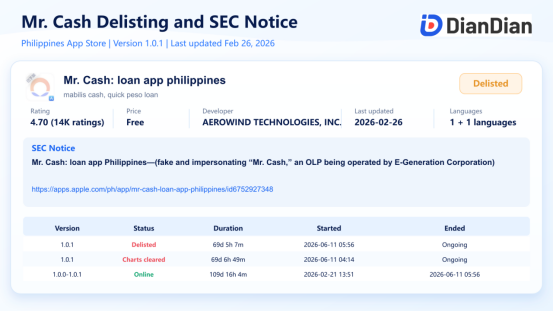
Diandian's analysis suggests that Mr. Cash's weakening growth is related in part to brand impersonation and traffic diversion in the market. As early as March, the SEC reported the App Store listing 'Mr. Cash: loan app Philippines' as a fake and impersonating 'Mr. Cash' application. However, the app was not removed from the chart and delisted until June 11, by which time it had already accumulated a certain scale. At the same time, according to Diandian's listing and delisting monitoring, another app called 'Mr. Cash-Fast Lending App' has recently appeared; its compliance status is unknown.
For the legitimate Mr. Cash, brand impersonation is not a one-off risk. It continuously erodes customer-acquisition efficiency and user trust, creating long-term pressure that is difficult to escape in the short term.
Mr. Cash-'X' Delisting Details. Source: Diandian Data
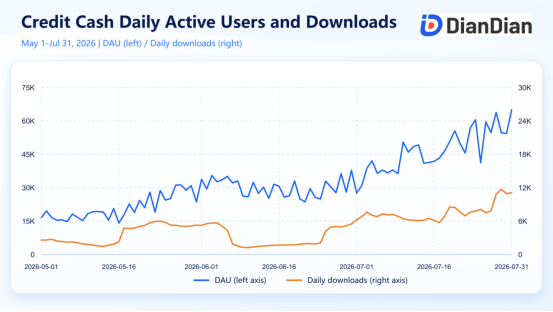
Credit Cash-Online Loan App was the standout in terms of market growth. Its active users and downloads jumped 68.82% and 156.45% month on month in July, respectively. Looking at daily performance, both daily active users and daily downloads reached new three-month highs: daily active users exceeded 65,000 and daily downloads surpassed 11,000. The increase in new-user acquisition lifted active users at the same time, producing a stepwise rise.

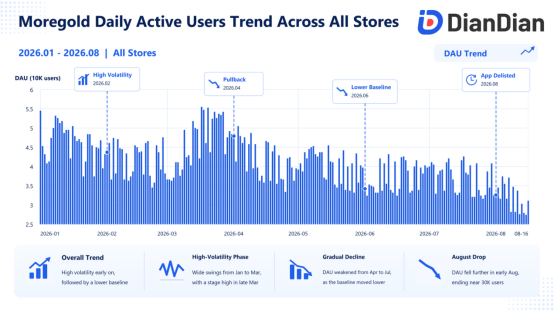
Moregold, ranked No. 20, showed some signs of stabilization in July: active users reached 162,500, up a marginal 0.34% month on month, while downloads rose 8.46% to 65,300. However, the app was removed from Google Play on August 4. Judging by the timing, its removal may be related to platform information disclosure, verification of the operating entity's qualifications, and Google Play's financial-services policy review following the implementation of the new rules.
Public snapshots show that multiple sets of loan-term language previously appeared in Moregold-related apps, with differences in key information such as loan amounts, daily interest rates, and APRs. For cash-loan apps, whether loan terms are disclosed consistently and can be verified is a compliance item that both the SEC and app stores will closely scrutinize.
Market Developments: Bank Funding, AI Credit Assessment, Payment and Repayment Infrastructure, and Post-Loan Compliance Heat Up Together
1. Philippine Public Sector SSS Advances Digital Microloan Infrastructure
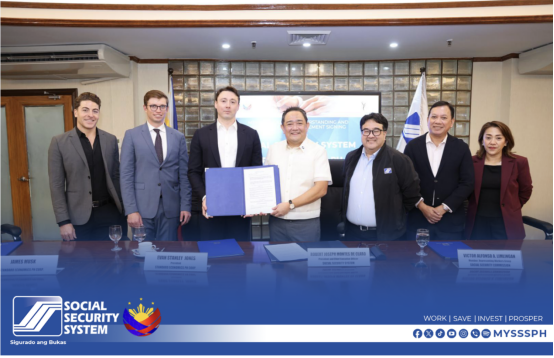
On July 3, the Philippine Social Security System (SSS) signed an agreement with Standard Economics to support development of the 'SSS LoanLite' digital microloan project. Built on Standard Economics' Economic Superintelligence platform, the project integrates identity verification, AI risk assessment, intelligent underwriting, payments, anti-fraud, and data security. It is aimed at SSS members with at least 12 months of contributions and is intended to provide short-term emergency loans of PHP 1,000 to PHP 20,000, with terms of 15 to 90 days and an annual interest rate of 8%.
https://www.sss.gov.ph/news-and-updates/sss-taps-tech-firm-standard-economics-for-micro-loan-initiative-2/
As a public-sector inclusive-finance project, LoanLite aims to provide members with a lower-cost, traceable, formal short-term financing channel and reduce their dependence on informal high-interest lenders. SSS previously stated that the microloan project aims to build a loan portfolio of up to PHP 40 billion within two years. If implemented smoothly, competition in the Philippine digital-lending market will no longer be limited to commercial cash-loan apps. Public institutions will also use AI, digital payments, and data infrastructure to help reshape G2C inclusive-finance services.
2. Bank Funding Continues to Flow to Leading and Compliant Fintech Platforms
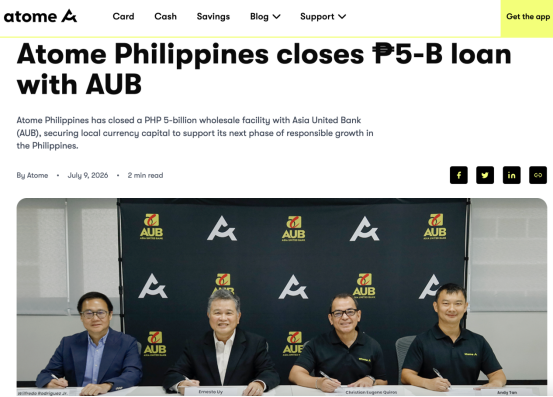
On July 9, Atome Philippines announced that it had secured a PHP 5 billion local-currency wholesale financing facility from Asia United Bank (AUB) to support its next phase of growth in the Philippines. The funds will mainly be invested in the continued expansion of the Atome PayLater Anywhere Card. The card has now been issued to more than 3 million Filipino users, 80% of whom are first-time cardholders. Its use cases cover everyday spending such as groceries, dining, household goods, telecommunications, and utility bills.
https://www.atome.ph/blog/atome-philippines-closes-%E2%82%B15-b-loan-with-aub
This financing shows that funding supply in the Philippine digital-lending market is expanding beyond competition among standalone cash-loan apps into BNPL, credit-card-like products, and consumer-finance scenarios backed by bank credit lines. For Atome, local-currency financing helps reduce currency-mismatch pressure and expand PayLater coverage. For the industry, the entry of bank funding into compliant fintech platforms through wholesale credit facilities means leading players' advantages in funding costs, scenario coverage, and risk-control capabilities will become even stronger.
3. Collections and High Fees Remain the Market's Main Risk Themes
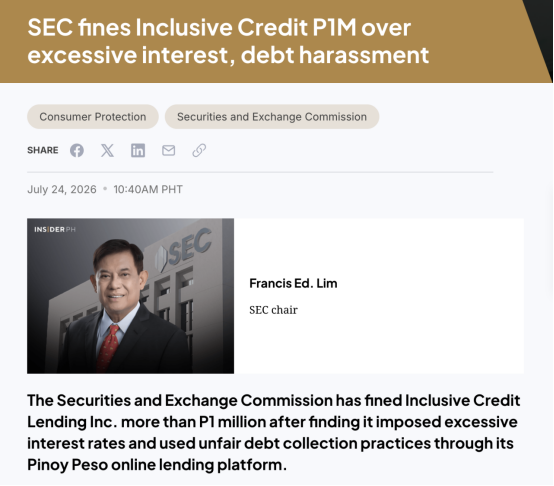
In a July 21 enforcement order, the Philippine SEC imposed an administrative fine of PHP 1.03 million on Inclusive Credit Lending Inc. over excessive interest charges and unfair collection practices on its Pinoy Peso online-lending platform. The case originated from a borrower complaint alleging that 38% of the principal was deducted before disbursement. The SEC determined that this upfront deduction translated into an effective seven-day interest rate of 61.29%, equivalent to a monthly rate of 262.67% and a daily rate of 8.67%, significantly above the 15% monthly effective-rate cap under MC No. 3.
https://insiderph.com/sec-fines-inclusive-credit-p1m-over-excessive-interest-debt-harassment
In addition to the rate issue, the SEC found that the platform's collection practices violated MC No. 18 (2019), which prohibits unfair debt collection. The complaint involved threats, harassment, and public shaming, including the public disclosure of borrowers' identities and photos on social media. The penalty shows that while the SEC is reopening market supply under the new OLP rules, enforcement against high rates, upfront deductions, opaque disclosures, and abusive collections has not eased. For cash-loan platforms, rate disclosure before lending and compliant post-loan collections remain the core regulatory red lines in the Philippine market.
Conclusion: One-Star Reviews in a Regulatory App Reflect Persistent Collection Problems
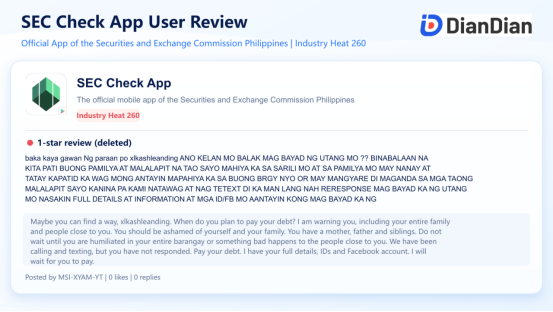
SEC Check App is the Philippine SEC's official mobile application and serves as an entry point for regulatory inquiries and public education. One of its core functions is allowing the public to check whether a company is registered and qualified to conduct regulated activities such as lending and financing. Precisely because of its regulatory status, a one-star review that appeared in the app's comment section on July 29 was particularly jarring.
According to Diandian's rating and review monitoring, the commenter not only named the borrower, but also threatened to involve the borrower's family and neighbors, claiming to possess personal information including identity documents and a Facebook account. This closely matches the typical characteristics of 'unfair debt collection' that the Philippine SEC has been combating for years.
The review has since been deleted by the platform. However, the fact that it appeared in the official SEC app's review section itself is another reminder of the deeper problems Philippine cash-loan regulation urgently needs to address after the new rules: not only whether platforms can be listed and whether their operating entities are registered and compliant, but also whether post-loan collection and data use can be effectively constrained.