文
A
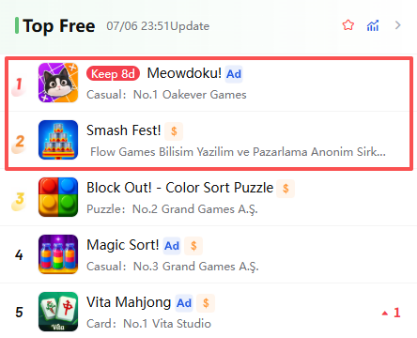
Over the past half month, the top two spots on the U.S. iOS free games chart have basically been occupied by two new titles released around the same period: Meowdoku! and Smash Fest!.
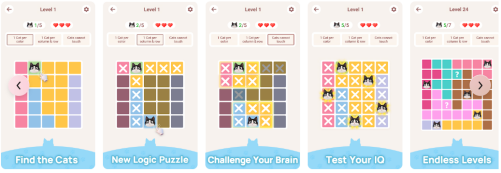
Meowdoku! from LeXin ShengWen has already been covered frequently by domestic industry media recently, so we will only briefly mention it here. The game is a pure IAA Sudoku title with micro-innovation under a cat theme. Its rules are very simple: players double-tap to place kittens on a board made up of several colored blocks. Each color can contain only one kitten, each row and column can also contain only one kitten, kittens cannot be adjacent to one another, and each round allows three mistakes.
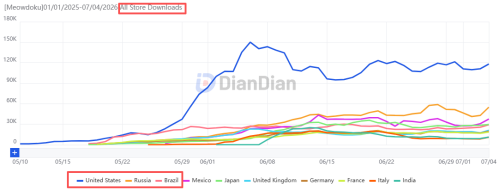
The game first launched on Google Play in selected countries and regions at the end of April this year, started small-scale user acquisition and testing in early May, and launched on the App Store in mid-May. At the same time, user acquisition gradually ramped up, and its corresponding data grew significantly, reaching 950,000 downloads in May. At the beginning of June, it stabilized in the top three of the U.S. iOS free games chart, and its data then grew explosively, with daily downloads peaking at 540,000 and June downloads reaching 12.75 million. The game is still maintaining high user acquisition, with daily downloads hovering around 500,000.

Image source: SocialPeta
It is worth noting that besides Meowdoku!, LeXin ShengWen's Vita Mahjong and Arrows - Puzzle Escape have also recently held leading positions on the iOS and Google Play free games charts in Europe and the United States, putting the company in the spotlight for the moment.
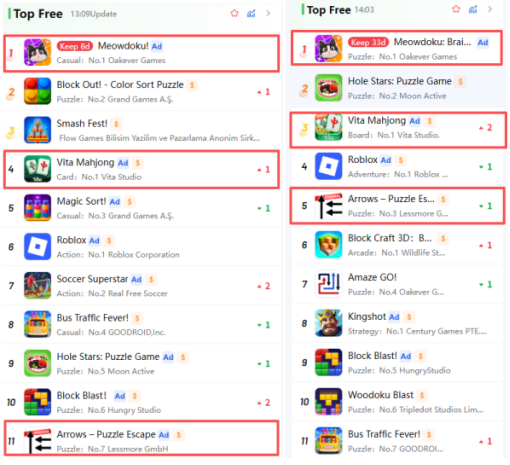
The left image shows the U.S. iOS free games chart, and the right image shows the U.S. Google Play free games chart.
Compared with Meowdoku!, the new title Smash Fest! from Flow Games, a new-generation Turkish casual game studio, has been relatively low-profile. However, since its official launch in early-to-mid June, its market data has begun to grow rapidly, faintly showing the traits of a dark horse. What is even more worth watching is that, as a hybrid-casual product, it chooses one of the most common amusement-park activities--knocking down cans--as its entry point. Players do not need to understand complex rules: they only need to aim, fire, and watch objects collapse to receive clear feedback. It may well become a prototype for the next generation of hybrid-casual hits and attract attention and learning from major hybrid-casual developers.


Below, we will further break down the product's testing rhythm, data performance, and its different thinking at the gameplay level.
01
Android has not yet scaled, and user acquisition has not been fully opened
Smash Fest! reached 2.83 million downloads in nearly one month
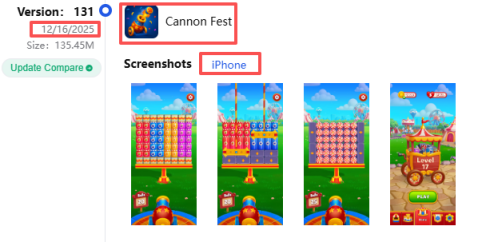
Diandian Data shows that as early as mid-December 2025, the game was listed on the App Store in selected countries and regions under the name Cannon Fest. It conducted tentative user acquisition in January this year, was officially renamed Smash Fest! in early May, and only launched on Google Play at the end of June.

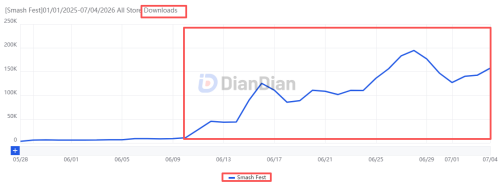
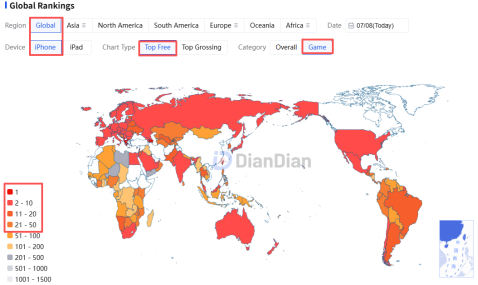
Looking at specific market performance, Smash Fest! only began generating corresponding download data at the end of May, when daily downloads were still fluctuating in the four digits. But starting on June 11, its daily downloads entered a fast-growth track. The next day, the game entered the top 50 of the iOS free games chart in 62 regional markets; on June 13, it reached the top two of the U.S. iOS free games chart and has not dropped out since.

Download trend of Smash Fest! since launch
Downloads reached a peak of 195,000 on June 28. Although they have declined since then, the drop has been limited. Daily downloads are still above 150,000, and its chart performance has even improved further, placing it in the top 50 of the iOS free games chart across 111 regional markets.

Smash Fest!'s ranking on global iOS free games charts on July 8
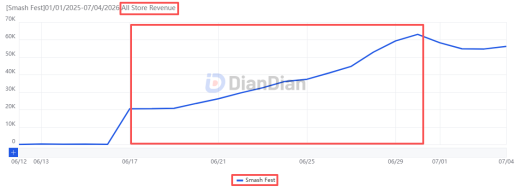
In terms of IAP revenue, the game only began generating statistically trackable IAP revenue in mid-June, when daily revenue hovered in the three digits. On June 17, it reached the $20,000 mark, about RMB 140,000, and then gradually grew until peaking at $63,000 at the end of the month, about RMB 430,000. Since then, daily revenue has fluctuated between $50,000 and $60,000, about RMB 350,000 to 420,000, and the game has just entered the U.S. iOS grossing games chart at No. 75.

Revenue trend of Smash Fest! since launch
As of now, Smash Fest! has only been testing and generating data for a little over one month. Its cumulative downloads are around 2.9 million, with the United States, Japan, and Russia ranking as the top three markets at 40.55%, 10.55%, and 5.17% respectively. Total revenue is estimated at $790,000, about RMB 5.35 million, with the United States, the United Kingdom, and Australia ranking as the top three revenue markets at 91.08%, 2.71%, and 0.84% respectively.
In fact, in terms of absolute data, especially IAP revenue, Smash Fest! may not yet seem to have reached breakout-hit level. However, it should be noted that the game only started testing on Android in mid-to-late June, and at the same time it has not carried out any Android user acquisition at all. Even user acquisition on the Apple side has basically stopped over the past 30 days.

Image source: SocialPeta
Therefore, if the game can reach its current performance relying only on brand promotion and store recommendations, that better demonstrates its success. In addition, there is undoubtedly more room for growth later. To achieve this, gameplay experience and differentiated innovation become especially important.
02
Starting from a real-world theme, turning “smashing things” into levels
Low entry barriers do not equal shallow gameplay; the loop is supported by physics feedback
Over the past two years, one obvious change in hybrid-casual products is that they have relied less and less on abstract rules themselves, and have instead actively looked to real life for themes that users can understand more easily. Offline experiences such as marbles, sand art, yarn spools, cards, and can-knockdown games are being repackaged into casual gameplay, often reducing both the cognitive threshold and the explanation cost of user-acquisition creatives.
The logic behind this is not complicated: real-world themes come with users' existing experience. When players see the screen, they do not need to learn rules; as long as they understand that they need to knock something down, sort it, fill it, or clear it, they can quickly get into the flow. Combined with physics feedback, ASMR sound effects, level constraints, and light numerical systems, even a very small action can be amplified into a satisfying loop that supports continued play.
Smash Fest! is a typical product under this line of thinking.
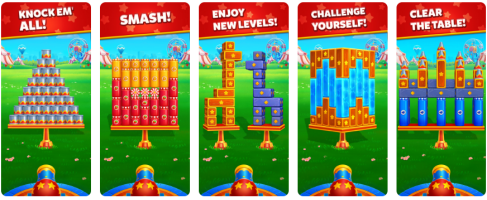
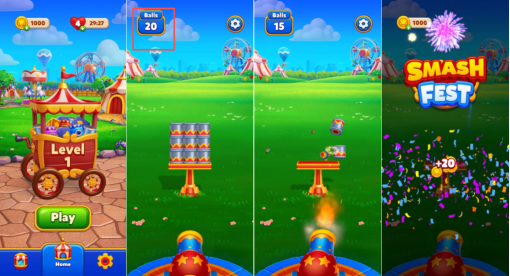
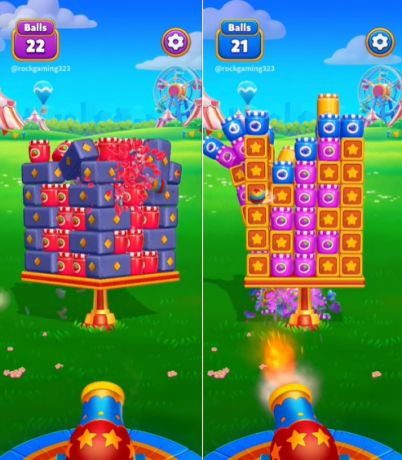
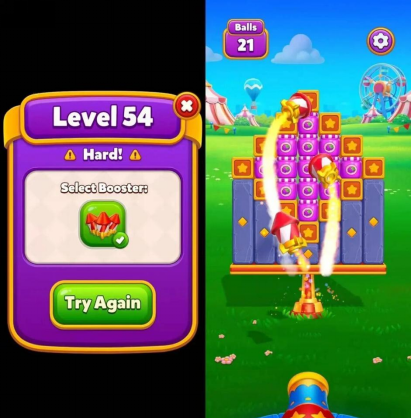
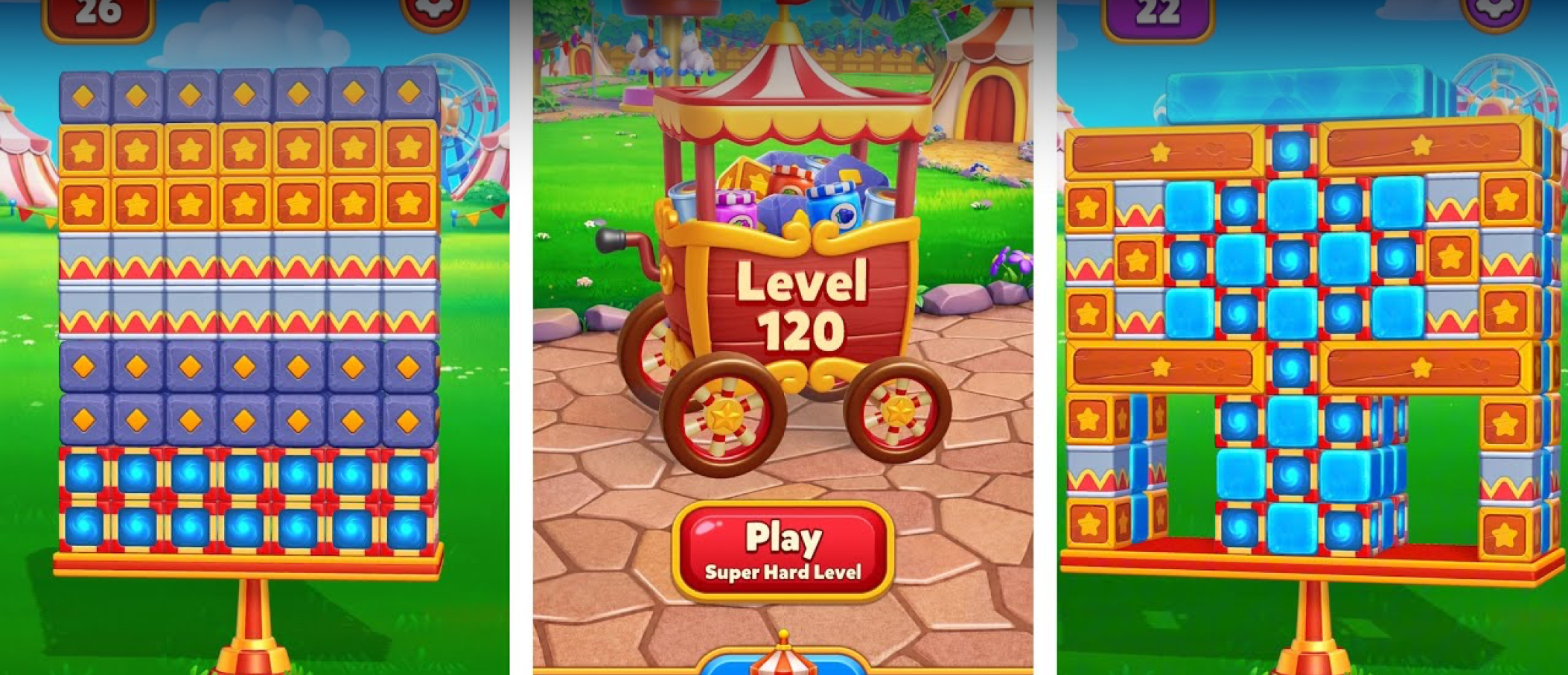
The gameplay of Smash Fest! can be summarized as a very direct physics-destruction level structure: from a fixed perspective, players control a cannon at the bottom of the screen, aim at various objects on the platform ahead, fire cannonballs, and knock all targets down within a limited ammunition count to advance to the next level.

Its rules require almost no explanation. After entering a level, players see a group of arranged objects in the center of the screen, which may include cans, wooden blocks, glass jars, metal blocks, ice blocks, and more. At the bottom are the cannon and the remaining number of cannonballs. What players need to do is judge which part of the structure is easiest to break through, push over, or trigger into a chain collapse, and then tap to fire. After the cannonball hits, the objects roll down, tip over, shatter, or splash according to their weight, shape, material, and placement. Once all objects leave the platform, the level is cleared.

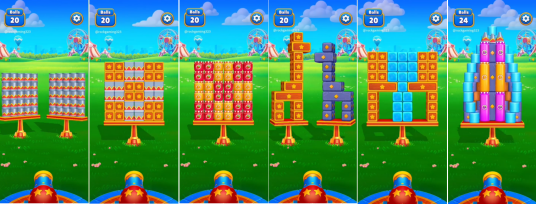
The focus of this gameplay is not operational complexity, but “where to hit.” Because each level has a limited number of cannonballs, players cannot simply fire blindly; they need to observe the target structure before shooting. For example, lightweight cans are easier to knock away and are suitable as a breakthrough point for chain collapse; wooden blocks and stones are more stable, so direct hits may not produce the ideal effect; glass jars shatter when hit and generate stronger visual feedback; objects such as ice blocks and cylindrical logs change the collapse direction of the whole structure because of differences in friction, rolling, and force transmission.
Therefore, although Smash Fest! looks like stress-relief destruction, there is actually a light layer of level puzzle-solving underneath. Players need to judge the support relationships between objects: should they hit the bottom first to make the upper layer collapse, or hit the middle first to create a gap? Should they aim at the center of a single object, or shoot at the seam between two objects and use the cannonball's impact to drive targets on both sides at once? Especially when levels introduce front-back stacking or multi-layer vertical structures, front-row objects absorb the cannonball's impact while bottom objects are suppressed by the weight above, forcing players to find weak points more precisely.
The game's level progression mainly creates variation through “new objects + new arrangements + less room for error.” Early levels are mainly built around cans, making the goal easy for players to understand. Later, materials such as wooden blocks, glass jam jars, metal blocks, ice blocks, and cylindrical logs are introduced, and levels shift from simply clearing the platform to judging materials and structures. Further on, object arrangements also become more complex: objects may be split into left and right groups, stacked into multiple layers, block one another from front to back, or even appear on rotating platforms, making shooting angle and timing variables that affect the result.

Its core satisfaction comes from “revealing the result.” Once players press fire, the actual operation is already over, and all they can do next is watch how the cannonball hits and how objects collapse in chains. When successful, one cannonball knocks down a large number of targets, producing extremely direct feedback. When it fails, there are often only one or two objects left, naturally leading players to think, “If I try a different angle next time, I can pass.” This process of prediction and verification within just a few seconds is the game's most important retention hook.
Monetization also revolves around this loop. When a level fails or players come close to clearing it, extra cannonballs, coins, stamina, items, and rewarded ads all have natural entry points. For example, when players have already knocked down most objects and only a few targets remain, buying or watching an ad for an extra chance feels more natural than being blocked purely by numerical gates.

Image source: Youxibenzi
Overall, Smash Fest! does not rely on complex systems to support its gameplay. Instead, it turns an extremely lightweight real-world prototype into a hybrid-casual loop of “observe the structure, choose the impact point, wait for the collapse, and try again when you are just short.”
03
From its core idea to the makeup of its core team
Smash Fest! deeply understands how to leverage existing strengths, dismantle, and recombine
It is especially worth mentioning that Smash Fest! did not invent an entirely new gameplay system from scratch. More precisely, it seized a “small gameplay opportunity” that had already been validated.
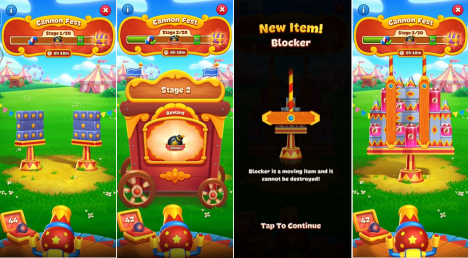
In Peak Games' Toon Blast, there was once a limited-time event called Cannon Fest: players first obtained cannonballs in mainline match-and-blast levels, then entered independent event levels and used the cannonballs to clear objects on a platform before receiving rewards. This design was originally only a supplementary module in Toon Blast's long-term operation, providing veteran players with extra goals and short-term feedback.


Cannon Fest
With Smash Fest!, what the team did was an act of “amplification.” It took the part of Cannon Fest that users could understand most easily and that could also be displayed most easily in ad creatives, then rebuilt levels, visuals, and monetization around “fire, knock down, and clear the platform.” It did not win through complex innovation; instead, it dismantled a proven satisfying point from a mature product into a lighter, more direct new product better suited to hybrid-casual user acquisition.
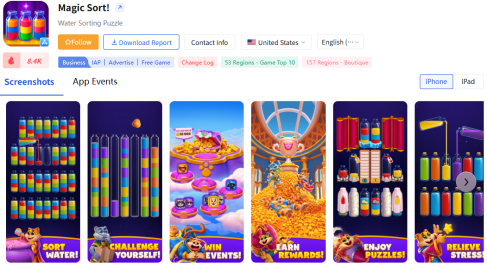
This approach also aligns with the product habits of Turkish casual teams in recent years. They are not obsessed with creating rules out of thin air, but are better at finding prototypes that can be amplified from mature materials, gameplay, or validated modules, and then reintroducing them to the global market through art packaging, level pacing, and monetization design. For example, Magic Sort! rebuilt visual feedback and operation rhythm on the mature water-sort gameplay framework, while Smash Fest! goes a step further by separating an event experience that players had already encountered in a leading product into an independent new title.

The reason this path works is inseparable from the team's own accumulated experience. Although Flow Games, the studio behind Smash Fest!, was founded only recently, it is not a team exploring completely from scratch. Public information shows that Flow Games was established in May 2025 with registered capital of 250,000 Turkish lira, and its main publicly available product is currently Smash Fest!.

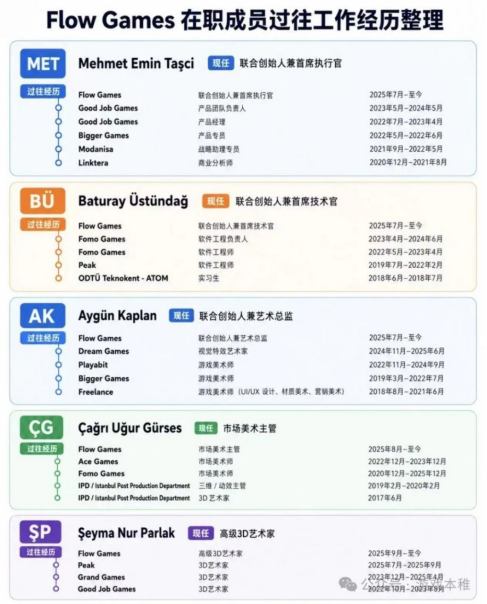
Judging from the core members' backgrounds, Flow Games looks more like another reorganization after the mobility of Turkish casual-game talent. Co-founder and CEO Mehmet Emin Tascı previously worked at Good Job Games; co-founder and CTO Baturay Ustundag has experience at Peak and Fomo Games; Art Director Ayqun Kaplan came from Dream Games; and Senior 3D Artist Seyma Nur Parlak previously worked at Grand Games.

Image source: GameMarket Insights
Therefore, although Smash Fest! appears on the surface to be the first product from a new studio, behind it stands a group of seasoned practitioners familiar with casual gameplay validation, user-acquisition creatives, art style, and level pacing.
From today's perspective, Smash Fest! provides a new sample for the hybrid-casual track: the gameplay prototype can be very small, but it must be intuitive enough, provide strong enough feedback, and be continuously digestible through level design. Whether it can continue scaling later will depend on multiple factors, including Android growth and long-term content supplementation, and will require continued observation.
At least for now, however, there are already many imitators on the market. It once again shows that Turkish casual game studios' advantages lie not only in art and user acquisition, but also in their ability to judge, dismantle, and amplify lightweight gameplay. For hybrid-casual products, opportunities are not necessarily hidden in complex systems; they may also come from a small experience that has been re-understood and repackaged.