文
A
Over the past few years, word games have not been pushed to the margins simply because of their lightweight gameplay. Instead, they have maintained a steady presence in the casual puzzle category and shown a clearer shift: growth is no longer driven only by traditional formats such as crosswords, spelling, and word search, but is extending toward daily puzzles, semantic grouping, and lightweight logic judgment.
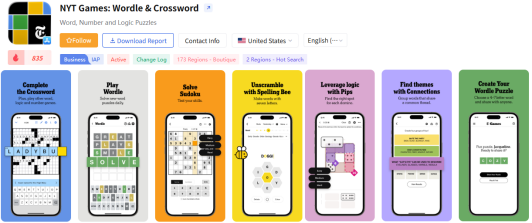
Take The New York Times’ NYT Games as an example. In a report last June, The Verge noted that NYT Games’ word-game platform NYT Games: Wordle & Crossword was played a total of 11.1 billion times in 2024. Among them, Wordle, in which players guess a five-letter word within six tries, accounted for 5.3 billion plays; Connections reached 3.3 billion plays; and Strands, which integrates themed clues into word-search gameplay, reached 1.3 billion plays.

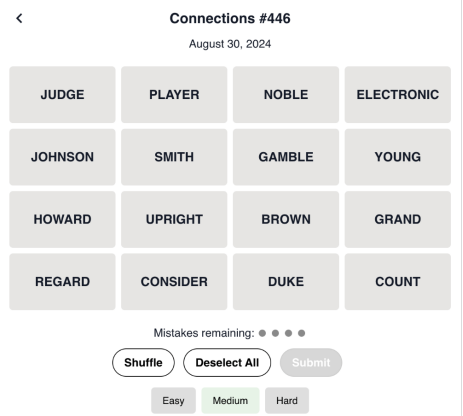
These figures show that word games can still form high-frequency usage habits. Meanwhile, the popularity of Connections, which asks players to split 16 words into four themed groups through static grouping, indicates clear demand for semantic-grouping gameplay. It is lighter than traditional crosswords, requires less text input, yet involves more thinking than ordinary word search. Players must identify hidden relationships among a seemingly loose set of words and complete a short, high-feedback cognitive check.

Image source: GameMarket Insights
But the problems with semantic grouping are also obvious. It depends heavily on the content library and puzzle design. If it is made into pure text questions, it can easily become a lightweight daily-puzzle product, running into challenges around level volume, ad pacing, monetization points, and long-term retention.
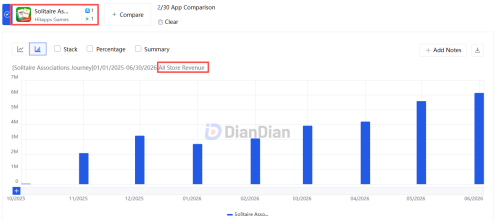
As a result, many products over the past two years have begun combining “word grouping” with other mature casual frameworks, placing classification judgment into more intuitive forms such as hexagons, sorting, elimination, and drag-and-drop. For example, HitApps’ self-developed and self-published Solitaire Associations Journey merges solitaire with word-classification and association gameplay. Since launching in October 2025, its revenue has continued to rise; its current monthly revenue is around $6.13 million, about RMB 42 million, while cumulative revenue has reached $32 million, about RMB 214 million.

Monthly revenue trend of Solitaire Associations Journey since launch
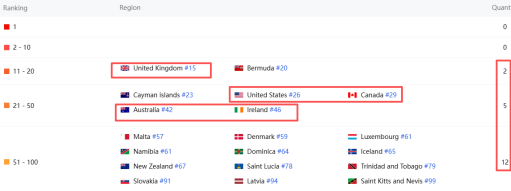
Recently, another breakout title in this direction, Bubble Word Jam, has also emerged. The game was little known at launch, but its metrics surged from May to June, generating more than 3.7 million downloads and $1.58 million in IAP revenue, about RMB 11 million. During the period, it peaked at No. 15 on the U.S. iOS free games chart and is still in the top 100 free iOS games in 19 countries and regions. In addition, because of its rapid rise, major overseas casual puzzle game companies LeXin ShengWen and Tianlong Huyu quickly moved into similar products.


Bubble Word Jam’s ranking on global iOS free game charts on July 6
So what kind of product is this game, and what has its testing history and market performance actually looked like? Diandian Global will take a closer look below.
01
“Semantic grouping + bubble merging” creates differentiation
Tactility and instant feedback are the key to winning
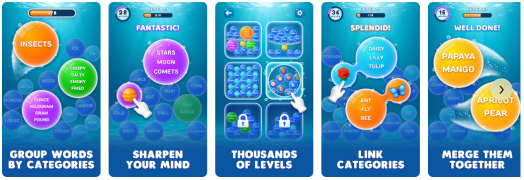
Bubble Word Jam is published by Lion Studios, which was launched by AppLovin in 2018 as AppLovin’s game publishing division and was sold to Tripledot Studios in 2025. Its gameplay is not complicated. It is closer to a lightweight vocabulary puzzle built around “semantic grouping + bubble merging,” essentially putting Connections-style semantic-grouping questions into the interaction framework of bubble elimination. Yet this simple change in presentation has brought a significant lift in data performance.

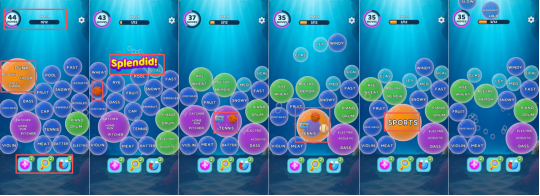
The game uses a typical lightweight puzzle level structure. Each level scatters multiple small bubbles containing words, and the objective is to identify several groups of words that share the same theme, then drag and merge them together. Usually, four words form a complete category; once matched successfully, they generate a larger category bubble and are cleared. Each level provides a fixed number of word bubbles and a move limit. After failing, players can obtain extra moves or boosters through ads or in-game resources.

As levels progress, four words of the same type may form a more specific object or category represented by an icon, and that icon then becomes a new independent bubble that can continue to be nested and cleared.
In the early stages, difficulty mainly comes from whether players can recognize obvious categories, such as colors, animals, fruits, or vehicles. As levels advance, the challenge shifts from simple recognition to finer semantic distinctions. User reviews mention that after around levels 40 to 70, some categories become more “specified-answer” oriented. Within the same broad theme, there may be several similar words, and players must match the system’s preset group, as shown above, rather than simply putting together any four related words by intuition.
Bubble Word Jam’s biggest innovation lies in using bubble physics and merge feedback to strengthen the sense of operation. When players drag one word bubble close to another related word bubble, the bubbles attract, cluster, and eventually pop once a full category is formed. This layer of packaging is crucial: if players were only asked to tap four words, it would feel more like a logic question; but bubble movement, collision, and clearing make it closer to the instant feedback of a casual match game, creating a strong sense of comfort and satisfaction.
02
Bubble Word Jam began testing last September and broke out this May
It generated more than $1.5 million in the past two months, with daily revenue continuing to grow
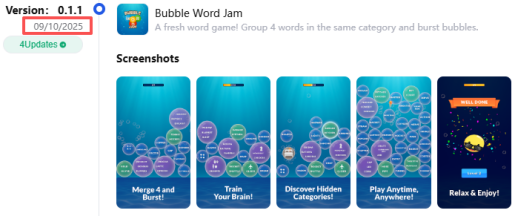
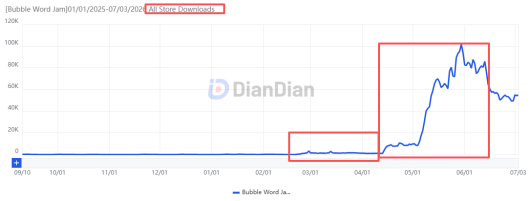
Notably, this is not a completely new title. As early as mid-September 2025, the game had started small-scale testing in the United States. At that time, daily downloads were generally below 1,000, and there was no corresponding IAP revenue to track.

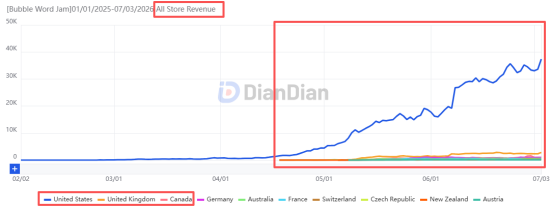
In February 2026, the game’s daily downloads gradually rose to four digits, while measurable IAP revenue began to appear. Starting in mid-April, it gradually launched in more countries and regions worldwide, and the corresponding metrics began to improve significantly. That month, monthly downloads were about 156,000, up 240% month on month, while estimated monthly revenue reached $51,000, about RMB 350,000, up 325% month on month.

Download trend since the game began testing
By May, the game finally began scaling user acquisition significantly, and its metrics entered an explosive growth phase, with daily downloads once peaking at 100,000 near the end of the month. In May and June, monthly downloads reached 1.72 million and 2.02 million respectively, while estimated monthly IAP revenue reached $500,000, about RMB 3.4 million, and $1.08 million, about RMB 7.34 million.

Image source: SocialPeta
It is worth noting that around mid-to-late June, the game began to contract its user acquisition, leading to a clear decline in daily downloads. However, daily revenue remained solid with no visible drop. At present, daily downloads are around 60,000, while estimated daily revenue is around $50,000, about RMB 320,000.

Revenue trend since the game began testing
As of now, Bubble Word Jam has accumulated around 4.13 million downloads. The United States, the United Kingdom, and France rank as the top three markets, accounting for 42.46%, 10.08%, and 4.98% respectively. By platform, Google Play accounts for as much as 65.26%.
Total revenue is estimated at $1.78 million, about RMB 12.03 million. The United States contributes as much as 78.05%, followed by the United Kingdom at 5.79% and Canada at 2.31%. By platform, the App Store performs slightly better, accounting for about 60.31%.
03
Word grouping still has room for reinvention
“Bubble association and merging” triggers a new wave of copycats
Judging by the results, Bubble Word Jam’s breakout is not just an isolated case of one product suddenly scaling. It is more like proof of one thing: in the overseas casual puzzle market, word-grouping gameplay still has room to be reinvented. As long as developers can find the right interaction shell and transform the cognitive feedback of “understanding word relationships” into more intuitive tactility, rhythm, and clearing satisfaction, this originally static puzzle format still has the opportunity to be repackaged into a mobile product with high downloads and strong conversion.
Of course, this path is not easy. Semantic-grouping games rely heavily on the quality of their question banks and the boundaries of their answers. Once content becomes repetitive or categories feel forced, players can quickly move from an “aha moment” to feeling stuck by the system. If ads, boosters, and move limits are pushed too hard, they can also rapidly erode the relaxed feeling that this type of product should have.
Still, at least for now, Bubble Word Jam has sent a relatively clear signal: for mature casual gameplay, micro-innovation does not necessarily require rebuilding the underlying mechanics from scratch. Sometimes it is enough to take a proven cognitive model and express it through an interaction method better suited to mobile devices. The combination of word grouping and bubble merging may not become a long-term mega-category, but it has already proven that opportunities in the casual puzzle market are still hidden in these seemingly small gaps between gameplay formats.
Finally, it is worth emphasizing that simple mechanics and excellent instant feedback not only bring impressive performance, but naturally also spark a wave of imitation. Bubble Word Jam is no exception, and a group of similar titles is already on the way.
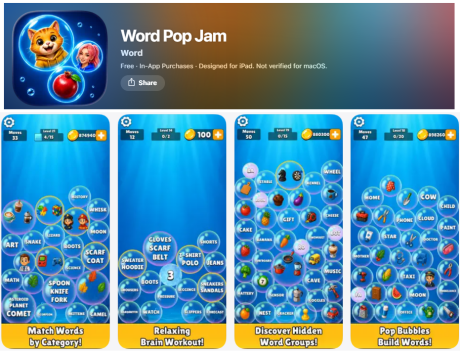
For example, Afranur Aycicek’s Word Pop Jam, which is currently in testing, offers a gameplay experience almost identical to the original.

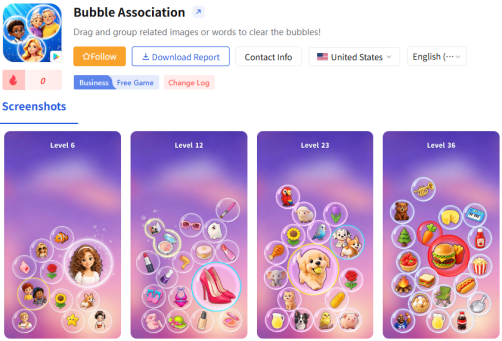
There are also new titles that have moved beyond word grouping and only adopted the association and synthesis structure under a bubble presentation. For example, Tianlong Huyu launched a new game called Bubble Association in early June, replacing words inside bubbles with pictures and lowering the overall entry barrier.

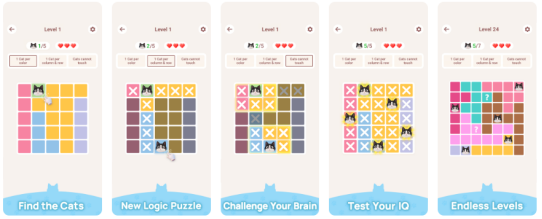
Among these products, the most noteworthy and more clearly innovative one comes from LeXin ShengWen. Although the company has recently been sweeping the global market with its new puzzle title Meowdoku!, a cat-themed micro-innovation on Sudoku that reached 12.75 million downloads in June and currently ranks in the top 20 free iOS games across 57 regional markets, it has still not forgotten to monitor global casual-market trends in real time.

Meowdoku!
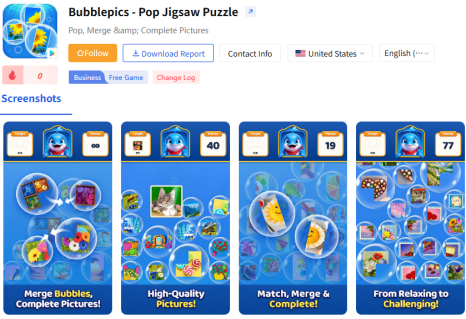
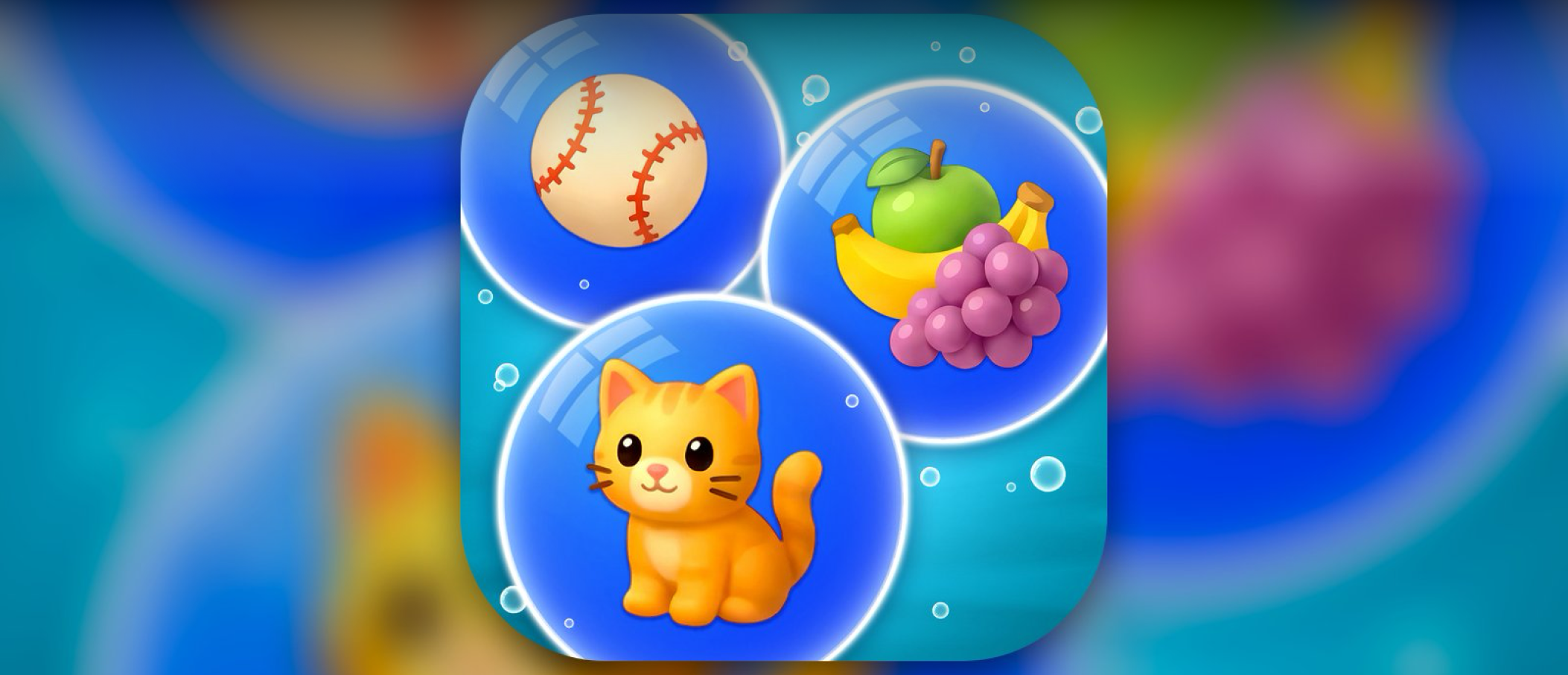
After noticing Bubble Word Jam’s market performance, LeXin ShengWen listed a new game, Bubblepics - Pop Jigsaw Puzzle, in mid-June. The game uses a “bubble fusion + jigsaw puzzle” mechanic: only puzzle pieces with the same picture can be placed together, and players clear the level by assembling all pictures correctly.

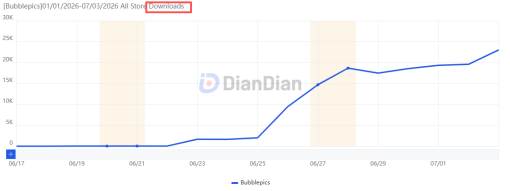
By mid-to-late June, the game had already begun testing in more than 170 countries and regions. Over the past week, as user acquisition increased significantly, daily downloads climbed to around 25,000, making its future performance worth watching.

Image source: SocialPeta

Diandian Data will continue to follow more new-game developments in this direction.