文
A
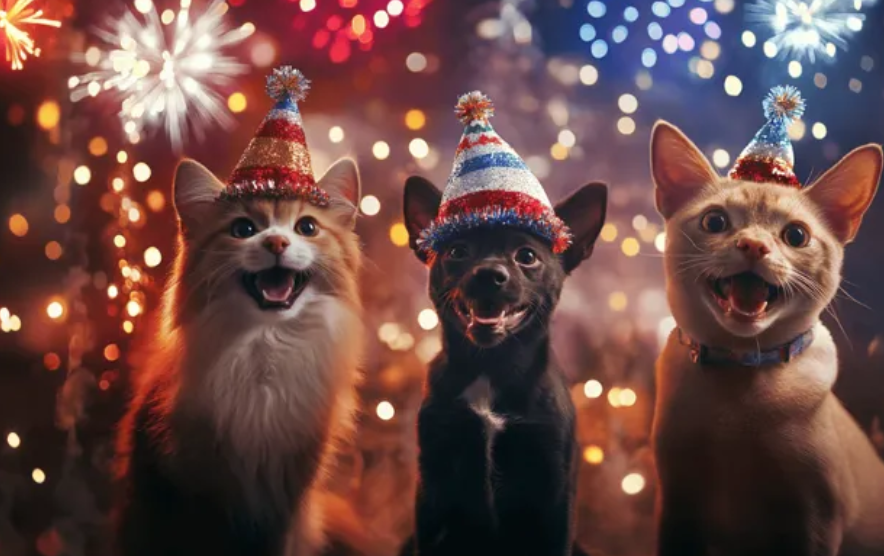
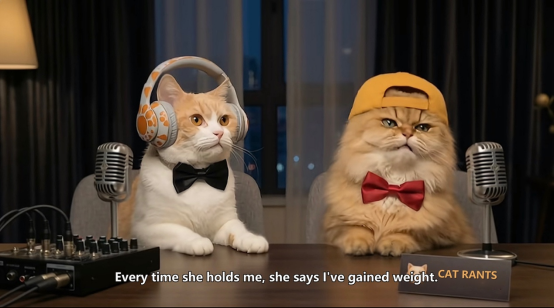
Recently, a wave of 'talking' pets has been appearing frequently on short-video platforms.
With AI processing, a single pet photo can be turned into a human-like character; add lip-sync, voice, and lines to an ordinary video, and the pet begins to roast its owner or speak its supposed 'inner thoughts.'

These pieces of content do not look especially complicated. In many cases, they simply let a pet say lines in human language such as 'I don't want to take a bath today,' 'My owner secretly ate again,' or 'Actually, I understand everything.'
Yet it is precisely this seemingly lightweight content that is attracting large numbers of views, likes, and shares.
According to Guangming Online, the 82-episode Orange Cat Micro-Drama on Douyin has accumulated more than 24 million views, while the 38-episode Fat Orange Dress-Up Story has reached 130 million cumulative views. Titanium Media's outlet Diangchang has also reported that the overseas AI puppy channel Damai published 145 videos in 10 months, gained 85,000 followers, and generated considerable advertising revenue.
This raises a question: is this merely another special-effects craze driven by new models and new templates, or is it an AI content demand worth watching over the long term?
The answer depends on whether it can cross the most critical step: moving from one-off visual novelty toward sustained personalized relationship expression. This may be the key for pet AI videos to move beyond the template boom.
Templates create the first surprise, but relationship memory determines whether users are willing to keep creating around the same pet.
1. Pets Are the Most Natural Entry Point for AI Anthropomorphic Content
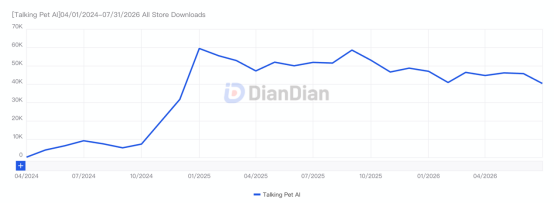
DianDian Data shows that downloads of Talking Pet AI climbed rapidly from the end of 2024. Although they have fluctuated since then, they have generally remained at a relatively high level. For a vertical tool whose core function is highly focused on 'making pets talk,' this sustained performance shows that pet anthropomorphism has moved from a content format on short-video platforms into an independent product scenario that users actively search for, download, and use.

Monthly download trend of Talking Pet AI from April 2024 to present. DianDian Data
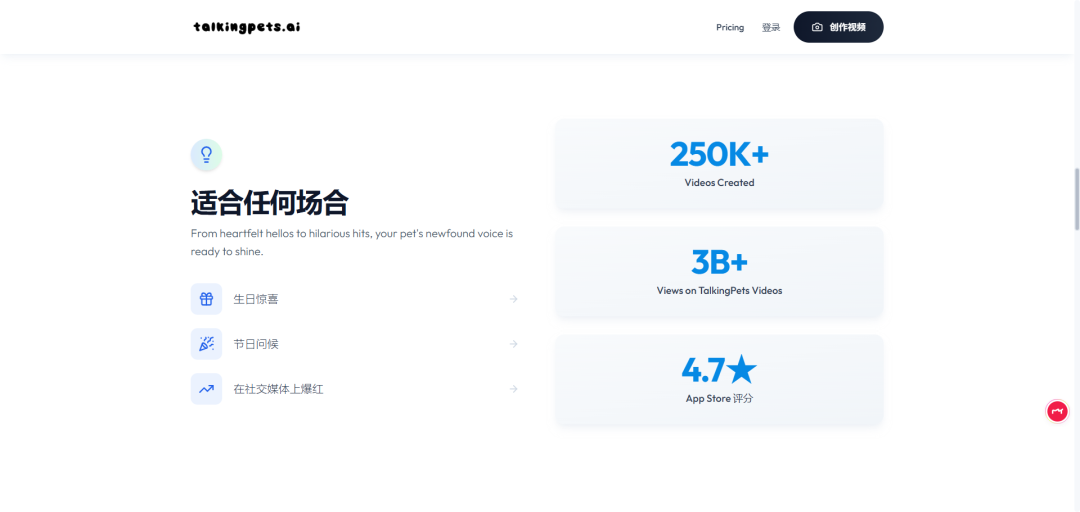
This wave of growth did not happen in isolation. According to the Talking Pets official website, related content has received more than 3 billion views on TikTok, and some highly interactive comments were concentrated in early to mid-December 2024, largely coinciding with the rise in downloads. This provides an important clue: pet AI videos have a strong 'watch and imitate immediately' attribute.
Screenshot of data displayed on the Talking Pets official website
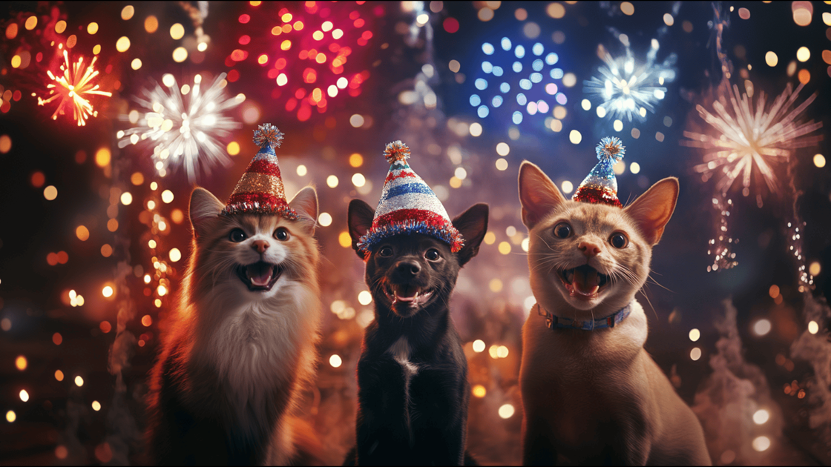
Users first see talking, singing, or blessing-delivering pet videos on short-video platforms, then naturally think of their own pets. When tools compress the production process into simply uploading a photo, entering text, or selecting a song, users can more easily complete the conversion from watching to downloading and then to sharing. The Christmas and New Year period at the end of 2024 also provided clear use cases for holiday greetings, family messages, pet singing, and similar content.
Source: App event details page
Therefore, the download growth of Talking Pet AI looks more like the result of short-video distribution, holiday scenarios, and low-barrier tools working together.
What it shows is not the sudden explosion of a single AI feature, but that the popularity of pet anthropomorphic content is spilling over from platform viewing into actual tool demand.
This demand was not created out of thin air by AI. Before generative technology became widespread, users were already accustomed to adding subtitles to pets, inventing inner monologues for them, and understanding pets as 'family members' with personality, emotions, and the ability to interact with humans. From early smart pets that went viral because they seemed to 'understand human language,' to the 'radish tissue cat' whose line 'zheng bang' was replicated into an internet meme, personified pet content has gradually evolved from individual cute-pet narratives into a content form that can be imitated and spread.
What AI has done is give this mature content language lip-sync, voice, and more complete performance.
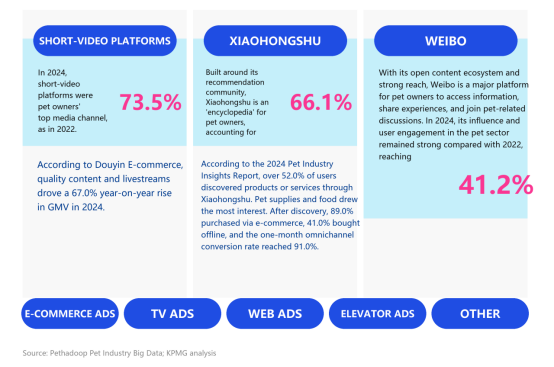
First of all, pets carry very high emotional density. Companionship, care, attachment, and longing already exist in everyday relationships between people and pets. KPMG's 2025 China Pet Industry Market Report also links the development of the pet economy to consumption upgrading, shifts in social attitudes, and lifestyle changes.

Source: KPMG 2025 China Pet Industry Market Report, Social Media Is Reshaping Pet Owners' Consumption Decisions; Short Videos and Xiaohongshu Are Leading the New Pet Economy
For AI content, this means a pet is not a random piece of material, but an entry point into a relationship loaded with emotional memory. What users watch is often not just an animal, but the way a pet and its owner get along.
Second, pets leave just the right amount of blank space for personality imagination.
In psychology, 'anthropomorphism' refers to the attribution of human intentions, personality, emotions, and behavioral characteristics to non-human objects. Research by Epley, an American behavioral scientist who mainly studies social cognition and anthropomorphism, and others suggests that people use familiar human experience to understand objects that are difficult to judge directly, making their behavior easier to explain.
Pets cannot fully tell their owners what they are thinking. A look, an instance of waiting by the door, or a single bark or meow may be interpreted by the owner as grievance, anticipation, jealousy, or impatience. The absence of language does not block understanding; instead, it leaves room for imagination. AI did not invent this imagination. It simply turns the 'inner monologue' once written in subtitles into more direct voice, expression, and imagery.
Finally, the material threshold and expressive pressure for pet content are both relatively low. Pet owners usually have large numbers of photos and videos on their phones and do not need to reshoot complicated material to participate in the trend. Even if the generated result is somewhat exaggerated, it can be understood as a humorous effect.
Expressing emotion through a pet also feels more natural than having the owner speak directly to the camera. A line such as 'Every day after you leave, I wait for you by the door' may seem too direct if said by a person; when said by a pet, it can contain attachment, longing, and a touch of humor at the same time.
Pets therefore satisfy three conditions needed for AI content distribution at once: material is readily available, emotion is instantly understandable, and the result is suitable for sharing. It is private enough without feeling overly heavy; it can carry emotion while retaining a cute and funny outer shell.
What AI amplifies is not a new demand that suddenly appeared, but a content habit that has long existed: people continuously add personality, language, and emotions to pets, then use pets to understand and express a relationship.
2. What Truly Moves Users Is Not 'It Can Talk,' but 'It Feels Like Itself'
Many current pet AI videos rely on similar templates: pets become human, sit in front of the camera and talk, or roast their owners in an exaggerated tone. Templates can create first-glance novelty and are also the easiest to copy.
When large numbers of pets use the same actions, voices, and lines, the technical spectacle quickly turns into content noise. That is because what users truly care about is often not whether 'a pet can talk,' but whether 'what it says feels like my pet.'
Is it clingy or aloof? Does it like waiting by the door, or does it always pretend not to care when the owner comes home? What habits between it and its owner are familiar only to the two of them? Is the owner using this video to express happiness, apology, longing, or farewell? This information is hard to obtain directly from a single photo. It comes from relationship memory accumulated through long-term companionship.
The same line, 'Why did you only come back now?' can carry completely different meanings when placed on different pets. To a stranger, it is just an anthropomorphic line. To the owner familiar with that pet, it may correspond to the action of waiting by the door every day, and to countless concrete memories of coming home.
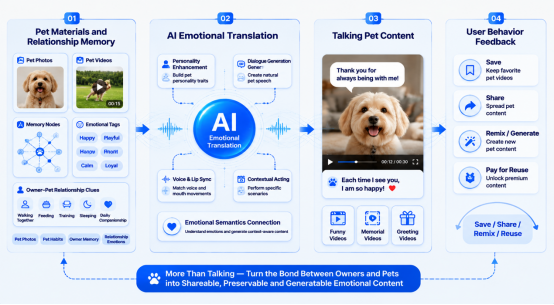
Technology solves the question of 'how to make the pet look like it is talking.' Relationship information determines whether 'what it says can make the owner believe it.' What AI completes here is not factual restoration, but emotional translation: converting the user's understanding, memories, and feelings about the pet into a piece of content that can be watched, saved, and shared.

This kind of 'reality' also does not mean the visuals must be indistinguishable from the real thing. Even if the result is obviously exaggerated, as long as the character's personality, tone, and specific context match the owner's understanding of the pet, it can still resonate.
This is also the dividing line between pet AI content and ordinary special effects. Ordinary special effects pursue a one-time visual transformation; pet AI content pursues character continuity: it feels like the pet this time, and still feels like the pet next time. Even when the scene and lines change, the user can still recognize that this is the same pet.
Templates make a pet open its mouth; relationship information makes the user feel, 'This is exactly it.'
3. Templates Generate, but Relationship Memory Determines Whether Users Come Back
The easiest misjudgment about pet AI videos is treating the surprise of a single generation as long-term product value. More natural lip-sync, more refined visuals, and richer voices certainly improve the first experience, but these capabilities will quickly become industry standards as models iterate.
When basic effects are no longer scarce, the real question a product needs to answer is: can it continuously understand the same pet?
This requires products to move from a one-time process of 'upload one photo and apply one template' toward building a long-term profile around the pet. Appearance features are only the most basic layer. Personality, habits, common actions, the owner's forms of address, family relationships, and shared experiences are the real keys to making content feel increasingly like that pet.
A dog that always waits by the door for its owner and a cat that tends to hide under the sofa and observe the whole family should not use exactly the same narrative logic. The former is suited to stories about waiting, reunion, and companionship; the latter may be better suited to dry humor, an observer's perspective, and family roasts. When a product remembers these differences, generation can move from random hits to stable expression.
The value of a pet profile lies not only in improving the accuracy of a single video, but also in lowering the cost of the next creation.
Users do not need to explain 'who it is' again every time. The system can directly call on the accumulated image, tone, and relationship background, then generate content according to a new holiday, location, or emotion.
This changes the unit of use for pet AI tools. What users purchase is no longer an isolated one-time generation, but a digital character that can continuously enter different stories.
Character consistency therefore matters more than the number of templates. A birthday greeting generated today, the first trip recorded tomorrow, and a growth recap made six months later all require the pet's appearance, voice, and personality to remain coherent. Only then can the content users save turn from scattered works into an accumulative relationship timeline.
Continuous scenarios also bring more natural reasons for use.
Daily roasts are suitable for sharing; birthdays and holidays are suitable for blessings; travel and growth are suitable for recording; illness, separation, and commemoration carry deeper emotions. Different scenarios are not about piling up templates, but about giving users new expressive entry points across the lifecycle of a relationship.
This path is slower than simply chasing trends, but it is also harder to copy. Hot templates can be followed by similar tools within days, but the long-term materials, settings, and shared memories accumulated around a single pet do not migrate easily. What users leave behind is not a generation record, but an increasingly complete set of relationship data.
For products, this is also the most valuable asset: model effects can be matched, templates can be replicated, but the history between a user and a specific pet is naturally unique.
Therefore, the product turning point for pet AI videos is not when generation quality reaches a dazzling technical standard, but when the system begins to have the ability to 'remember it.'
Once a product can remember who the pet is, how it tends to express itself, and what it has experienced with its owner, each new generation no longer starts from zero. Every creation supplements the context needed for the next creation, and the product gradually shifts from an effects tool into an editor for relationship content.
At that point, users come back not to try the same function again, but because there are new stories worth handing to this familiar character to express.
If users are willing to repeatedly generate content around the same pet in different contexts, pet AI video may become a sustainable niche content scenario.
4. The Value of Pet AI Content Will Move from Traffic to Relationships
Pet AI content connects two seemingly contradictory characteristics: an extremely low participation threshold on one end, and highly personalized emotional needs on the other. The former is suitable for user acquisition, while the latter is what may create differentiation and monetization.
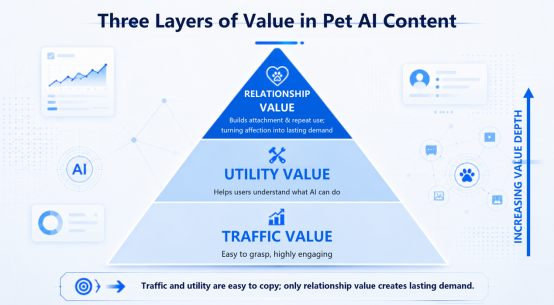
Along this path, the value of pet AI content can be roughly divided into three layers.

The first layer is traffic value. Pet material is common, emotionally dense, and easy to watch, making it a suitable entry point for general AI video tools. Users can upload one photo and see a result, quickly understanding capabilities such as lip-sync, dubbing, and character generation.
The second layer is tool value. Products need to let users stably control the pet's image, voice, actions, and scenes, while compressing a complex generation process into creative steps that are easy to modify. Competition here is about effects, speed, and controllability.
The third layer is relationship value. Pet profiles, character consistency, shared memories, and continuous stories allow products to keep accumulating content around the same pet. Competition here is not about who launches a template first, but who better understands what users want to express through this pet.
These three layers of value also correspond to the process through which this type of content moves from short-term excitement toward long-term use: traffic lets users see it, tools let users participate, and relationships let content continue accumulating after one generation. The first two layers determine whether it can spread quickly; the third determines whether it has a longer lifecycle.
From traffic value to relationship value, pet AI video does not present a ready-made commercial formula, but a migration of content value: as generation capabilities become increasingly widespread, what is truly scarce will no longer be the technology that makes pets speak, but the ability to make the expression feel more and more like the pet, and more and more part of the relationship between pet and owner.
What is truly worth noting about 'making pets speak' is not that AI has added another visual effect, but that the personality imagination, shared memories, and emotions between people and pets, which were once difficult to present directly, are being converted into content that can be made, watched, saved, and shared.
When a product only knows there is a cat or a dog in the photo, it offers a special effect. When it knows the pet's personality, habits, names, and shared experiences, it begins to offer relationship content.
How far this 'emotional business' can ultimately go depends on whether products can cross this step: from making a pet speak to remembering this pet; from creating a one-time surprise to accompanying users in continuous expression.
Templates are responsible for inviting users in; relationship expression is what may make users stay and pay.