文
A

In the first half of this year, Lilith made quite a few moves on the product side. Both the number of new games it revealed and the diversity of genres were eye-catching.

Among them, three titles are particularly worth watching: Clash of Critters, which has been in public beta in European and U.S. markets for more than a month and remains strong; Warline: Sniper Strike, a casual SLG with shooting gameplay that has gone through nearly a year of testing iterations and may officially launch in the second half of the year(hereinafter referred to as Warline); and Totally Mall: Merge & Gossip, Lilith's first merge-2 title that has just entered testing(hereinafter referred to as Totally Mall).

The outside world's typical perception of Lilith used to be card games, SLGs, and globally oriented mid-to-hardcore products. But from Clash of Critters and Warline to Totally Mall, Lilith's recent new titles share one common change: they all place lighter themes, lower entry barriers, and stronger casual packaging at the first point of product entry.
In addition to their vastly different genres, the above products are also at different product stages. So how have the products already in testing performed in terms of data? What testing cycle is each product currently in? How does a very early-stage new title like Totally Mall differentiate itself? In addition, these three products have one commonality despite their differences: a casualization trend. Does this mean Lilith is seeking a transformation? In the following sections, Diandian Global will break down and analyze these questions in detail.
01
More than one month into public beta, daily revenue remains stable above $300,000
Clash of Critters may become another Lilith classic
First, let's look at"Lilith's New Pet-Catching Game Enters Public Beta: Why Did It Earn $5.1 Million in 4 Days Despite 'Skipping Asia-Pacific + Restrained Ad Spend'?"an article published earlier by Diandian Global,which introduced Clash of Critters, a pet-themed, Coin Master-like vertical casual tower defense game. Readers can click the link to read the detailed gameplay analysis.

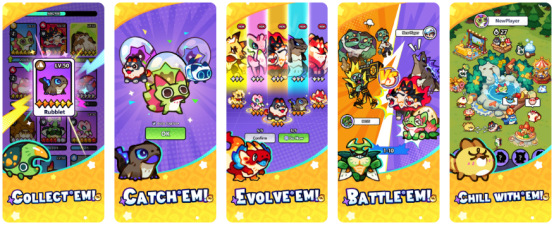
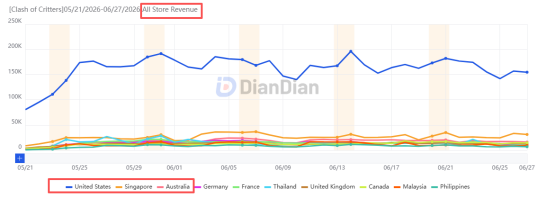
The game combines "pinball machine + pet raising + vertical lane-based tower defense + Coin Master-like" gameplay. It officially launched in 170 countries and regions worldwide on May 21. As of now(June 27), 38 days after public beta(first-month revenue was around $10.7 million, approximately RMB 72.6 million), its cumulative revenue is estimated at around $12.7 million(approximately RMB 86.1 million). The U.S., Singapore, and Australia ranked as the top three markets by revenue share at 48.71%, 7.88%, and 5.19%, respectively. By platform, the App Store held a slight advantage at 69.25%. In terms of RPD, the figure was about $2.04(approximately RMB 13.89).

Clash of Critters revenue trend since public beta
What deserves particular attention is that beyond the strong absolute revenue performance, Clash of Critters' daily trend sends an even better signal.
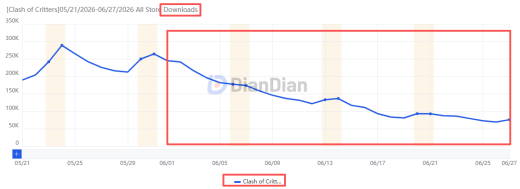
The game's first-day revenue was around $120,000(approximately RMB 813,000), with daily downloads of around 190,000. After that, as ad spending remained at a stable high level, daily downloads fluctuated between 200,000 and 290,000, while daily revenue grew slowly, reaching a peak of $410,000(approximately RMB 2.8 million)after 10 days. After the peak, ad intensity began to decline significantly, and daily downloads also fell quickly(currently around 75,000 daily downloads). Interestingly, however, daily revenue only fluctuated within a narrow range, basically stabilizing between $300,000 and $400,000, and currently sits at around $325,000(approximately RMB 2.21 million).


Image source: DataEye

Clash of Critters download trend since public beta
(The U.S., Russia, and Thailand ranked as the top three by downloads, accounting for 28.82%, 6.76%, and 6.44%, respectively)
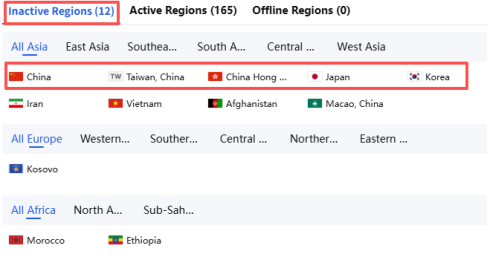
All of the above indicates that Clash of Critters is not a new game that "surges and collapses" before falling into silence. Through its highly recognizable "doodle sticker" art style and positive, satisfying gameplay loop, it has already stabilized its market performance. In addition, there are not many direct competitors in the current market, and ad spending appears likely to remain at a restrained level. After later launches in mainland China, Hong Kong, China / Macao, China / Taiwan, China, Japan, and South Korea, the title still has considerable growth room. Therefore, it should be able to provide Lilith with a stable, long-term revenue source going forward.

02
Warpath validated the feasibility of modern military-themed SLGs
Warline accelerates testing: monthly downloads surpass 1 million, with a possible launch this year
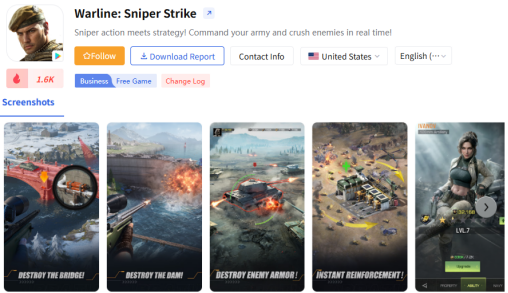
Second, and also most worth watching, Lilith is once again making a move in SLG, one of its strongest categories. Its new game Warline: Sniper Strike(hereinafter referred to as Warline)has already been listed on Google Play in more than 170 countries and regions worldwide, and has conducted two scaled-up overseas tests in the past six months.

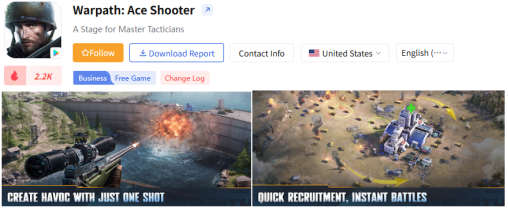
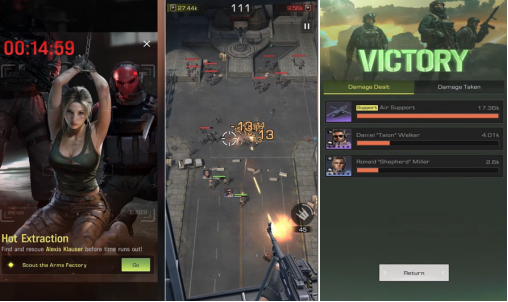
The title adopts a relatively hardcore and vertical modern military warfare theme, uses a realistic art style, and builds its gameplay framework around "first-person shooting + SLG." This product direction is very likely closely related to Lilith's previously released World War II SLG Warpath: Ace Shooter.

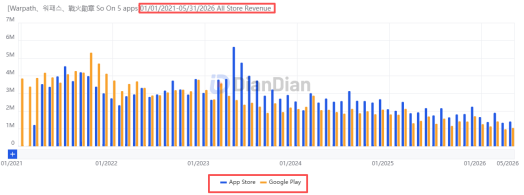
Warpath launched in November 2020. Its early performance was fairly average, but revenue continued to rise through ongoing iterations. Although it began to decline in 2024, monthly revenue currently remains stable at around $2.5 million(approximately RMB 17.25 million), and cumulative revenue since 2021 has reached $350 million(approximately RMB 2.4 billion, excluding mainland China Android). The U.S. accounts for as much as 310.19%, making it the best-performing modern warfare-themed SLG overseas at present.

Warpath dual-platform monthly revenue trend since 2021
Warpath helped Lilith validate the feasibility of modern military themes in overseas SLGs while also accumulating sufficient experience. Warline looks more like a lighter-weight entry point into the same direction.
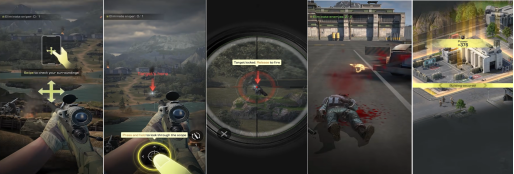
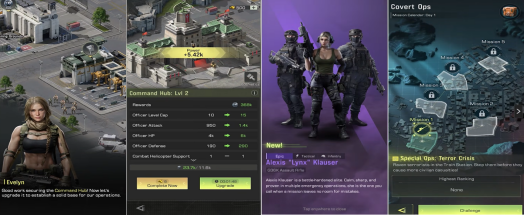
At the beginning of Warline, players are first placed in a modern warfare scenario and directly enter sniper/shooting stages, then quickly move into rescue missions. At this point, the core goals are to eliminate enemies, capture strongholds, build an operations base, and complete search-and-rescue tasks. Players need to aim at enemy soldiers, vehicles, or aerial targets across different battlefields, completing missions through sniping or vehicle-based shooting.
The advantage of this design is that modern military themes are already familiar to overseas users, while traditional war SLGs have a relatively high early entry barrier. By first letting players build satisfaction through aiming, headshots, and slow-motion kills, the game delivers theme immersion and operational feedback upfront.
During the process, through a very ample set of shooting missions, players gradually unlock inner-city buildings, which then lead into exploration of outer-city land plots. The level design also introduces hero-squad combat, thereby unfolding the progression system, while the later stages connect to longer-term SLG content.


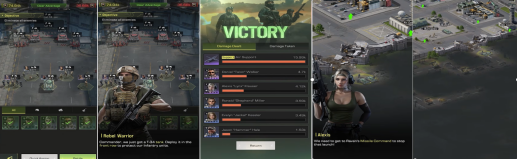
The game also includes some additional designs. For example, after joining an alliance, players can participate in intra-alliance shooting ranking competitions, further integrating shooting naturally into the SLG layer. Another example is the separation of gathering queues and combat queues.
Diandian data shows that Warline has been in iterative testing for nearly a year.
The game first appeared in a very small number of regional markets in mid-to-late July 2025. Ad material delivery also began at the end of the same month, and its official overseas social media accounts posted their first updates in early August;


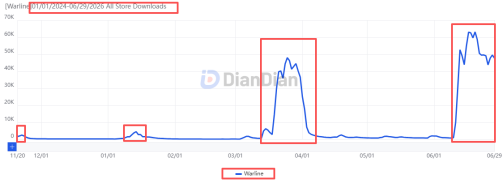
In mid-to-late November 2025, as ad spending increased slightly, the game began generating trackable data. At that time, daily downloads peaked at around 2,500, but quickly dropped to three digits. It was not until January 2026 that daily downloads briefly returned to four digits again, peaking at around 4,500 before falling back to three digits. During this period, no trackable daily revenue was generated;
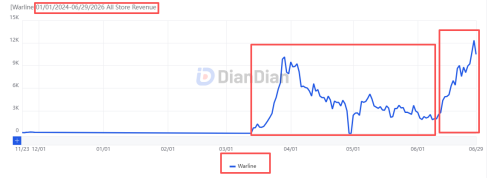
However, when the timeline reached mid-March 2026, things finally changed. The game launched in more regional markets, including the U.S., Indonesia, and France, and began its first scaled-up test, which lasted nearly two weeks. During this period, daily downloads rose from four digits all the way to a peak of 50,000, while daily revenue also reached a high of $10,000(approximately RMB 69,000). From a monthly data perspective, thanks to this first scaled-up test, downloads in March surged to 535,000(less than 2,000 in February), while revenue increased to $71,000(approximately RMB 480,000).

Warline download trend since testing began
Starting in April, ad intensity began to fall back, and monthly downloads dropped to 90,000. However, because of continued contributions from users accumulated earlier, monthly revenue reached $157,000(approximately RMB 1.06 million); May was largely a continuation of April, with monthly downloads and monthly revenue at 31,000 and $103,000, respectively(approximately RMB 704,000). But from that month onward, the game's official social media accounts began updating at a stable frequency;

Warline revenue trend since testing began
In early-to-mid June, the game entered more regional markets and began its second scaled-up test. As of now, ad intensity has not declined significantly, pushing the game's monthly data to a new high: monthly downloads reached 1 million, while monthly revenue reached $170,000(approximately RMB 1.2 million).

Image source: DataEye
As of now, the game has accumulated around 1.65 million downloads. Brazil, Indonesia, and the U.S. ranked as the top three markets by download share at 13.64%, 11.47%, and 8.93%, respectively. Total revenue is around $490,000(approximately RMB 3.34 million), with the U.S. ranking No.1 at 41.49%, followed by Germany and France.
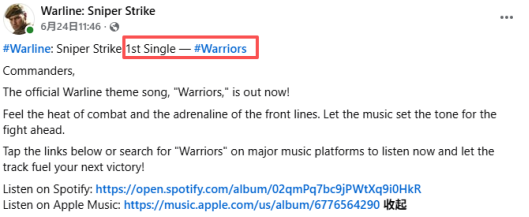
From a vertical development perspective, Warline has been in testing for close to a year, and the related data collected is already relatively comprehensive. In addition, the game conducted two scaled-up tests within four months this year, and the official team has recently begun releasing promotional materials such as trailers and theme songs. These moves clearly show that the game's overall process is accelerating, and it is highly likely to officially launch in the second half of this year.

03
An 1980s retro style + a light mystery teen-drama story hook
Totally Mall prepares to enter the crowded merge-2 battlefield
Next is Lilith's latest important move: entering the merge-2 category. This category has indeed become, after casual SLGs, one of the most-watched segments over the past two years, with the most blockbuster products, the most impressive revenue, the strongest long-term capabilities, and the most participation from well-known global Chinese publishers. It is therefore understandable that Lilith wants a share of the market.
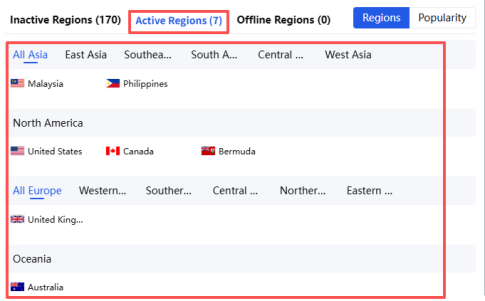
Diandian data shows that in mid-to-late June 2026, Lilith's publishing account "FARLIGHT" listed a new merge-2 title called Totally Mall: Merge & Gossip(hereinafter referred to as Totally Mall)on Google Play in seven regional markets including the U.S., Canada, Australia, the U.K., and Malaysia.


According to DataEye, Totally Mall conducted almost no ad delivery during this test. Based on exposed test videos, the game had only prepared two to three days of content, and it had already been removed from stores on June 30. It was most likely intended to validate core early-stage metrics such as initial retention.

As for what makes Totally Mall unique, we need to return to the specific content experience.
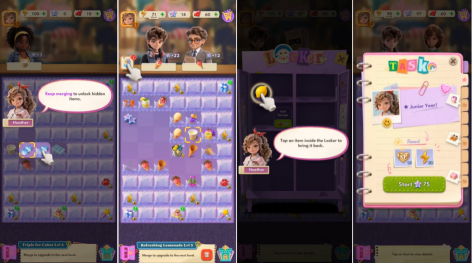
In terms of art, the game adopts a retro European and American cartoon style. The protagonist is a big-eyed, curly-haired girl wearing a denim jacket and red headband, holding 1980s consumer symbols such as cassette tapes, sunglasses, rainbow spring toys, and coffee. The overall visuals emphasize a retro, sweet, neon, and youthful feel.

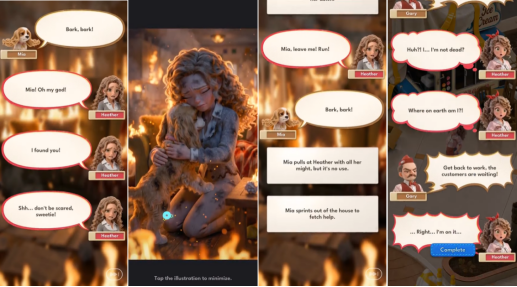
In terms of setting, players take on the role of an ordinary middle-aged woman who, after an accidental fire, returns to age 16 in the 1980s. In the seaside town of Santa Bella, players not only need to bring Oasis Mall back to life and turn it back into a popular teenage gathering place in the city, but also prevent the greatest tragedy of their younger years: the mystery of a friend's murder.


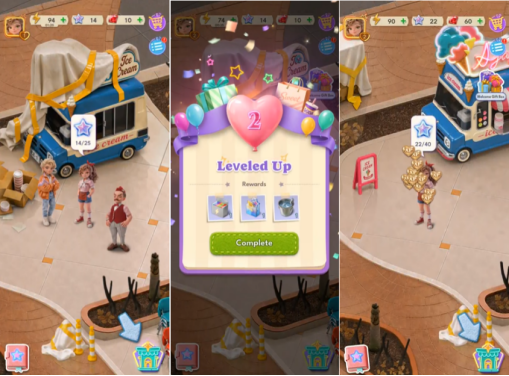
In gameplay, the core remains typical Merge-2. On the merge board, players combine two identical items into higher-level items, complete customer or story orders, earn resources for renovation, upgrades, or story progression, restore, upgrade, and decorate Oasis Mall's shops and public areas, unlock new characters, relationships, and clues, and continue investigating the truth behind the friend's death.

Compared with products such as Gossip Harbor and Love & Pies that combine "merge-2 + story gossip," this game's differentiation lies in its time-rewind setting and a story hook that feels more like a light mystery teen drama. On top of merging, it uses "youth rebirth + mall management + mystery investigation + interpersonal gossip" for hybrid storytelling.
Although Totally Mall did not generate trackable market data during this test, as Lilith's first product entering the merge-2 category, its follow-up moves will inevitably become more frequent, and Diandian Global will continue to watch it closely.
04 Summary
Through its recently launched new titles, we can clearly see that Lilith is paying increasing attention to casual games, and its overall new-game lineup appears to be tilting in that direction.
This change is first and foremost related to the continuous evolution of categories and shifts in user preferences in the broader market. Second, judging from the launch order of its new titles across different regional markets, Europe and the U.S., especially the U.S., are Lilith's most important core markets. Casual tower defense, casual SLGs, and merge-2 are precisely some of the categories that U.S. users are most willing to pay for at present. Therefore, capturing the current and future spending power of U.S. users has become an urgent priority for Lilith.
Overall, Diandian Global believes that although Lilith currently has many layouts around casualization and lighter-weight products, this should not be seen as a pivot, but more as an expansion. The company will not stop exploring card games, SLGs, shooters, or other mid-to-hardcore tracks.
Rather than saying Lilith is "transforming into a casual game company," it is more accurate to say that it is making the front end of its products lighter: using lower-threshold gameplay, more mass-market themes, and faster positive feedback to bring users in first, then connecting them to the long-term progression, social, live-ops, and monetization systems that Lilith excels at. This may also become a shared direction for a group of future mid-to-hardcore global publishers: not simply shifting from mid-to-hardcore to casual, but reshaping mid-to-hardcore games with casualized entry points.