文
A

Since the second half of last year, women's casual games have begun to break out across the board, becoming one of the clearest growth directions in China's domestic market. Unlike traditional otome games, which depend on characters, gacha pools, and story-heavy content, this wave of products places female-oriented strengths such as themes, art, narrative, and emotional feedback into more accessible gameplay frameworks including simulation management, merging, and idle mechanics. Developers then use WeChat and Douyin mini-games to acquire early users and validate monetization before expanding to app stores and overseas markets.
The most representative leading products are certainly My Garden World, which generated approximately $10.44 million in global revenue over the past month, equivalent to RMB 70.25 million and excluding the domestic Android version, and Fashion Department Store City, which generated approximately $6.10 million on China's domestic iOS platform over the past month, equivalent to RMB 41 million.
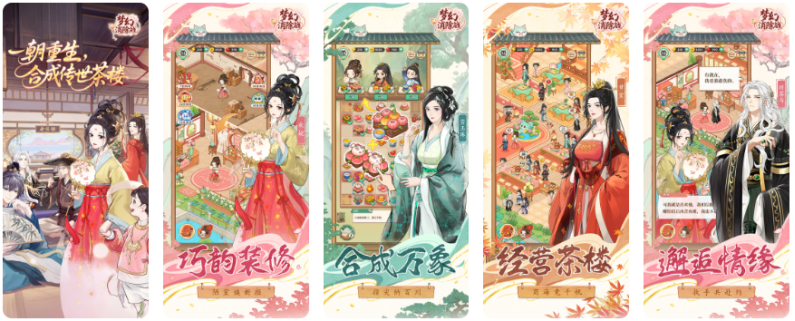
It is worth noting, however, that amid the battle for this emerging category, another powerful dark-horse title has not yet received the serious attention it deserves: Dream Merge, a game built around an oriental period-style teahouse and combining Merge-2, narrative, and renovation-and-construction gameplay.
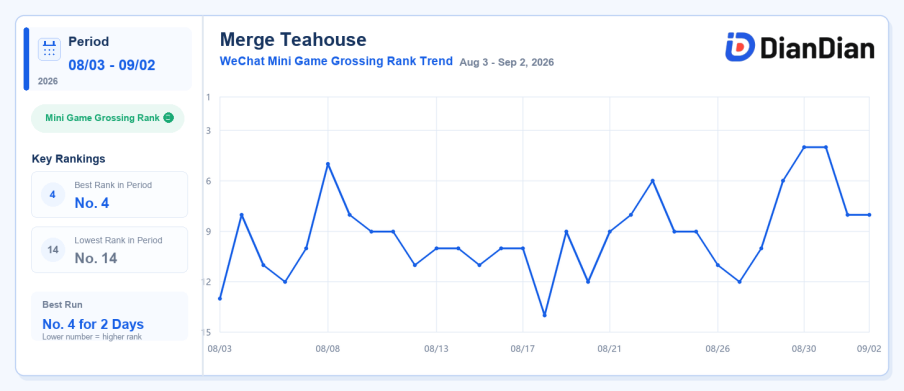
According to Diandian Data, after launching as a mini-game last year, the title performed strongly throughout. Over the past month, it never fell out of the Top 15 on the WeChat mini-game bestseller chart. Its overseas version, Merge Teahouse, has also become a major focus. Since launching early this year, its revenue has surged steadily, with monthly revenue now reaching $3.84 million, equivalent to approximately RMB 25.8 million.
So what kind of product is Dream Merge / Merge Teahouse? What testing process and platform transitions has it gone through? What market results has it achieved? And what does it mean for its developer, Fantang Games? Diandian Overseas breaks down and analyzes these questions below.
01
The Domestic Mini-Game Holds Up the Core Business
Overseas Revenue Grows for Seven Consecutive Months, with Monthly Revenue Nearing RMB 27 Million
Public information shows that Dream Merge was developed by Shanghai-based Fantang Games and published by Xipu Games. The latter's actual controller is also one of the former's major shareholders. Viewed along a chronological timeline, the game went through a relatively long preparation period.
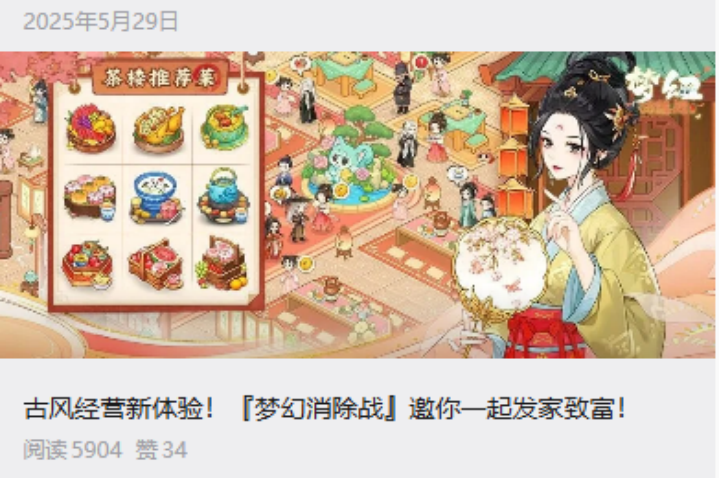
The title obtained its publication approval as early as 2020, but no public information about it emerged for a long time. It was not until the end of May 2025 that the official WeChat account first revealed the product, marking its entry into a more clearly defined phase of market rollout.
In terms of platform strategy, like most women's casual games, it chose mini-games as its primary breakthrough channel. Around August 2025, the title began accumulating users on WeChat mini-games and entered the Top 100 bestseller chart. It subsequently climbed into the 30s, then entered Douyin's Hot and Bestseller Top 20 in October of the same year, and rose to No. 9 on Douyin's bestseller chart in early December.
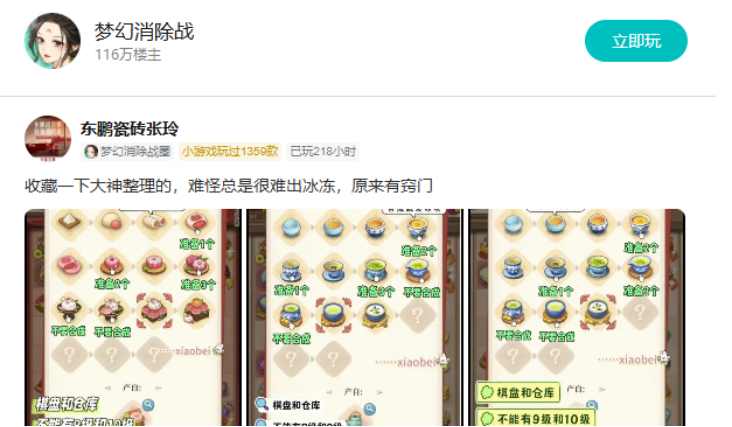
As its ranking improved, the game also established a community system centered on energy and events. Players can obtain additional energy through check-ins, comments, posts, and mutual link clicks. The community simultaneously handles benefit distribution, user reactivation, and viral sharing. By the end of 2025, its WeChat game community had gathered approximately 390,000 users and more than 4.79 million posts, while the 20 Douyin communities operated by the official team had nearly 19,000 members in total.
More importantly, the mini-game's strong performance has continued to this day. It has not fallen out of the WeChat mini-game Top 50 over the past month and currently ranks No. 8. This performance shows that the mini-game is no longer merely an early user-acquisition entry point, but has become a core domestic revenue channel.
Compared with its mini-game operations, the company invested significantly less effort and resources in the app version, and its market performance has naturally been more limited.
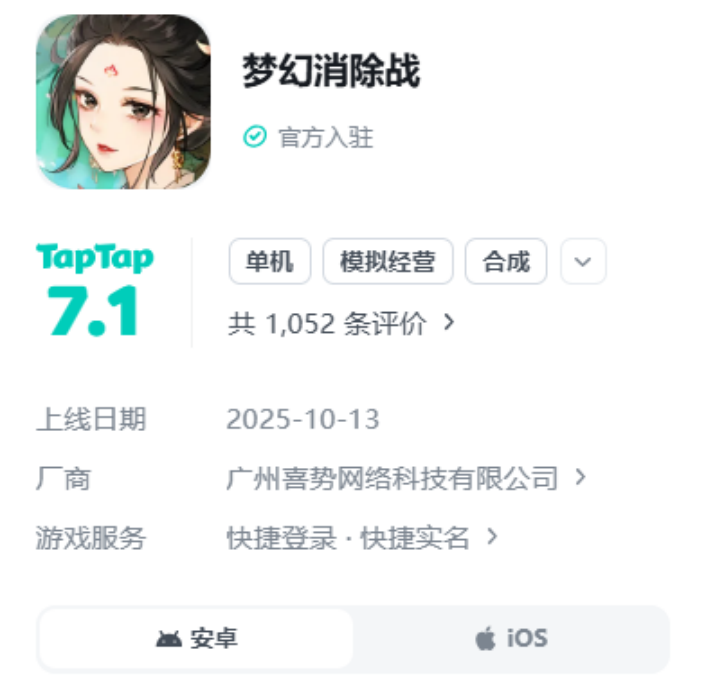
The official TapTap page shows that the Android version launched in October 2025, while the domestic iOS version officially launched in December. As of August 29, 2026, cumulative downloads of the domestic iOS version were approximately 297,000, while total revenue was only $1.242 million, equivalent to RMB 8.36 million. iOS revenue over the past 30 days was approximately $562,000, equivalent to RMB 3.78 million.
Clearly, the domestic app is not currently the strongest channel. This may explain why the product previously received limited industry exposure: its main achievements were concentrated in mini-games rather than in app charts, which are easier for the market to observe.
At the same time, what truly allowed Dream Merge to reveal more of its potential was its overseas version, Merge Teahouse.
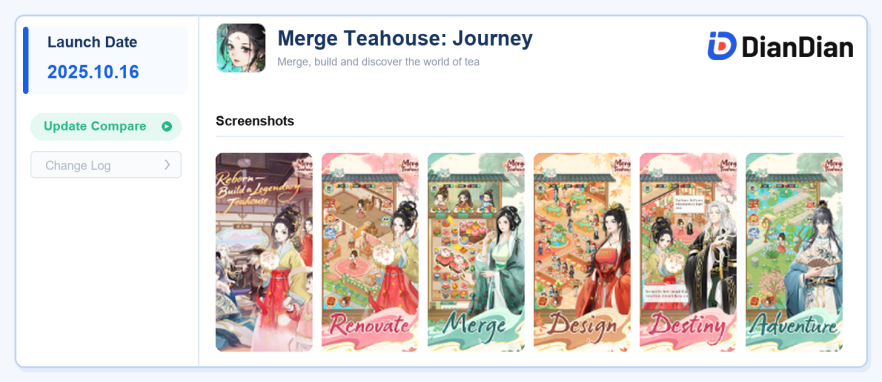
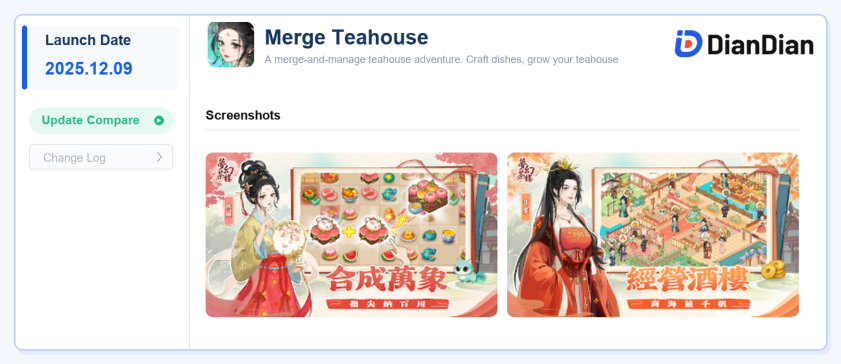
Diandian Data shows that in mid-October 2025, the title conducted early testing under a package named Merge Teahouse: Journey, but the package was removed one month later. In early December of the same year, Merge Teahouse was launched on both major platforms in most countries and regions and opened for pre-registration.
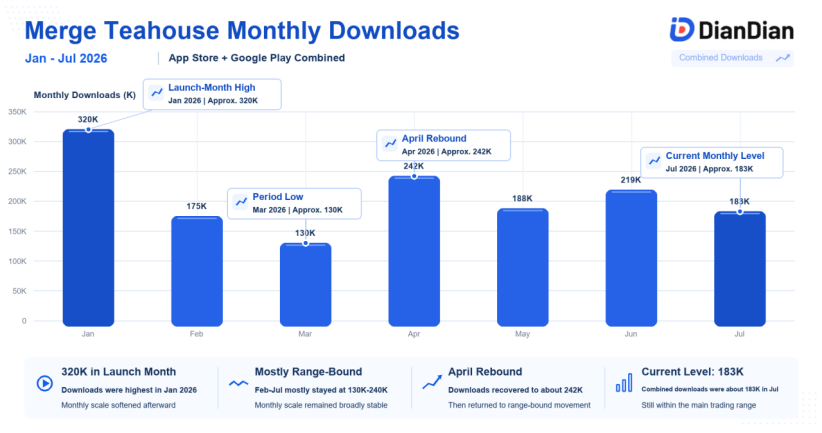
By mid-January this year, the overseas version officially entered testing. It recorded approximately 320,000 downloads in its first month. Monthly downloads declined slightly afterward, but generally fluctuated between 130,000 and 240,000, and currently stand at approximately 183,000.
Compared with relatively stable user additions, the growth on the revenue side is more noteworthy.
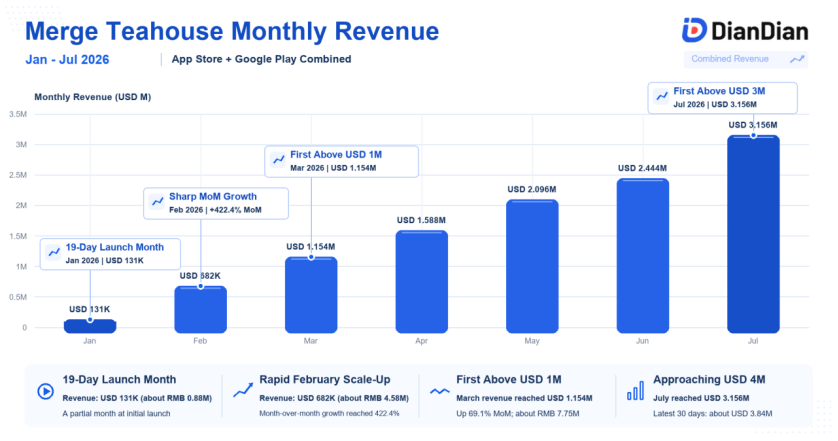
Specifically, because January covered only 19 days, revenue for that month was approximately $131,000, equivalent to RMB 880,000. February revenue was approximately $682,000, equivalent to RMB 4.58 million, representing a sharp 422.4% month-on-month increase. In March, revenue grew another 69.1% to $1.154 million, equivalent to RMB 7.75 million, surpassing $1 million for the first time. The product then entered a sustained upward climb. Revenue reached $3.156 million in July, equivalent to RMB 21.2 million, exceeding $3 million for the first time. Over the past 30 days, revenue was approximately $3.84 million, equivalent to RMB 25.8 million, and it continues to approach $4 million in monthly revenue.
To date, the title has accumulated approximately 1.6 million downloads. South Korea, the United States, and Japan ranked as the top three contributors, accounting for 24.56%, 21.84%, and 21.76%, respectively. Total revenue was approximately $15.10 million, equivalent to RMB 101 million, with Japan, South Korea, and the United States accounting for 33.12%, 21.42%, and 17.8%, respectively.
The download and revenue trends, together with the operation of its overseas accounts, make it clear that Merge Teahouse has not made sustained, large-scale investments in paid user acquisition. Instead, it places greater emphasis on community operations. Its Facebook page currently has approximately 31,000 followers. It has also established Instagram and YouTube accounts, as well as X accounts for users of different languages. Daily content mainly covers version events, redemption codes, character stories, holiday themes, and community rewards, helping maintain ongoing player contact and event participation.
From this perspective, Dream Merge was not simply a domestic app translated and pushed overseas. Instead, it went through mini-game validation, a domestic app supplement, adjustments to its overseas test package, and multilingual distribution. Although the domestic and overseas channels followed different paths, they separately validated the product's version content, event supply, user retention, payment depth, and community-operation capabilities.
02
Merge, Ongoing Story Releases, and Renovation: The Underlying Rules Are Not New
A Period-Style Rebirth and Revenge Story Creates Differentiation
Although the domestic title contains the word 'elimination,' Dream Merge is not a traditional match-three game. It is a merging game built around Merge-2 mechanics.
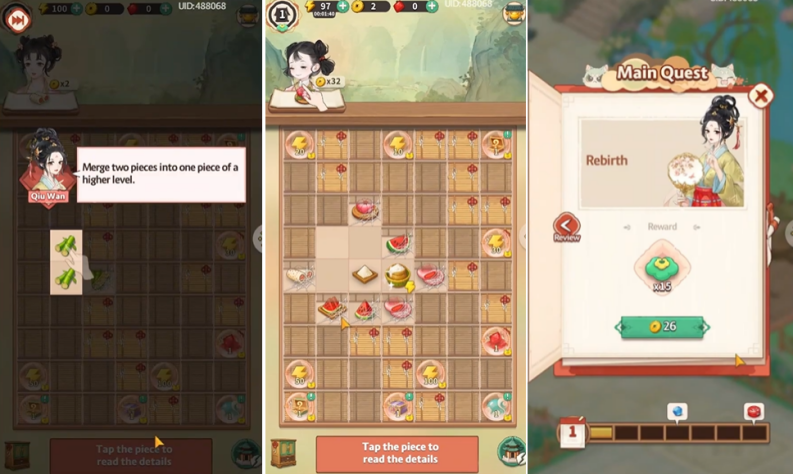
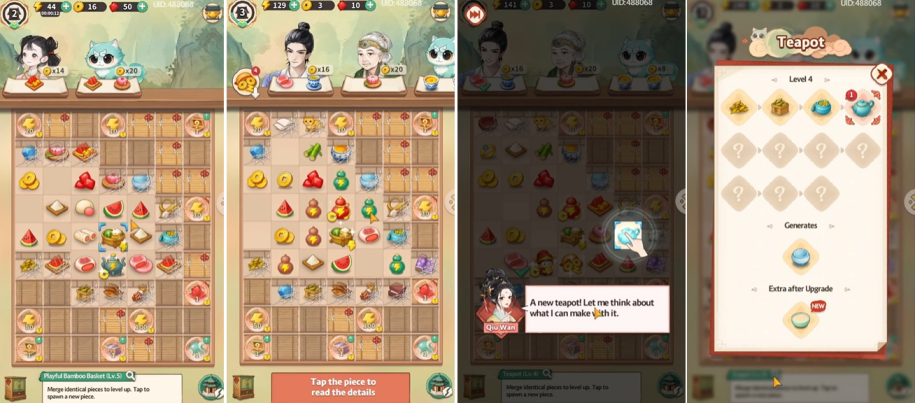
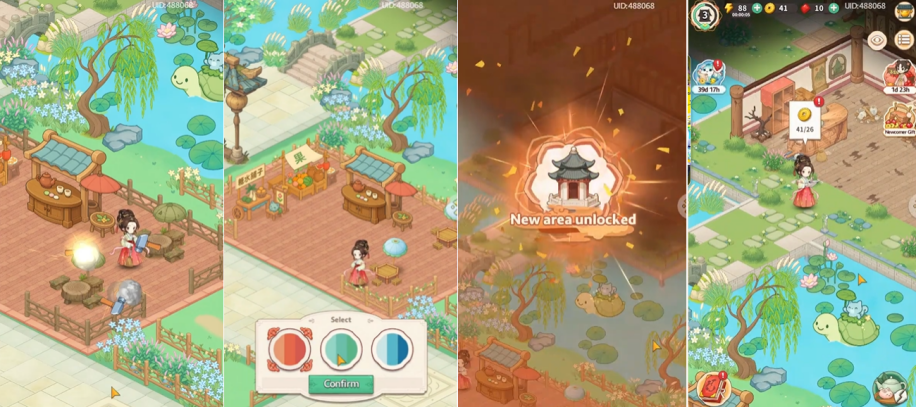
Players tap generators to obtain basic items such as tea leaves, pastries, fruit platters, food boxes, jewelry, embroidered goods, lanterns, and dressing cases. They then merge two identical items into a higher-level product, fulfill customer orders, and earn coins. Coins are used to unlock chapters, repair the teahouse, and replace furniture, moving players into the next stage of the story and order requirements.
The complete loop can therefore be summarized as follows: generators produce items; items are merged and upgraded; orders are completed; coins and resources are earned; the story advances; the teahouse is repaired; and new character relationships, scenes, and events are unlocked.
The underlying rules are not complicated. The light strategy mainly comes from energy, board space, generator cooldowns, and order selection. Players must avoid allowing low-level items to fill the board, while also deciding whether limited energy should be invested in ordinary orders or more time-consuming special orders. As higher-level requirements increase, resource planning will become progressively more important.
Beyond this mature merging framework, the game's primary differentiation comes from its story.
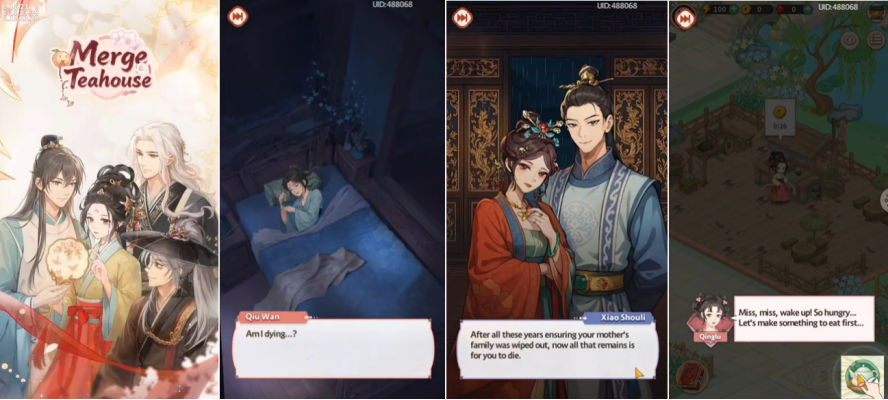
In her previous life, the heroine Qiu Wan trusted her lover to the wrong person and ultimately suffered betrayal by her closest relatives and the destruction of her family business. After being reborn, she decides to start over from the family teahouse. She runs the business and protects her friends and relatives while investigating the truth behind the teahouse's secret recipe, a fragmentary medical formula, and the case that destroyed her family. The story itself does not depart from the familiar formulas of rebirth and revenge, a female-led comeback, and romantic entanglements with multiple characters, but it still feels relatively fresh within the Merge category. The game continually leaves mysteries through memories of her previous life, a body in the back courtyard, an incomplete medical formula, and different factions' attempts to uncover the teahouse's secrets. As a result, the player's goal is not merely to complete the next order, but also to continue unlocking the story that follows.
This sense of following an ongoing series is the key link connecting the product's story and gameplay.
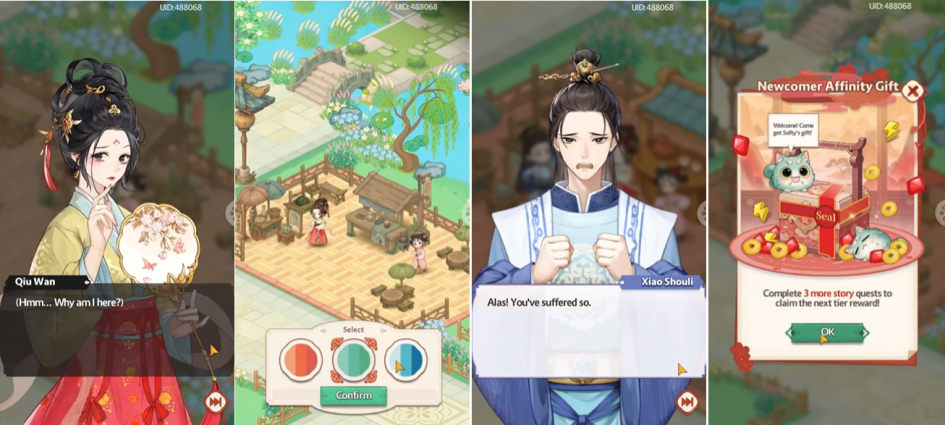
Teahouse management and renovation provide progress and visual feedback rather than complex simulation management. Coins are mainly used to clear ruins, repair buildings, unlock chapters, and replace furniture. Although the store copy emphasizes the number of furniture items and the freedom of decoration, the actual experience is closer to 'merge orders + chapter-based narrative + renovation showcase.' There are no complex production chains, staff scheduling, or management decisions.
The art continues Fantang's longstanding strength in female-oriented presentation. Story dialogue uses period-style 2D character illustrations, with facial expressions, movements, and localized animation used to strengthen character performances. Maps and teahouse scenes use animated chibi characters, reducing the cost of continuously producing content. Compared with similar mini-games, its advantage lies not in technical specifications, but in maintaining a relatively unified oriental classical style across its characters, art, themes, and scenes.
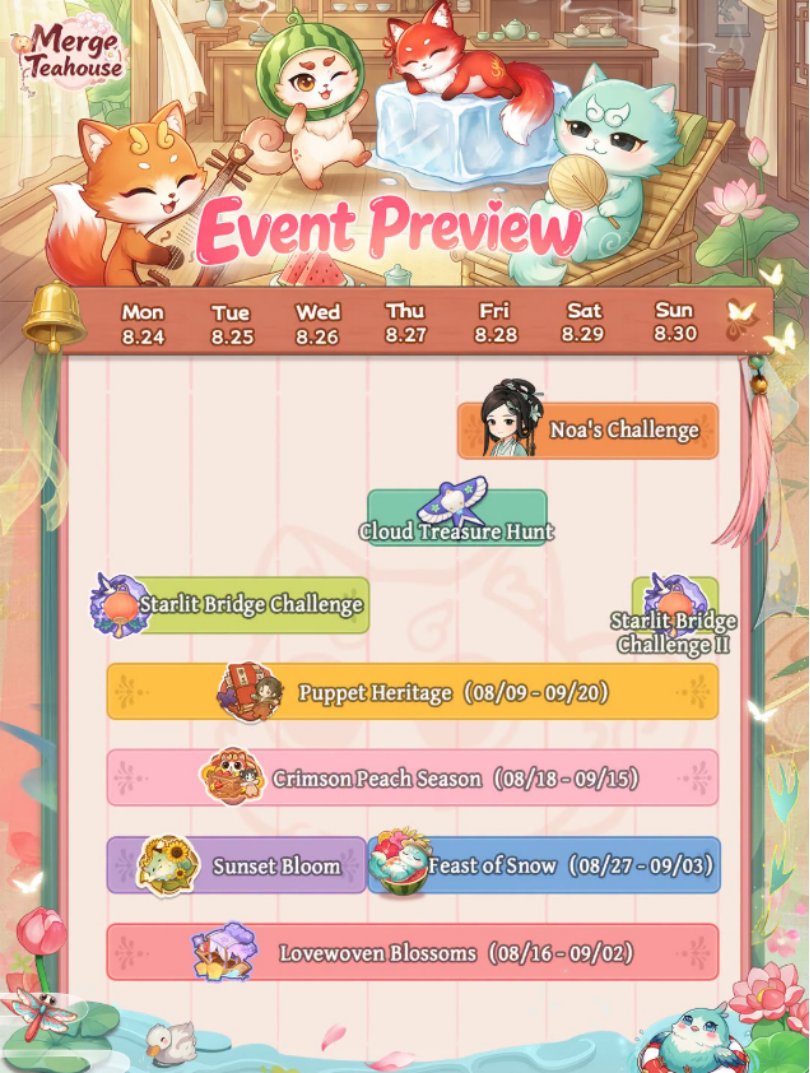
Long-term content is supplemented mainly by themed events, collection systems, and leaderboards. The game has already introduced activities and features including frozen-pear digging, vegetable-garden watering, coin competitions, a hot-spring season, an illustrated collection, and card collecting. The domestic version has also added traditional cultural elements such as Suzhou embroidery and puppet theater, further reinforcing the teahouse and oriental period-style packaging.
Of course, the problems with this structure are also clear. As higher-level orders appear in greater concentration, energy consumption, generator waiting times, and pressure on board space will all increase.
Overall, Dream Merge's competitiveness does not lie in the Merge-2 rules themselves. Rather, it repackages a mature gameplay loop through a period-style teahouse, rebirth and revenge, and an ongoing narrative, then strengthens retention through mini-game communities and frequent events. The product has already demonstrated that this combination can attract users. What remains to be tested is whether its story and event supply can keep pace with revenue growth over the long term.
03
More Than a Decade of Accumulation in Anime-Inspired and Female-Oriented Games
Fantang Rebuilds Its Product Model Around Mature Gameplay
The level of polish shown by Dream Merge in its art, characters, and story is closely connected to developer Fantang Games' long-term experience with female-oriented and mid-to-hardcore anime-inspired products.
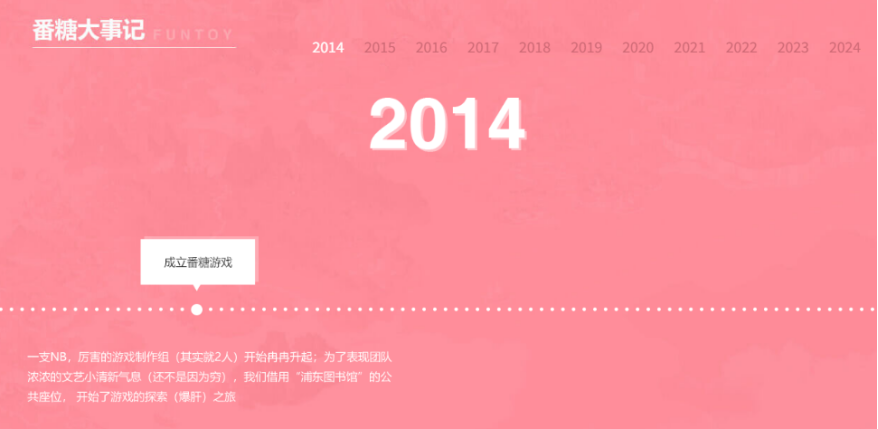
Fantang Games was founded in 2014 with an initial team of only two people. Judging from the company's subsequent direction, it has consistently focused its product portfolio on anime-inspired content, character development, and female-oriented games.
Its first product, Natsume's Beautiful Diary, released in 2015 and brought the company into the industry's view. The game combined female-oriented romance development with dress-up gameplay, and Hero Entertainment acquired a five-year publishing agency right for RMB 2 million. It received multiple store recommendations and attempted an overseas release, but its long-term commercial performance in China was relatively ordinary. In 2019, operating rights returned to Fantang, and the game was removed from China's mainland iOS platform in 2022.
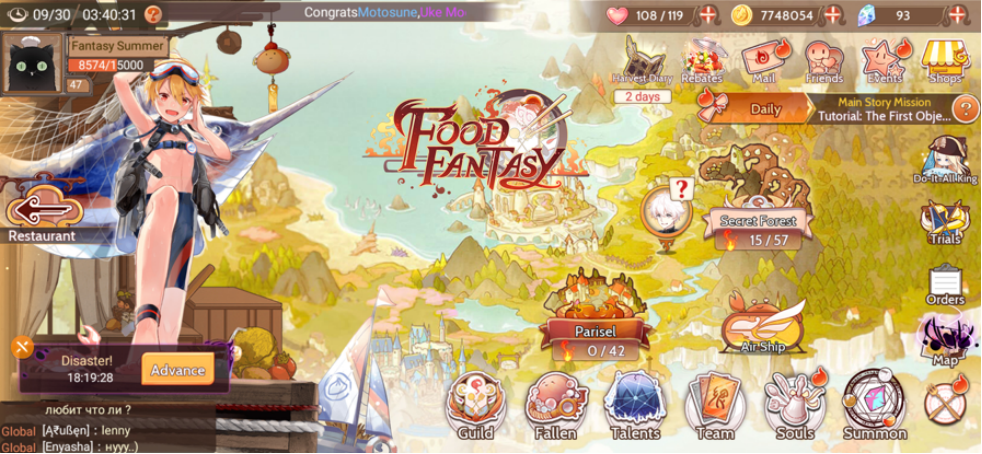
Fantang subsequently shifted toward anthropomorphic food characters and character development. After three rounds of rebuilding from scratch and seven rounds of large and small tests, Food Fantasy launched at the end of 2017 and became the company's first product to establish a genuinely long-term revenue stream.
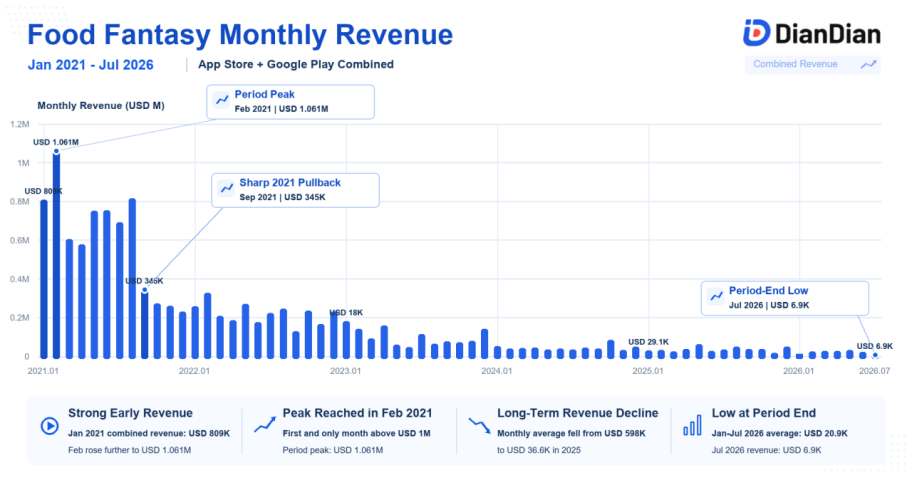
During its initial launch period, the title's peak monthly revenue reached as high as $4.5 million, equivalent to approximately RMB 30 million. Beginning in 2018, the game gradually expanded overseas, further increasing revenue. However, as its operating life grew longer, the game inevitably entered a declining cycle at the end of 2021. From 2021 to the present, its cumulative revenue has been only $12.2 million, equivalent to RMB 82 million and excluding the domestic Android version.
Of course, Food Fantasy's early performance also gave Fantang the ability to invest in a larger-scale product: Code Name: X.
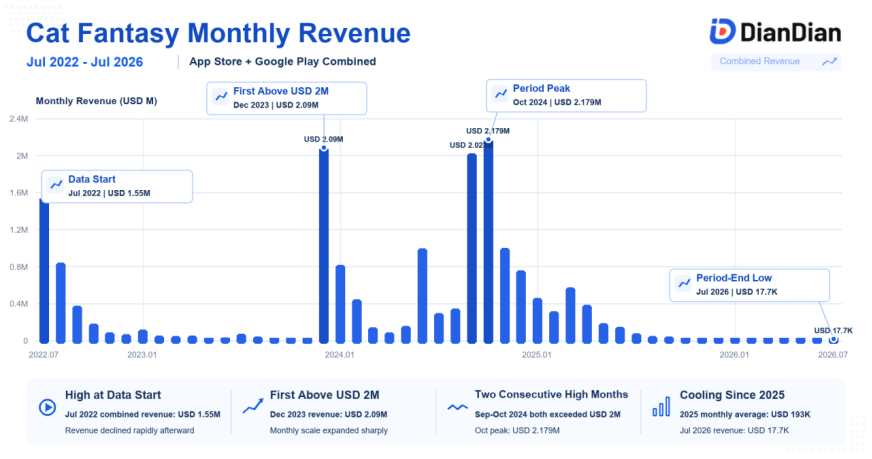
The title used a framework combining anthropomorphic cats, a lightly cyberpunk city, and strategic RPG gameplay. It was first revealed in 2020, and pre-registration exceeded 4 million before the open beta. To advance the project, Fantang's team temporarily expanded from several dozen people to more than 200. After launching in China in July 2022, the game reached as high as No. 19 on the iOS bestseller chart, but soon began to decline. Fantang did not immediately give up. It continued to deliver major rework updates, launched Version 2.0 in China, and gradually brought the product to Hong Kong, China and Macao, China, Japan, South Korea, Europe, and North America. The overseas launch did bring several waves of new users and revenue growth, but the game never established a stable high-level performance.
Diandian Data shows that from 2021 to the present, the game has accumulated approximately 4.918 million downloads globally and approximately $17.375 million in revenue, equivalent to RMB 117 million. Revenue during the first eight months of this year was down to only $115,000, equivalent to RMB 774,000.
As Code Name: X came under pressure in long-term performance, Fantang's organizational scale also contracted. Business-registration annual reports show that its headcount fell from 248 in 2021 to 84 in 2024, while its office moved from Xuhui to Jiading. In 2025, the market also reported layoffs on the Code Name: X project team. Although personnel changes cannot be attributed entirely to a single product, the failure of the high-cost anime-inspired route to generate stable returns was an important backdrop to Fantang's subsequent product-direction adjustment.
It is against this backdrop that the value of Dream Merge / Merge Teahouse lies in more than simply launching another new game.
On the one hand, it continues Fantang's existing strengths. Period-style characters, female-oriented storytelling, ongoing narrative, and overseas localization all draw on experience from Natsume's Beautiful Diary, Food Fantasy, and Code Name: X. On the other hand, it clearly reduces the burden of gameplay and content production, placing the art and narrative capabilities once used for mid-to-hardcore products into a Merge-2 and mini-game framework.
More importantly, the product has completed an initial transition from domestic mini-games to apps and then to both major overseas platforms. The domestic mini-game provided users and baseline revenue, while the overseas version continued to grow over more than seven months and generated approximately $15.1 million in revenue. For Fantang, which has experienced team contraction and gaps between products, this is one of the few new products in recent years to have generated relatively clear market feedback.
Dream Merge / Merge Teahouse has not only helped Fantang temporarily move beyond its previous operating pressure, but has also shown that it does not need to keep expanding its team or raising production specifications to find its next product. Fantang appears to have finally found a product model that better matches its scale while connecting domestic mini-games, apps, and overseas markets. Its next task is to further develop a female-oriented casual product line capable of sustained output.