文
A

Downloads and Revenue Diverge as Google Play's Share Continues to Grow on Both Metrics
According to Diandian data, total mobile game downloads and revenue in Japan and South Korea increased by 2.95% and 1.48% quarter on quarter, respectively, in Q2 2026. South Korea stood out in both downloads and revenue, with revenue growth exceeding 3.61% quarter on quarter, making it the main force behind the region's overall growth. Compared with the same period in 2025, mobile game downloads in Japan and South Korea increased by 9.87%, approaching double-digit growth. Revenue growth, however, was relatively moderate, resulting in a degree of divergence between downloads and revenue.
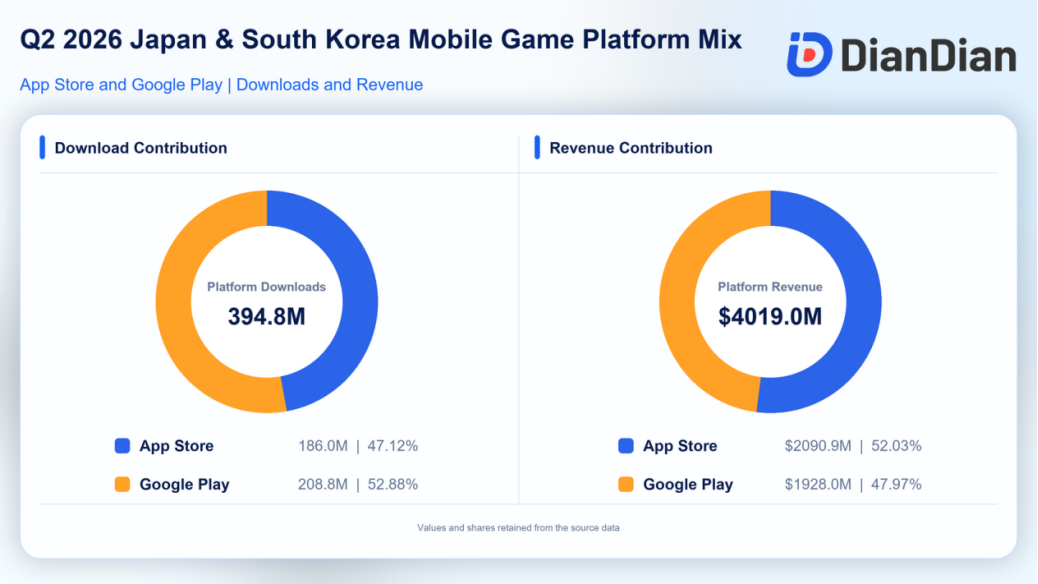
By platform, unlike markets such as Southeast Asia where Android platforms hold an overwhelming lead, the two platforms contributed relatively balanced shares of both downloads and revenue in Japan and South Korea. The App Store nevertheless demonstrated stronger user spending power and commercialization efficiency, contributing 52.03% of revenue from 47.12% of downloads. Based on platform data, App Store revenue per download was approximately 1.2 times that of Google Play. In terms of platform-share trends, Google Play's share of both downloads and revenue has continued to grow over the past two years, becoming the main driver of the increase in the region's total mobile game count and performance.
By category, casual, puzzle, and simulation were the three leading categories by mobile game downloads in Japan and South Korea, while sports and racing products recorded some of the strongest growth. By revenue, role-playing, strategy, and action led the market, with midcore and hardcore products continuing to form the commercial foundation of the region. Notably, desktop-style card and board games recorded particularly strong revenue growth, rising more than 27.9% quarter on quarter.
Popular Casual Mechanics Travel Well as Localization Unlocks the Potential of Proven Formats
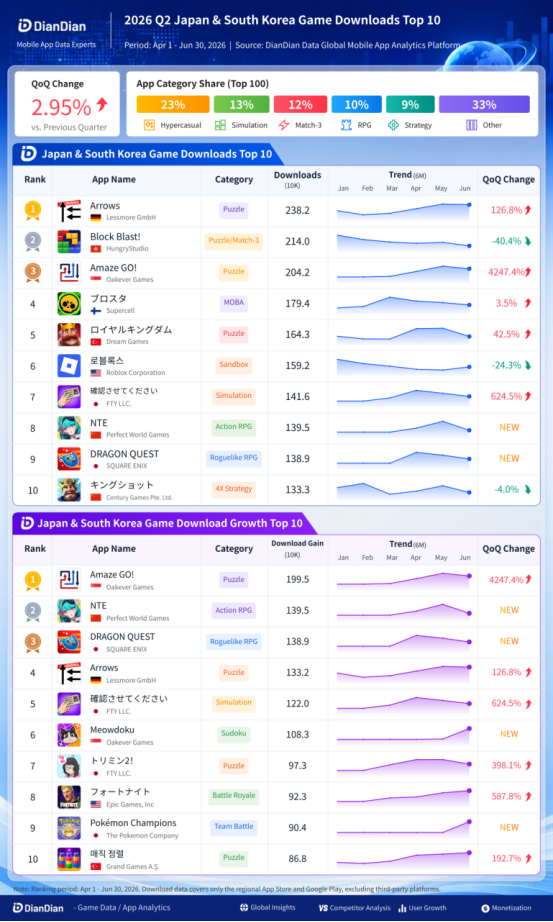
During the period, several light casual puzzle products performed strongly by downloads in Japan and South Korea. In addition to the globally popular arrow-puzzle titles Arrows and Amaze GO!, which topped the regional mobile game download and fastest-growing download charts with more than 2.38 million downloads and 1.99 million incremental downloads, respectively, the classic match-3 title Royal Kingdom and the new Sudoku-inspired creative title Meowdoku also delivered solid results. These examples show that even in mature Tier-1 markets such as Japan and South Korea, light gameplay still has considerable room for user expansion.
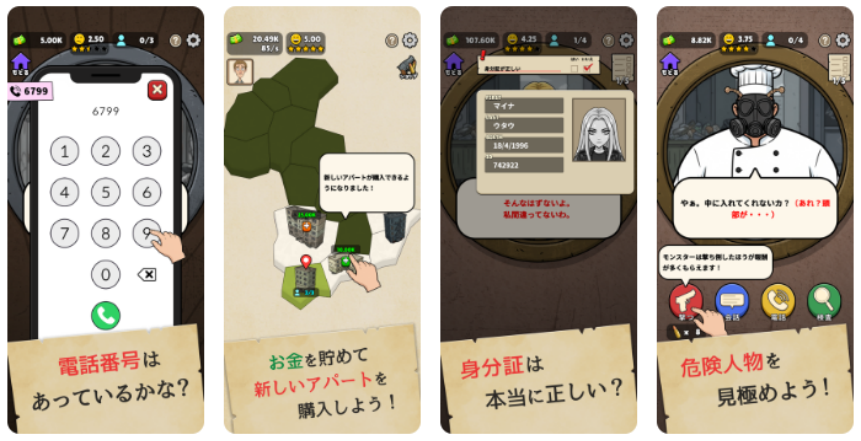
The two products released by Japanese publisher FTY LLC., Kakunin Sasete Kudasai and Torimin 2!, which appeared in this period's rankings, may provide further evidence. The former's core 'identity judgment' mechanic has already produced global hits such as Papers, Please and Quarantine Zone: The Last Check. This title places the scenario in apartment management, which is more familiar to Japanese users, and asks players to screen tenants from among ordinary people, criminals, and monsters. The latter continues the 'think outside the box' theme, integrating mobile puzzles, spot-the-difference tasks, and choice-based judgments into localized scenarios.
Identity judgment and lateral-thinking puzzles are not entirely new mechanics. What FTY LLC. has done as a Japanese publisher is make the language style, visual packaging, humor, and content pacing more relevant to local players, adding situational immersion and shareability to familiar mechanics. It also lowers the barrier to play through short-form design, making the products better suited to local players' fragmented entertainment habits. The rapid rise and user acquisition of both titles validates the viability of reconstructing mature gameplay mechanics through localization.
In Tier-1 markets such as Japan and South Korea, publishers may not need to rely on complicated system innovation. Recombining existing mechanics through locally resonant thematic packaging, scenario design, and emotional feedback can also reactivate user interest.
Chinese Products Lead as Midcore and Hardcore Games Dominate Revenue
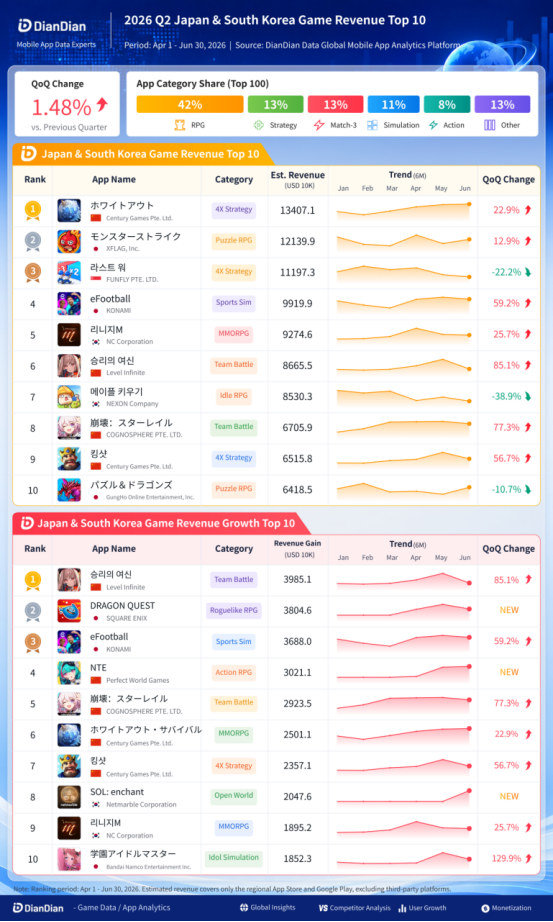
The Q2 revenue rankings show that midcore and hardcore categories such as role-playing, strategy, and action remained the main sources of mobile game revenue in Japan and South Korea. Chinese products stood out in particular. Century Games' snow-and-ice post-apocalyptic survival strategy game Whiteout Survival retained the top spot in the regional mobile game revenue ranking, with estimated quarterly revenue exceeding US$134 million. The same publisher's Kingshot also maintained strong momentum, with estimated revenue exceeding US$65.15 million, up more than 56.7% quarter on quarter.
Anime-style products also experienced a concentrated surge in revenue. Goddess of Victory: NIKKE and Honkai: Star Rail recorded quarter-on-quarter revenue growth of approximately 85.1% and 77.3%, respectively, driven by user reactivation around their 3.5-anniversary and third-anniversary versions. Goddess of Victory: NIKKE topped the fastest-rising revenue chart with an estimated revenue increase of more than US$39.85 million. Chinese products have now moved beyond breakthroughs by a handful of leading titles in Japan and South Korea and are gradually expanding into multiple segments, including team-based combat, 4X strategy, MMORPGs, and action role-playing games.
The performance of new releases further confirms domestic publishers' ability to distribute and monetize products in Japan and South Korea. NTE, a new action role-playing game from Perfect World Games, generated nearly 1.4 million downloads in its launch quarter and estimated revenue of more than US$30.21 million, ranking fourth on the regional fastest-rising revenue chart. Despite lacking the foundation of a mature local IP, the title quickly entered the field of view of core Japanese and South Korean users through its art, character development, and open-ended content. Its early performance on both platforms also shows that Chinese publishers are gaining a deeper understanding of local users' aesthetic preferences, content needs, and spending behavior.
At the same time, the influence of local IP remains significant. Dragon Quest, released by Square Enix, entered the regional fastest-rising game revenue chart at No. 2 in its launch quarter with estimated revenue exceeding US$38.04 million. The gap between its download scale and revenue performance highlights the monetization advantages of established IP such as Dragon Quest in Japan and South Korea. Long-accumulated brand awareness, world-building, and a core user base remain strong competitive barriers in these markets.


Downloads and Revenue Rise Steadily as Platform Monetization Efficiency Gradually Converges
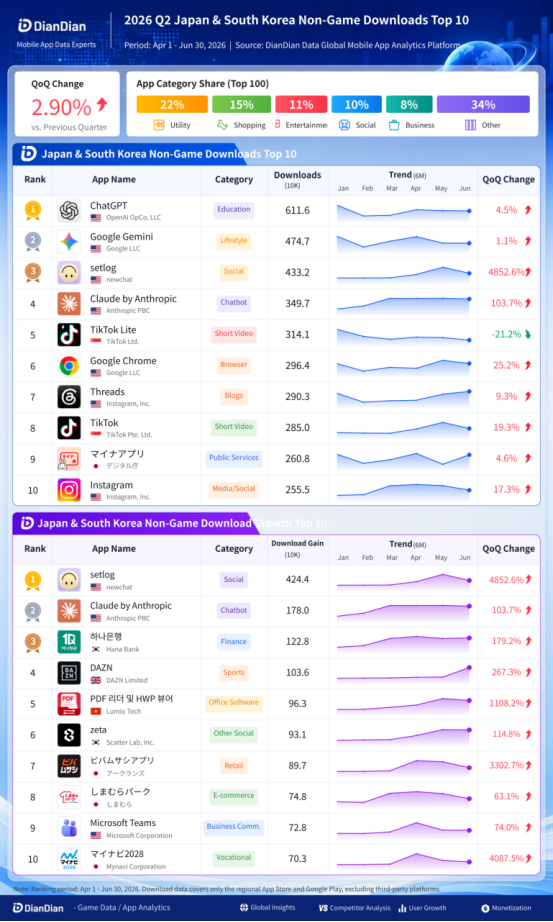
The non-game app market in Japan and South Korea grew slightly faster than the game app market. Total downloads and revenue increased by 2.9% and 2.89% quarter on quarter, respectively, maintaining a steady upward trend. Japan outperformed South Korea in both non-game app downloads and revenue growth, becoming the main factor driving the region's overall Q2 improvement. Year on year, non-game app downloads grew by nearly double digits, at 9.47%, further confirming that mature app markets in Japan and South Korea still have relatively stable demand for new users.
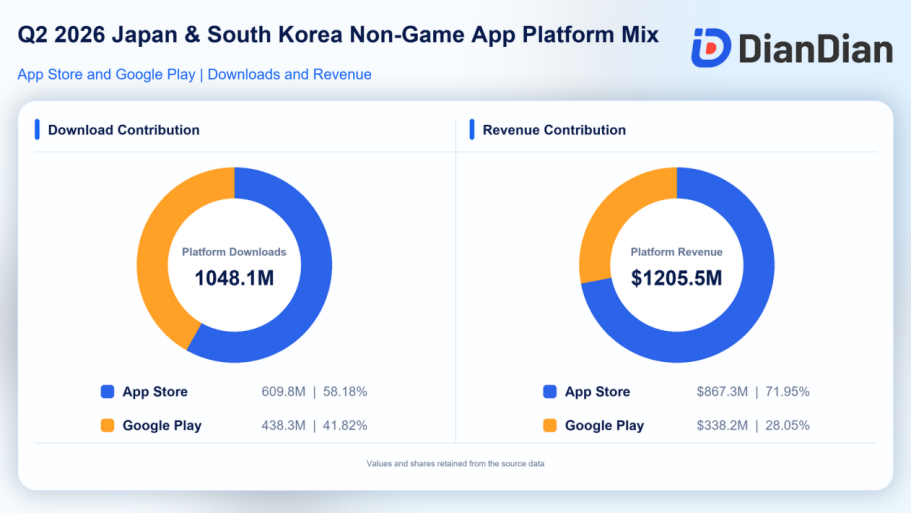
By platform, the App Store accounted for a relatively large share of both downloads and revenue in game apps, especially on the revenue side where its share exceeded 70%, giving it a clear lead in platform data. Based on platform data, the App Store's relative revenue per download was approximately 1.8 times that of Google Play, higher than in game apps. Over the past year, however, Google Play's share of revenue contribution has continued to rise, and monetization efficiency between the platforms is gradually converging.
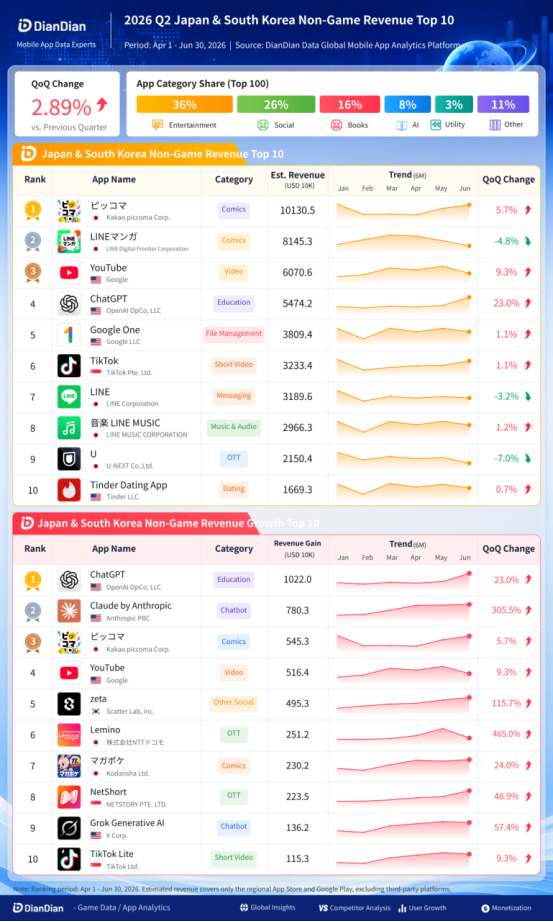
By category, lifestyle, tools, and entertainment were the three leading categories by downloads. Social networking and communications apps were active, with downloads up more than 9.2% quarter on quarter. Revenue was concentrated mainly in entertainment, social networking and communications, and books and reference. As large AI models are deployed more rapidly and enter a phase of scaled commercialization, tools and productivity apps recorded the strongest revenue growth, rising by more than double digits quarter on quarter.
Close-Friends Social Networking Finds a New Formula as Setlog Goes Viral
During the period, Setlog, a real-world social app launched by New Chat Inc., quickly went viral in Japan and South Korea. It generated more than 4.33 million downloads in Q2, up 4,852.6% quarter on quarter, taking the top spot on the regional fastest-growing non-game app download chart by a wide margin. Statistics show that the app topped the free charts on both the App Store and Google Play in Japan and South Korea, with its growth rapidly extending from its home market of South Korea into Japan.
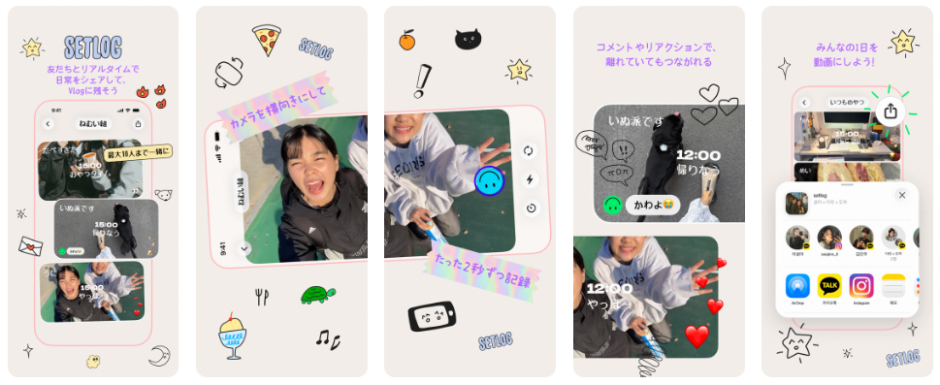
Setlog's gameplay is not complicated. When prompted on the hour, users record a roughly two- to four-second video and upload it to the same group as invited friends. The system then automatically stitches the clips from multiple users into a daily vlog. Unlike Instagram and TikTok, which emphasize public display and content polish, Setlog focuses on unfiltered daily life, low-pressure sharing, and shared memories among friends. It meets young users' shifting need from 'showing oneself' to 'being present for one another.'
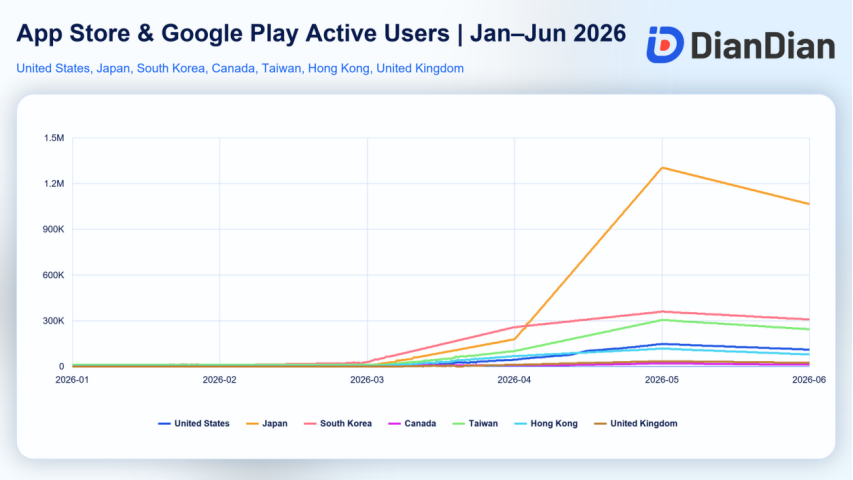
Setlog's growth began in South Korea and then spread to Japan, Taiwan, China, and Hong Kong, China, with the help of K-pop artists such as Karina and SEVENTEEN and their fan communities. Growth has not been synchronized across markets, however. According to Diandian's monthly active-user trends, the magnitude of the app's growth in Japan was clearly higher than in other regions. This was partly related to the launch of Japanese-language service in late April and may also have reflected the product's closer fit with Japanese users' need for more authentic, private, and low-pressure social interaction.
Based on current user-activity trends, the product is gradually entering a stable operating phase. The earlier example of BeReal's declining popularity shows that Setlog is now moving beyond the first stage of rapid download growth typical of close-friends social products. Whether frequent recording can become a long-term habit, how private images will be properly protected, and whether advertising, subscriptions, or value-added features will undermine the low-pressure experience all require further validation. Still, Setlog's rise at least shows that social demand is not saturated in mature app markets such as Japan and South Korea, and that close-friends social networking remains a promising niche.
AI Apps Accelerate Commercialization as Claude's Downloads and Revenue Grow Severalfold
In Q2, revenue from generative AI apps grew rapidly, becoming the main reason for the sharp increase in revenue among tools and productivity apps in Japan and South Korea, and consequently a major driver of growth in the region's non-game app market. The three leading products, however, showed clear divergence between downloads and revenue.
ChatGPT continued to consolidate its leading position in Japan and South Korea this quarter, retaining the top spot on the non-game app download chart with more than 6.11 million downloads. On the revenue side, it continued to focus on subscription monetization, adding a US$100-per-month Pro plan to fill a pricing gap. It also further expanded and optimized professional capabilities such as model-based image generation, office integrations, and programming to attract more users in specialized fields to purchase or upgrade their memberships. A steady product-update cadence has supported continued revenue expansion after download growth stabilized, driving estimated Q2 revenue growth of more than 23% quarter on quarter and putting the app at the top of the regional fastest-rising non-game app revenue chart with an incremental gain of more than US$10.22 million.
Google Gemini has focused more attention on competition for ecosystem entry points. In addition to launching a US$100-per-month AI Ultra plan, a move that directly affects subscription revenue on the app side, it has emphasized increasing usage frequency through the Chrome, Workspace, and Android ecosystems. In April, Gemini in Chrome expanded into Asia-Pacific markets including Japan and South Korea, embedding AI capabilities into products such as Gmail, Maps, and YouTube and helping app downloads remain at a high level.
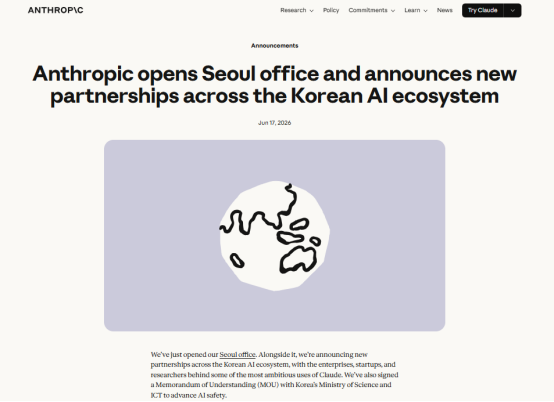
Claude by Anthropic achieved severalfold growth in both downloads and revenue on the strength of its reputation among professional productivity and enterprise users. Revenue growth reached approximately 305.5% quarter on quarter, showing significantly stronger momentum in paid conversion. In Q2, Anthropic successively launched Claude Cowork, Opus 4.7, Opus 4.8, and Claude Design, continuously strengthening its capabilities in programming, complex reasoning, design, and enterprise knowledge work. In June, it also opened an office in Seoul and advanced product deployments with South Korean companies including NAVER, Nexon, LG CNS, and Samsung SDS, further expanding Claude's influence among core user groups.
Overall, as representative global Tier-1 markets, Japan and South Korea offer a direct view of the frontier in AI product evolution and commercialization strategy. As the user base expands, competition among leading publishers has shifted from simply competing for downloads toward a comprehensive contest involving model capabilities, ecosystem entry points, professional use cases, and subscription systems. In the future, Japan and South Korea will not only remain important battlegrounds for AI apps seeking high-value users, but will also continue to serve as key testing grounds for advanced features and subscription monetization.